M6 and M5 Ultra: New Apple Chips Promise Stronger Local AI Performance


Set Trending Topics as a preferred source on Google.
For years, the Mac mini was the least conspicuous device in Apple’s lineup. That changed with the hype around OpenClaw, the open-source AI assistant built by Austrian developer Peter Steinberger. Because the agent works best when it runs locally and around the clock, developers started treating the small desktop as infrastructure, in some cases stacking several of them side by side. Base models sold out in the US as a result. Apple CEO Tim Cook said both machines, the Mac mini and the Mac Studio, were great platforms for AI and agentic tools, and that customers were recognising this faster than the company itself had predicted. OpenClaw has since reached 3.2 million active users.
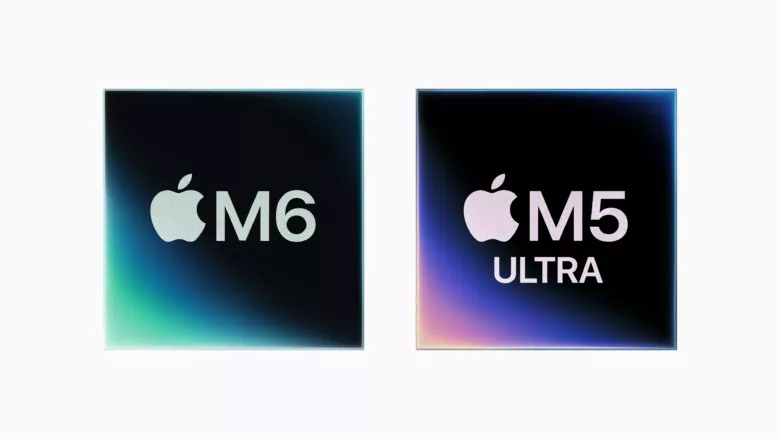
Against that backdrop, Apple has just introduced two new chips: the M6 in the new Mac mini and the M5 Ultra in the new Mac Studio. Both are aimed squarely at the use case that turned the Mac mini into a bestseller, which is running AI models directly on the device.
How the M6 and the M5 Ultra Compare
| M6 | M5 Ultra | |
|---|---|---|
| Found in | Mac mini (base model) | Mac Studio (top model) |
| Process | 2 nanometre, single die | quad die, two M5 Max chips joined by UltraFusion |
| CPU | 12 cores (2 super, 4 performance, 6 efficiency) | up to 36 cores (12 super, 24 performance) |
| GPU | 12 cores with Neural Accelerators | up to 80 cores with Neural Accelerators |
| Neural Engine | dual 16-core | 32-core |
| Unified memory | up to 32GB | up to 512GB |
| Memory bandwidth | up to 170GB/s | 1.2TB/s |
| Peak GPU compute for AI | roughly 30 percent above the M5 | up to 4.7 times the M3 Ultra |
| Realistic local model size | mid-sized models, roughly up to 30 billion parameters | models with several hundred billion parameters |
| Price in the DACH region | from 1,049 euros | from 6,599 euros |
| Price in the US | from $899 | from $5,499 |
Both machines also come in a middle configuration: the Mac mini with the M5 Pro from 1,999 euros ($1,699), the Mac Studio with the M5 Max from 2,999 euros ($2,499). Euro prices include VAT, and educational pricing is lower in each case. Both devices can be pre-ordered now and reach stores next month, while the Mac Studio configuration with 512GB of memory follows about a month after that.
Why Local AI Is a Hardware Question in the First Place
A language model has to fit into memory in its entirety while it runs. On a conventional PC that job falls to the graphics card’s video memory, which is in short supply: Nvidia’s flagship consumer card tops out at 32GB. Since moving to its own silicon, Apple has used a different architecture known as unified memory. CPU, GPU and Neural Engine all draw on the same pool, and that pool can be sized far more generously. This is precisely what made Macs interesting to the local AI community, long before Apple began marketing the use case itself.
Memory bandwidth matters alongside capacity. It determines how quickly a model’s weights travel from RAM to the compute units, and therefore how many tokens per second a chatbot produces. The third factor is raw compute for matrix operations, for which Apple provides two building blocks: the Neural Engine, and, since the M5 generation, so-called Neural Accelerators that sit inside every individual GPU core.
The M6: The Chip Inside the Mac mini
According to Apple, the M6 is the company’s first chip built on a 2-nanometre process. Three points matter most for AI workloads:
- A dual 16-core Neural Engine, meaning two units working in parallel that together deliver up to twice the peak compute of the previous generation. Apple says system frameworks can address both engines simultaneously and automatically.
- A GPU grown to twelve cores, each with its own Neural Accelerator. Apple puts the gain in peak AI compute at just under 30 percent compared with the M5. This mostly affects prompt processing, the moment when a local model reads the input before it starts to answer.
- Up to 170GB/s of memory bandwidth, around ten percent more than the M5.
Memory remains the limiting factor: the M6 supports up to 32GB of unified memory. That comfortably accommodates quantised models of roughly 20 to 30 billion parameters, such as Meta’s recently released Muse Glimmer, or smaller models with a very large context window. For the frontier models available in the cloud, that headroom runs out. The M6 therefore addresses the same audience that has been buying the Mac mini lately: people who want to run a permanently available agent or a mid-sized model on their own network and would rather not pay per token in the cloud.
Anyone who needs more room inside a Mac mini can find it in the second configuration. Apple also offers the machine according to its own announcement with the M5 Pro, which brings up to 18 CPU cores, up to 20 GPU cores, 64GB of unified memory and 307GB/s of memory bandwidth. In Austria the M6 version starts at 1,049 euros and the M5 Pro version at 1,999 euros. What the surcharge buys is mainly memory and bandwidth, the two figures that determine maximum model size and output speed.
On the CPU side the complex grows to twelve cores, split into two new super cores, four performance cores and six efficiency cores. Apple cites up to 1.2 times the multithread performance of the M5. That matters for agentic workloads because such systems spend much of their time on tasks that have nothing to do with matrix multiplication, among them indexing files, compiling code and calling tools.
The M5 Ultra: The Chip Inside the Mac Studio
The M5 Ultra is the largest chip Apple has ever built. It comes about by using the UltraFusion interconnect to join two dual-die M5 Max chips. The result is a quad-die architecture, an Apple first, in which four chips present themselves to software as a single processor. Apple puts the bandwidth between the chips at more than 4.4TB/s.
For local AI, one figure is decisive: up to 512GB of unified memory at 1.2TB/s of memory bandwidth, which is 50 percent more bandwidth than the M3 Ultra. At that scale, models with several hundred billion parameters can run entirely on the device, meaning the class of open weights that has lately come above all from China and that otherwise requires server hardware or cloud access. On top of that sits a GPU with up to 80 cores, also equipped with Neural Accelerators, for which Apple claims up to 4.7 times the peak AI compute of the M3 Ultra, plus a 32-core Neural Engine.
The price reflects that ambition. The Mac Studio with M5 Ultra starts at 6,599 euros in Austria, the M5 Max version at 2,999 euros. Measured against server hardware with comparable memory capacity it remains an inexpensive option, and measured against the Mac mini the entry point is six times as high.
The CPU spans up to 36 cores, made up of twelve super cores and 24 performance cores. Apple aims this at classic professional workloads such as 3D rendering, video editing and scientific simulation, yet the announcement consistently names running large AI models as a purpose too. The applications it cites include LM Studio, Draw Things and MATLAB.
What Developers Get Out of It
Apple points to its Core AI, Core ML, Metal and Xcode frameworks, which are meant to drive CPU, GPU and Neural Engine automatically. Developers can use them to run and adapt Apple’s own foundation models locally, as well as third-party or self-trained ones. The practical effect is economic more than technical: running inference on your own hardware means paying once for the machine rather than continuously per token, and the data stays on the computer. That is exactly the argument that made OpenClaw and similar agents big.
All performance figures so far come from Apple’s own announcement, and independent measurements, whether from Artificial Analysis or established benchmark suites, are still outstanding. The spread within the lineup is striking: between the 64GB of the best-equipped Mac mini and the 512GB of the Mac Studio lies a factor of eight, and with it the decision whether a compact model or a frontier model runs on your desk. Prices range from 1,049 to 6,599 euros. For the mass market, the Mac mini therefore remains the device carrying the trend towards local AI, while the Mac Studio serves the niche that until now had to buy server hardware.