More Than 7,000 Jobs Gone: Layoffs in the Crypto Industry Are Picking up



Set Trending Topics as a preferred source on Google.
The crypto industry is in the middle of a wave of job cuts. Most recently, exchange Luno announced it is cutting around 20% of its global workforce. According to a Bloomberg report, CEO James Lanigan explained the move by pointing to investments in automation and broader operational improvements that have changed how many resources the business needs. At the same time, Luno is shifting its focus more towards institutional clients, financial infrastructure and B2B services. The company was founded in South Africa, belongs to Digital Currency Group (DCG) and says it serves around 16 million users across Africa and the Asia-Pacific region. It is not the first cut: back in January 2023, Luno reduced its headcount by 35%, affecting nearly 330 employees at the time.
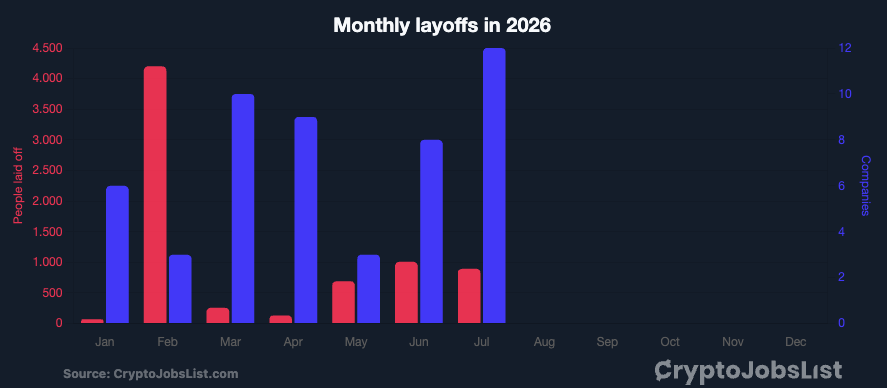
Luno is no isolated case. Tracking platform CryptoJobsList, which compiles layoffs from public announcements and media reports, has recorded job cuts or restructurings at twelve crypto and crypto-adjacent companies in July 2026 alone, with 894 disclosed positions affected. For 2026 as a whole, the platform counts more than 7,254 disclosed job cuts across 47 companies. The reason cited most often, according to CryptoJobsList, is “market conditions”.
Why the industry is shrinking
The backdrop is a pronounced bear market. Bitcoin hit an all-time high of around $126,200 on 6 October 2025 and has since lost roughly half its value – at the end of July 2026, BTC is trading somewhere between $60,000 and $64,000 depending on the venue. Unlike the crashes of 2022, there is no single trigger this time, no Terra collapse and no FTX bankruptcy: no major exchange has failed, and no significant stablecoin has lost its peg. Instead, macroeconomic factors are seen as the drivers – fading expectations of near-term US rate cuts after stubborn inflation, plus record outflows from US spot Bitcoin ETFs, roughly $4 billion in June alone. For crypto companies, that means falling trading volumes and therefore falling fee revenue, while many firms built up their cost base during the bull market. On top of that comes a second motive that appears ever more frequently in the official explanations: automation and AI. Several companies – from BitGo to Kraken to Crypto.com – cite the shift towards AI-driven processes as a reason for cutting staff.
The ten largest job cuts of 2026
| # | Company | Jobs cut | Share of workforce | Date | Stated reason |
|---|---|---|---|---|---|
| 1 | Block (fintech) | 4,000 | 40% | 26 February 2026 | AI pivot |
| 2 | Coinbase (exchange) | 500 | 14% | 5 May 2026 | Market conditions |
| 3 | Robinhood (fintech) | 290 | 10% | 16 June 2026 | Restructuring |
| 4 | Gemini (exchange) | 200 | 25% | 5 February 2026 | Market conditions |
| 5 | Crypto.com (exchange/CeFi) | 180 | 12% | 19 March 2026 | AI pivot |
| 6 | Kraken (exchange) | 150 | 5% | 16 May 2026 | AI pivot |
| 7 | LBank (exchange) | 100 | 10% | 18 June 2026 | AI pivot |
| 8 | BitGo (fintech) | 90 | 15% | 26 June 2026 | AI pivot |
| 9 | Keyrock (market maker) | 60 | 30% | 15 June 2026 | Restructuring |
| 10 | Polygon (layer 2) | 60 | 30% | 15 January 2026 | Acquisition |
Source: CryptoJobsList, as of July 2026. Only cases with disclosed figures are included.
The data should be read with some caution: CryptoJobsList also covers crypto-adjacent fintechs, so it is not a pure crypto indicator. And the statistics are heavily skewed by a single case – Block’s cut of 4,000 positions in February accounts for more than half of the annual total. Conversely, many entries lack concrete numbers: for Luno, only the percentage has been documented so far, as is the case for companies such as Optimism, Swyftx or Zap Africa, which at roughly 44% has recorded the largest cut of the year in relative terms.
Further cases from July: wallet company Exodus announced plans to cut 25% of its staff and reorganise around a full-stack card-issuance and stablecoin-payments platform – a move it expects to generate between $10 million and $13 million in annual operating savings. Blockchain infrastructure developer Gnosis, meanwhile, used X on Tuesday to invite companies to get in touch for introductions to former employees; in its quarterly report on 17 July, Gnosis confirmed it had reduced headcount following a review of its consumer-facing app.
BitMEX is closing its doors
How deep the cut goes is illustrated by a case that goes beyond layoffs: BitMEX, one of the most influential crypto exchanges of all, is shutting down. Operator HDR Global Trading Limited announced on 23 July that it will cease trading operations on 23 September 2026 at 04:00 UTC – following a “strategic review of the business and the broader crypto industry”, as the company’s blog post puts it. New account registrations have been halted with immediate effect, and from 26 August users will only be able to reduce existing positions rather than open new ones; open positions will be force-closed. Anyone who has not withdrawn their funds by the deadline faces monthly custody fees.
BitMEX launched in 2014 and invented the perpetual swap with up to 100x leverage, a product that today ranks among the most heavily traded instruments in the industry and has been copied by countless exchanges. Across its eleven years of operation, the company says it lost no customer funds to hacks – but it did accumulate major legal problems: founders Arthur Hayes, Benjamin Delo and Samuel Reed pleaded guilty to violating the Bank Secrecy Act by failing to implement an adequate anti-money-laundering programme. US President Donald Trump pardoned them in 2025. More recently, however, BitMEX had been losing significant market share in derivatives trading to nimbler centralised rivals and to decentralised derivatives platforms.