Nikon Strips Prize From A.I.-Altered Microscopy Video


Set Trending Topics as a preferred source on Google.
Too beautiful to be true: The camera maker Nikon has disqualified the winning video of its prestigious Small World in Motion microscopy competition. The entry “did not comply with the competition rules regarding generative AI,” Nikon said, as PetaPixel reported. The decision, the company added, should not be read as a judgment on the entrant’s professional reputation, scientific contributions or intent.
Structures That Don’t Exist
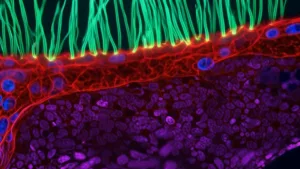
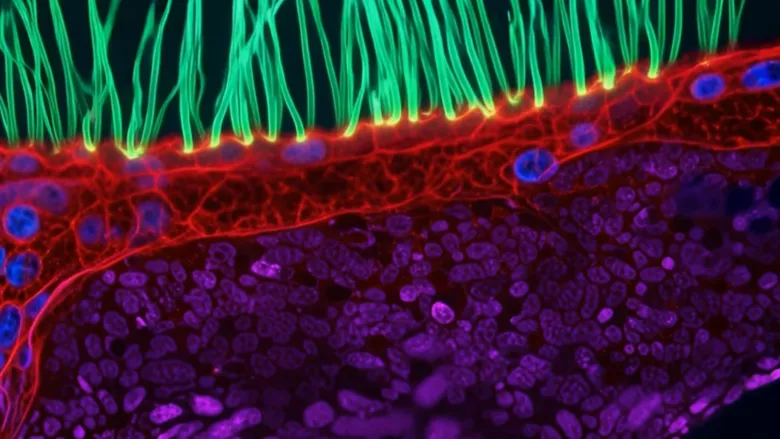
The winner, announced in September, was Ning Xu, an optical engineer at the National University of Singapore. His video showed cilia in airway tissue from a child with primary ciliary dyskinesia, a rare genetic disorder. As soon as the video was shared on LinkedIn, criticism poured in. Scientists spotted structures that do not exist in biology. The purple shapes resemble mitochondria but do not occur that way, said Edward Phelps, a bioengineering researcher at the University of Florida. Robert Hirst of the University of Leicester said the cells looked nothing like the cilia of patients with the disorder.
The decisive clue came from a doctoral student: Ian Donovan of UT Southwestern Medical Center found a SynthID watermark in the video. A.I. companies use this technique, developed by Google DeepMind, to mark generated content, and Google recently launched its own A.I. detector based on it. Nikon first re-reviewed the entry and ultimately withdrew it. The new winner is Nguyen Nam Nhat of Vietnam, with a video of a roundworm and the single-celled organism Dileptus. Nikon plans to revisit its rules and judging procedures for future competitions.
Edited or Invented?
Mr. Xu defended himself. The original footage was real, he said, and he used A.I. only in post-processing, to color structures in reconstructed grayscale data. A.I. “was not used to generate the experimental movie, the cilia, or their motion,” he said. Supporters point out that microscopy images are always processed, through staining, false color or reconstruction, and that Mr. Xu had disclosed his use of a neural network.
For many researchers, though, the issue goes beyond color. Scientists must be able to trust that what they see is grounded in actual measurements, said Melanie White, a developmental biologist at the University of Queensland. The debate is unlikely to stay confined to photo contests. Apple, too, wants its Reference Image feature to prove that a photo was not created with A.I.