Open-Weight Models From China Are Set to Supply BRICS Countries With AI


Set Trending Topics as a preferred source on Google.
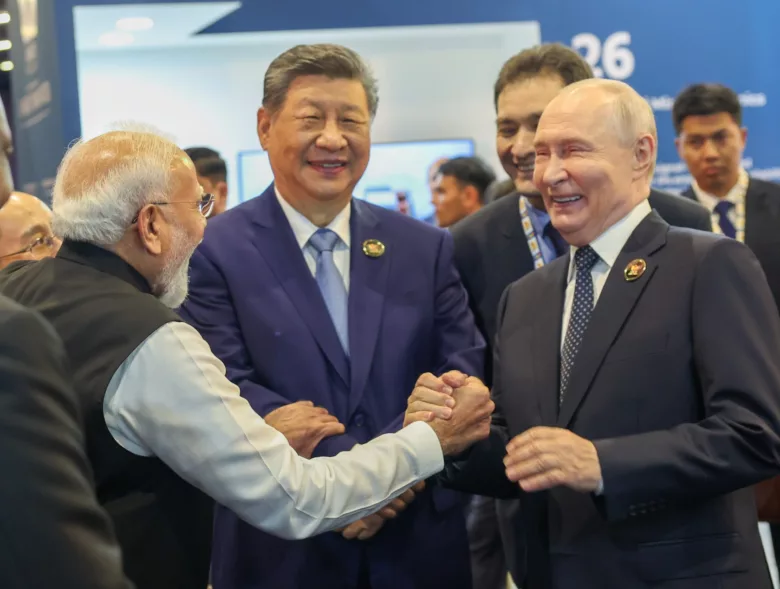
At the BRICS summit in New Delhi, Chinese President Xi Jinping has just offered to help the group’s eleven member states build a shared open-source AI base. At almost the same moment, the United States is arguing over whether the development of the most capable models should be slowed down. Anthropic CEO Dario Amodei, who proposed that brake, calls China the biggest open question in his own plan.
China has something real to offer here, because it currently leads the field in open-weight models. The lineup runs from Moonshot AI, whose Kimi K3 counts as the largest open-weight model released so far, through DeepSeek, Z.ai (formerly Zhipu) with its GLM series and MiniMax, to corporate players such as Xiaomi and Alibaba, whose Qwen family has become the default base for countless fine-tunes worldwide. Some of these models are now trained without Nvidia hardware on Huawei chips. For countries that lack gigawatt-scale data centers, freely downloadable weights are the fastest route to their own AI infrastructure, and that is precisely the gap Beijing is aiming at with its BRICS push.
Five Initiatives, One of Them for Open Models
In his speech to the group’s leaders, Xi put forward five initiatives. The first is an “open source and inclusive AI initiative”: China wants to be a pioneer in establishing a BRICS AI open-source community, support cooperation on developing and applying large language models, hold specialized AI seminars and training courses, and build an open AI ecosystem. The others cover trade and investment facilitation including a partnership of special economic zones, a cloud platform for a BRICS digital ecosystem, cooperation on smart factories and manufacturing standards, and an engineer training alliance with mutual recognition of competency standards.
The offer sits inside a speech built largely around rule-setting. International rules must be written by all countries, Xi said, and the logic of “might makes right” should have been discarded long ago. He called for WTO reform, more weight for developing countries in the international financial architecture, and a consensus-based global framework for AI governance so that new technologies can “light the way toward shared prosperity.” BRICS now comprises Brazil, China, Egypt, Ethiopia, India, Indonesia, Iran, Russia, Saudi Arabia, South Africa and the United Arab Emirates.
Open Question: Beijing’s Own Export Controls
How far that openness is meant to go remains unsettled. China’s Ministry of Commerce is reportedly weighing export controls on AI models, including tiered requirements for open weights: simple filing requirements for less capable models, security reviews for stronger ones, and in the extreme case a ban on public release for the most capable systems. Nothing has been decided, and consultations with companies including Alibaba, ByteDance and Zhipu are ongoing. Xi’s speech left open how a BRICS open-source community would square with such requirements, along with questions of funding, timeline and which specific models would be involved.
In the U.S., the Argument Is About Speed
In Washington, the opposite discussion is underway. Amodei recently published the essay “We Must Pace the Frontier,” proposing three stages for a slower pace: independent auditors with far-reaching access inside the labs, shared safety standards among leading developers in democratic countries, and eventually international agreements, China included, covering especially dangerous applications. OpenAI CEO Sam Altman pledged external auditors access “comparable to that of employees,” while Elon Musk offered a brief endorsement: Dario is right.
For Amodei, the hardest part is geopolitics. China is the “toughest dilemma” for his proposal, he said over the weekend in an interview on CBS “Sunday Morning”: a shared speed limit is hard to reach because “the incentives to pull ahead and the military advantage that you get from that are so large.” He added: “I don’t know if it’s possible, but we should try.” His plan therefore pairs a slower pace with tighter chip export controls and better protection against the theft of model weights.
The White House said no. Speaking to reporters during a stop in Ireland, U.S. President Donald Trump dismissed the three CEOs’ appeal: “We’re leading China in AI, and, frankly, I want to keep it that way, because whoever wins AI, wins.” He considers basic safeguards reasonable and warnings about catastrophic risk overblown.
The two tracks are about to meet head-on: Xi is expected in the United States later this month, and AI governance is likely to be a central topic in his talks with Trump.