Ox Alpha: A Mysterious New AI Model Aims to Win Developers Over


Set Trending Topics as a preferred source on Google.
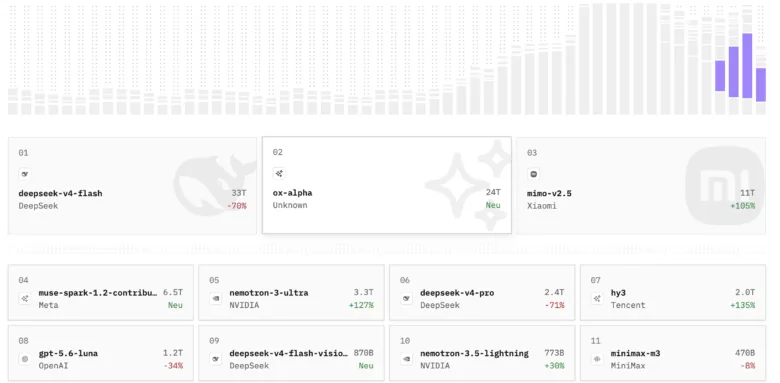
Since last Thursday, the AI scene has been puzzling over a model that officially does not exist. A so-called stealth model appeared under the name Ox Alpha (sometimes written “0x Alpha” in social posts) on the model platform OpenRouter and in the coding tool OpenCode: capable, multimodal, free to use for a week, and with no indication of which lab is behind it. The listing refers only to a “third-party provider who has chosen to remain anonymous during this preview”.
The specifications the anonymous provider claims for itself are ambitious: a context window of 1,048,576 tokens, so roughly one million, a maximum output of 131,072 tokens, text, image and video input, and an alleged capacity of 100 trillion tokens per day. Ox Alpha is described as a reasoning model for programming tasks, long-running agent jobs and production workloads.
One caveat matters here: those numbers describe capacity, not proven quality. A model can accept an enormous prompt and still lose track of what is in it. So far, none of it has been independently verified.
What OpenCode Is
OpenCode is an open-source coding agent for the terminal, built by the team behind the infrastructure framework SST. Rather than running inside its own IDE, the tool works on a repository straight from the command line: it reads files, proposes changes, executes commands and works through multi-step tasks. The key difference from rivals such as Claude Code or Cursor is model neutrality. Developers can pick from a long list of providers instead of being tied to one in-house model.
That is exactly what makes OpenCode attractive for quiet product launches. Putting a model here reaches the audience most likely to push it hardest, which is developers. Ox Alpha is currently available through two routes: OpenCode Zen, where the tokens are free but billing details are required, and the OpenCode Go subscription, which costs a monthly fee while offering the model itself at no charge.
The Hunt: Zhipu, Google, Microsoft or Cursor?
With the lab staying silent, the community has turned to forensics. Tokenizer behaviour, error messages, video token counts and phrasing patterns are all being picked apart. Four hypotheses dominate.
Zhipu AI, also known as Z.ai, is widely seen as the front-runner. Tokenizer fingerprinting has reportedly pointed consistently to the GLM family across several test runs, and the error codes are said to match those documented for the Z.ai API. The Chinese company has already live-tested earlier models under Alpha codenames and runs several clusters with tens of thousands of GPUs. The sheer volume of compute being given away cuts against the theory.
Microsoft entered the picture because Ox Alpha is said to use the cl100k_base tokenizer, an encoding developed by OpenAI. It otherwise shows up in Microsoft’s Phi and MAI lines, which on this reading would rule out Chinese models. The speculation centres on an unreleased version of the frontier model MAI 2.
Google is in play because the company recently followed up with Gemini 3.7 Flash, and a few employees have dropped cryptic hints about an upcoming release. A long-awaited Gemini 3.5 Pro is still missing. Working against the theory is a vision test that Gemini models usually pass and Ox Alpha does not.
The fourth trail leads to Cursor and SpaceX. One analyst floated Composer 3, Cursor’s next coding model, which according to reports was trained on supercomputer infrastructure from the SpaceX orbit. The argument here is mainly about capacity: few players can give away hundreds of trillions of tokens per day.
None of these theories is confirmed. The performance question is equally open for now: independent benchmarks, from Artificial Analysis for example, or ratings on Arena.ai are still outstanding. What is circulating comes from community tests with undisclosed methodology.
Anonymous Releases Have Become a Playbook
Ox Alpha is not a one-off but the latest entry on a growing list. The best-known example is Nano Banana: the image generator was first released anonymously for testing under that silly codename, climbed the community rankings, and only then was revealed as a Google product for Gemini. The name stuck and went from codename to brand, all the way to Nano Banana Pro and Nano Banana 2.
OpenRouter itself has hosted around a dozen such cloaked listings before. Quasar Alpha and Optimus Alpha turned out to be pre-release versions of GPT-4.1, Horizon Alpha and Horizon Beta early GPT-5 checkpoints. Hunter Alpha and Healer Alpha were later attributed to Xiaomi, Owl Alpha to the Chinese group Meituan. For other codenames such as Sonoma Dusk, Polaris Alpha or Aurora Alpha, the attribution has stayed open for good.
The benefit for the labs is obvious. They get real usage behaviour under load, they collect feedback with no reputational risk, and if the model convinces, the attention is already built up by the time the official announcement lands. A disappointing result, by contrast, can be sunk quietly.
The Real Coup Is the Price Tag
The most interesting thing about Ox Alpha may not be the technology but the marketing. Tokens cost nothing during the preview, both on input and on output. For a class of model where extended agent runs with six-figure token counts quickly rack up three-figure bills, that is a strong argument to at least give it a try.
The mix of free access, a huge context window and a tight deadline creates exactly the urgency that conventional product announcements can barely generate any more. Anyone who wants to test has to test now. And anyone who tests posts results, which in turn draws in the next round of testers. According to community figures, the model processed roughly 7.1 trillion tokens in its first week across some 134,000 individual users.
The effect works twice over. The lab buys itself training and test data from real-world use, and it buys itself reach. The guessing game about its origin amplifies both, because every attempt at an explanation produces fresh posts, videos and articles. A paid campaign with comparable impact would cost considerably more.