Innotech Expo: Inside Taiwan’s Bet on AI, Chips and Sovereign Networks

Set Trending Topics as a preferred source on Google.
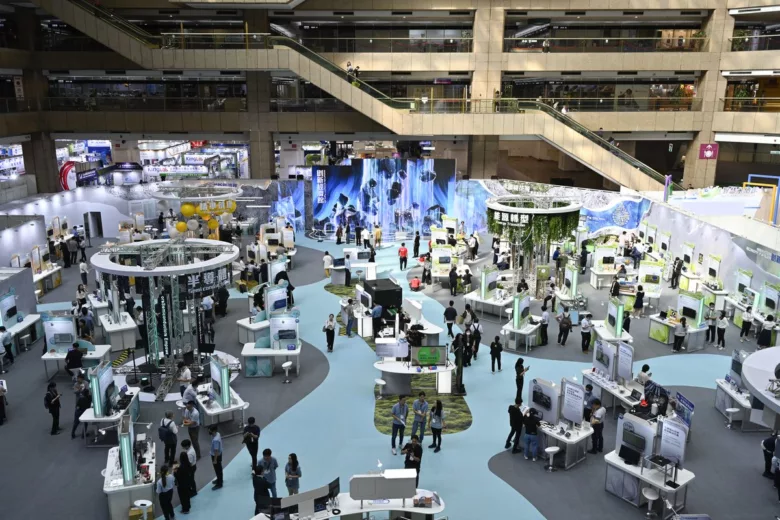
Taiwan has long been more than the workbench of the global semiconductor industry. Just how thoroughly the island is remaking itself into a laboratory for AI applications, quantum computing and sovereign communications infrastructure can be seen once a year in a single place: the Taiwan Innotech Expo, or TIE. The next edition runs from September 17 to 19 in Hall 1 of the Taipei World Trade Center. Trending Topics will be there and will report from the show floor.
What the TIE Is
The TIE is neither a pure inventors’ fair nor a conventional industry exhibition. It is a blend of the two. Eleven ministries and government agencies stand behind it, with the trade promotion body TAITRA and the Industrial Technology Research Institute (ITRI) running the operation. The format launched in 2015 under the name “Taipei International Invention Show and Technomart” and has carried its current brand since 2018.
The common thread: research coming out of universities, state institutes and companies should make the leap into real-world use as quickly as possible, which includes licensing, patent commercialization and matchmaking with international corporations.
For a sense of scale, organizers counted more than 50,000 visitors from 65 countries at last year’s edition, along with 422 exhibiting companies and research institutions from 19 countries and roughly 1,100 technologies on display. SoftBank, 3M, Dassault Systèmes and Plug and Play were among the participants. Organizers are aiming for similar numbers this time around, with some 440 exhibitors from 19 countries and again about 1,100 technologies.
The Big Theme: AI Across Every Sector
The motto of the coming edition revolves around AI as a cross-cutting technology, one that is seeping into industry, medicine and public administration. That ties closely to Taiwan’s government program of Five Trusted Industry Sectors, adopted in 2024: semiconductors, artificial intelligence, military technology, security and surveillance technology, and next generation communications, meaning 6G and the meshing of terrestrial with satellite networks. Anyone curious about how a state organizes technology policy along geopolitical fault lines will find the case study in Taipei.
The Three Pavilions
The show is divided into three main areas:
- The Innovation Economy Pavilion focuses on the marriage of hardware and software, in other words how AI models running on Taiwanese silicon end up inside industrial processes and how prototypes turn into products.
- The Future Tech Pavilion, also known as FUTEX, presents research on a three to ten year horizon. It is curated by the National Science and Technology Council (NSTC), Academia Sinica and several ministries, among others. According to the announcement, this year’s focus falls on projects ready for proof of concept and technology licensing, spread across six priority fields: AI applications, semiconductors, precision health, space technology, disaster prevention technology and net zero technology.
- The Smart Sustainability Pavilion gathers innovations in green energy, the circular economy and efficiency. Last year it housed 97 projects.
Inventions, Prizes and Matchmaking
One strand of the show belongs to inventors. Registration is open for the Taipei Invention Awards, and individuals, companies, students and faculty at every level of education are eligible. Expert panels first review the submitted documentation, then judge the entries on site on opening day. The top honor is the Platinum Award. Last year, 359 innovations were recognized. Rounding out the program are specialist conferences, including sessions on 5G and 6G and on multimodal AI models, plus matchmaking formats for biotech, semiconductors and photonics.
Why Europe Should Pay Attention
For European startups and research teams, the TIE is less a stage than a point of entry. This is where Taiwan negotiates licenses, looks for pilot project partners and opens doors to supply chains that half the AI industry currently depends on. It is also a chance to watch how a small country with enormous technological leverage conducts its own debate about sovereignty, a question very much alive in Brussels and Vienna as well.
Trending Topics will be on site at the Taiwan Innotech Expo 2026, filing reports, interviews and analysis from Taipei.