The Exploration Company: ESA Awards €760 Million Contract to This European SpaceTech


Set Trending Topics as a preferred source on Google.
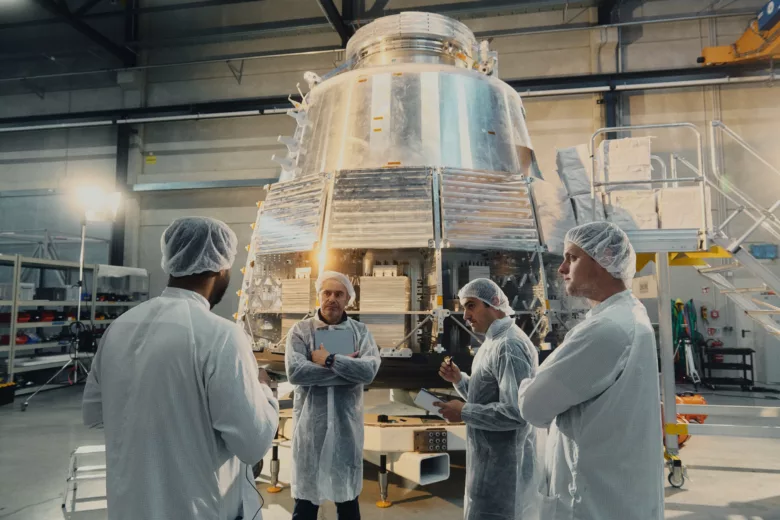
The European Space Agency has just signed a service contract with The Exploration Company (TEC) at the International Space Summit in Paris, the largest transportation contract ESA has ever awarded to a European space company. The French-German startup will use its reusable Nyx capsule to build a European link to low Earth orbit, carrying cargo to the International Space Station and bringing it back down again. The contract is worth up to 760 million euros.
It comes in two parts: 310 million euros for the demonstration mission, and a further 450 million euros for two optional service missions still to be confirmed. The plan covers a first Nyx demonstration flight to the ISS plus two additional cargo missions, either to the ISS or to a future commercial space station.
From LCRS to ALADDIN
The award marks phase two of a programme ESA member states launched back in 2022 as the Leo Cargo Return Service (LCRS), a competition asking European companies to propose a first step toward a cargo service to and from space stations in low Earth orbit. Two projects were selected and each received 25 million euros in initial funding.
At the ESA Council at ministerial level in November 2025, member states reaffirmed the project, which now enters phase two under a new name: ALADDIN, short for Autonomous LEO Accelerated Demo Docking to ISS Node. The name points to the two things ESA cares about most here: a compressed development timeline, and proof of autonomous docking with the ISS inside a tight operational window. The tender opened in the spring, and phase two moves the work from early development to full system completion and in-orbit demonstration.
“Europe is taking a big step towards greater autonomy in space,” said ESA Director General Josef Aschbacher. “Today’s agreement with The Exploration Company shows how ESA can act as an anchor customer, strengthening Europe’s commercial space sector and turning ambition into reality.” Daniel Neuenschwander, ESA’s Director for Human and Robotic Exploration, added that TEC is “advancing and mastering technologies that will remain in Europe and support a wide range of strategic industries.”
Private Investors Cover 40 Percent
The financing structure is where the deal gets interesting. As part of the tender, TEC had to demonstrate key technical readiness milestones and secure 40 percent of the funding for the Nyx demonstration from private investors. ESA covers the remaining 60 percent. That pushes the European model toward commercially delivered services with public agencies acting as anchor customers, much as NASA has done in the United States for years.
“This is more than a contract award: it reflects a shift in how we build space technology in Europe,” said Hélène Huby, CEO and founder of The Exploration Company. “We started the development of Nyx with private funding only, and we are now at a technical maturity level where ESA and member states’ public funding can support us massively, as anchor clients, to help us finalize the vehicle.” She also called it the first time in Europe that a five-year-old space startup has won a contract worth hundreds of millions of euros in open competition.
A Record Series C Just Days Earlier
The ESA contract lands right after the largest Series C round a European space tech company has ever raised. As Trending Topics reported, The Exploration Company recently closed 450 million US dollars in fresh capital, co-led by Bessemer Venture Partners, Atomico and the EQT-managed Scaleup Europe Fund. Existing backers Balderton, Plural, Cherry and Red River West joined as well, taking the company’s total funding to roughly 680 million dollars.
The money is earmarked for industrial scale-up: engineering, manufacturing, mission operations and propulsion. Alongside Nyx, TEC is developing Storm, a reusable high-thrust engine running on liquid oxygen and biomethane that is meant to underpin a future European heavy-lift rocket with 40 tonnes of payload capacity. Nyx itself is designed as a reusable, orbit-refuelable capsule able to return up to 3,000 kilograms of cargo to Earth. A demonstrator flight last year ended in partial success, with the capsule lost during splashdown.
The timing reflects a broader shift. Demand across the global space sector is rising, driven by connectivity, exploration, defense and new infrastructure in low Earth orbit. With the ISS due to retire toward the end of the decade and commercial stations coming online, a market is forming in which Europe currently has no transport capacity of its own.