Zagreb Set to Launch Europe’s First Commercial Robotaxi Service

Set Trending Topics as a preferred source on Google.
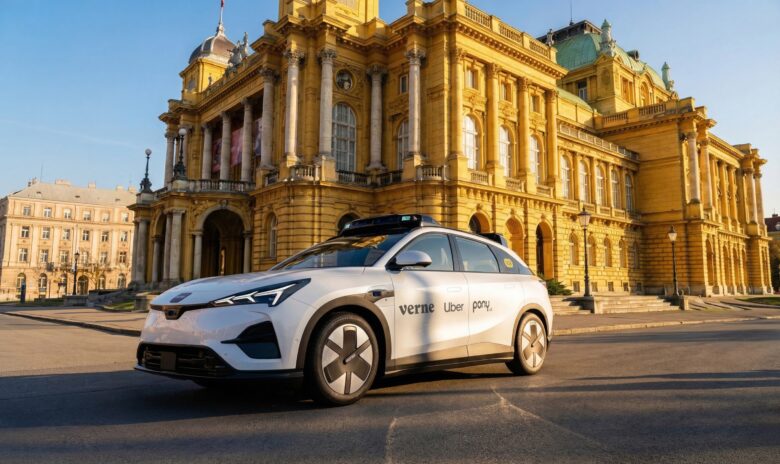
The Croatian capital Zagreb is expected to become the site of a significant milestone in the history of autonomous driving in Europe. The three companies Verne, Pony.ai, and Uber today announced a strategic partnership to launch the first commercial robotaxi service on the European continent. Initial test drives on public roads are already underway.
On the subject of the continent: it may not be the first robotaxi in Europe as a whole, as Waymo (a sister company of Google) already announced in autumn 2025 that it intends to launch in London during 2026.
The Three Partners and Their Roles
The project brings together three companies with clearly defined areas of responsibility. Each partner contributes a specific core competency to the collaboration, which together is intended to enable the operation of the service.
| Company | Role | Origin |
|---|---|---|
| Pony.ai | Development and provision of autonomous driving technology | China (NASDAQ: PONY, HKEX: 2026) |
| Verne | Fleet owner, service operator, and coordination of market approval | Croatia (spun off from Rimac) |
| Uber | Integration into the global ride-hailing network | USA (NYSE: UBER) |
Technology and Vehicle
For operations, the consortium relies on Pony.ai’s seventh-generation autonomous driving system, the so-called Gen-7 system. This is deployed in the Arcfox Alpha T5 robotaxi, a vehicle developed and produced in collaboration with the Chinese state-owned automotive group Beijing Automotive Group (BAIC). The vehicles are currently in the validation phase on the streets of Zagreb before paid operations commence.
Pony.ai already operates autonomous vehicles in several Chinese cities, including Guangzhou and Shenzhen, where the company states it has reached the break-even point on a unit-cost basis. These experiences are now to be transferred to the European market.
Planned Expansion
Zagreb serves as the first market from which the service is to be gradually expanded to further European cities. The partners have named a fleet of several thousand robotaxis within the next few years as a medium-term goal. Verne takes on responsibility for obtaining the necessary European regulatory approvals in the respective markets. Uber also plans to make an investment in Verne and to support the company as a strategic partner in its further expansion.
Statements from Those Involved
“In China, our Gen-7 has reached significant commercial scale. By leveraging these experiences, we are well positioned to accelerate commercialization internationally.”
Dr. James Peng, Founder and CEO of Pony.ai
“Europe needs autonomous mobility that can transition from testing to a real service. We are bringing together the technology, the platform, and the operational capabilities to make this a reality.”
Marko Pejkovic, CEO of Verne
“Through a strong ecosystem of partnerships, autonomous mobility can scale both globally and more effectively.”
Dara Khosrowshahi, CEO of Uber
Competition and Context
The project does not stand without competition. The US-based robotaxi provider Waymo has announced its intention to launch a service in London during 2026. For Uber itself, the partnership fits into a broader strategy in which the company has entered into collaborations with numerous autonomous vehicle developers over recent months in order to position itself in the growing robotaxi market.
Whether Zagreb will actually be the first to claim the title of commercial robotaxi pioneer in Europe depends on the progress of the approval processes and the exact launch date of paid operations. The public testing phase on Croatia’s roads is already underway.