$300 Million for Cambridge Aerospace: British Defence Startup Takes On Drones With Low-Cost Interceptors

Set Trending Topics as a preferred source on Google.
Europe’s defence tech boom has another protagonist: Cambridge Aerospace announced on Monday that it has closed a $300 million Series C round. The post-money valuation of the British air defence manufacturer now stands at $3.4 billion. The round was led by Californian growth investor DFJ Growth, with participation from Lux Capital, Accel, Lakestar, Never Lift, Ora Global and Elad Gil & Co.
What stands out most is the pace. Cambridge Aerospace was only incorporated in September 2024 — and has since raised more than $630 million in total, according to CEO Steven Barrett. As recently as April this year, the company closed a $200 million Series B at a $1.3 billion valuation, then co-led by Elad Gil & Co and Spark Capital. In roughly four months, the valuation has more than doubled; compared with the Series A in summer 2025 ($100 million at around $400 million), it is now eight times higher.
Skyhammer and Starhammer: Interceptors at a Fraction of the Cost
The company’s product promise is essentially an economic one. Conventional air defence suffers from a cost problem: shooting down a Shahed drone worth a few tens of thousands of dollars with a missile costing several million loses the exchange ratio — even when you win the engagement technically. That is precisely where the company’s first product comes in.
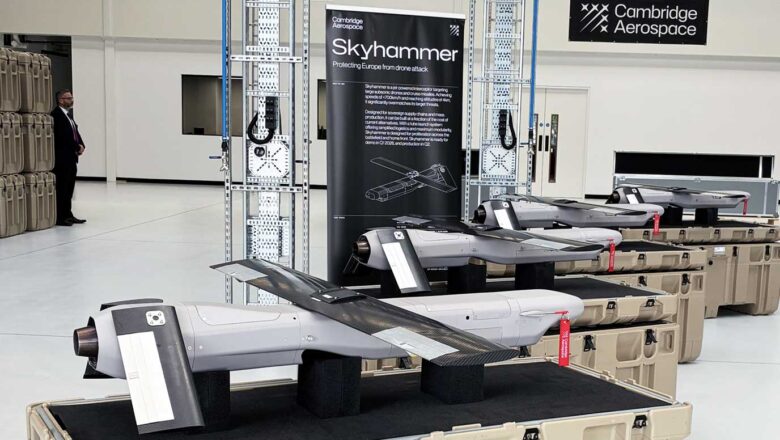
Skyhammer is a high-subsonic interceptor flying at roughly Mach 0.7 with a range of about 30 kilometres, designed for slower targets such as attack drones and cruise missiles. Unit costs are said to be in the “tens of thousands” of dollars — according to earlier company statements, one to two percent of the price of conventional interceptors. The approach: autonomy in guidance to keep development and manufacturing costs down, and mass rather than single-unit perfection.
The second system, Starhammer, is a rocket-powered high-speed variant for faster and higher-value threats — up to and including ballistic missiles. Starhammer is due to reach the market in 2027. In addition, the company is building its own solid rocket motor production facility in Norfolk, addressing one of the classic bottlenecks in European defence manufacturing.
The fresh capital is intended primarily to expand production. Output currently sits in the low hundreds per month; the stated goal is several thousand Skyhammers monthly.
Contracts From London, Tests in Jordan
Cambridge Aerospace already has customers. In April, the UK Ministry of Defence announced a multi-million-pound contract at the London Defence Conference for Skyhammer interceptors and launchers for the British Armed Forces and Gulf partners; shortly afterwards the systems were successfully tested in Jordan. In July came inclusion in the LEAP programme (Low-Cost Effectors & Autonomous Platforms). Talks with the US government are under way.
Around 250 people now work for the company, two thirds of them in technical and engineering roles, complemented by veterans of Allied armed forces. Beyond the UK, Cambridge Aerospace has a presence in Germany, Poland, Norway, Ukraine and Australia.
The founding team is unusually composed: CEO Steven Barrett is Regius Professor of Engineering at Cambridge and previously headed aerospace research at MIT. CCO Chris Sylvan served more than a decade in the Royal Marines before moving into emerging defence technology at US defence tech group Anduril. Serial founder Junaid Hussain completes the line-up. Former Defence Secretary Grant Shapps, who chaired the company, stepped down in June; there is no successor for now.
“This raise is testament to the incredible work of the entire Cambridge Aerospace team,” says Barrett. The new funds, he adds, will allow the company to scale manufacturing and delivery to keep pace with the speed of threats and the needs of Allied nations.
Randy Glein, founder and managing partner at DFJ Growth, frames the investment around the drone problem: Cambridge Aerospace has built an affordable and accurate counter-UAS system, and the firm surveyed the global landscape before settling on this team.
Political applause from London followed immediately. Defence Secretary Wes Streeting called the valuation a vote of confidence in Britain and pointed to the government’s “unicorn scheme”, designed to produce exactly this kind of scaling from British start-up to billion-pound company.
In Comparison: Helsing, Quantum Systems — and the New Order of Magnitude
The $3.4 billion valuation is impressive, but it places Cambridge Aerospace clearly behind the two German heavyweights in European defence tech — both of which, admittedly, have a significant head start.
Helsing closed a Series E of $1.8 billion at an $18 billion valuation on 13 July 2026 — the largest funding round in German startup history, backed among others by Dragoneer, Lightspeed, Iconiq, Goldman Sachs Alternatives, JPMorganChase and Canadian pension fund CPP Investments. Founded in 2021, the Munich company is thus valued at roughly five times Cambridge Aerospace and raised six times as much in a single round as the British firm has just taken on. Helsing’s focus, however, lies elsewhere: AI software for combat operations, electronic warfare, underwater reconnaissance and the uncrewed CA-1 combat aircraft.
Quantum Systems, meanwhile, closed a $1.2 billion Series D on 2 July 2026 at a post-money valuation of around $8 billion, co-led by Blackstone, Noteus, Airbus and Advent. That more than doubled the reconnaissance drone maker’s value within seven months — at the end of 2025 it stood at roughly $3.5 billion. Unlike most defence scale-ups, Quantum Systems already reports around €300 million in revenue (2025) with double-digit EBITDA margins.
More interesting than the absolute figures is the gradient. Cambridge Aerospace went from zero to $3.4 billion in under two years — Helsing took around three years to reach the billion mark, and Quantum Systems, founded in 2015, more than ten. All three rounds share a pattern that has defined the European market since summer 2026: capital increasingly comes not from classic venture funds but from crossover investors, private equity houses, pension funds and strategic industrial partners — money that would normally only appear shortly before an IPO.
And they share an open question about the substance behind the valuations. Helsing reported €26.9 million in revenue for 2024, against today’s $18 billion valuation. Cambridge Aerospace has only just delivered its first product. What investors are pricing in right now is less current numbers than the expectation that European defence budgets will translate into order books over the coming years — and that these companies will be able to deliver when they do.