$5 Billion Up in Smoke: Ukraine’s Drones Hit Russia’s Amazon Hard


Set Trending Topics as a preferred source on Google.
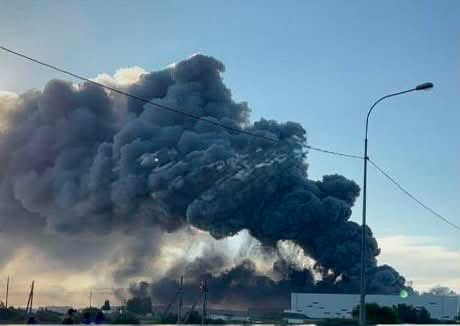
Since mid-July, Ukrainian drones have been systematically hitting the logistics centres of Wildberries. According to estimates by market researcher Data Insight, inventory worth up to five billion US dollars has gone up in flames. Moscow is now discussing a state bailout for the heavily indebted online retailer.
Wildberries is Russia’s largest online retailer – and for several weeks now one of the preferred targets of the Ukrainian drone campaign. As the Wall Street Journal reports, citing analyses by market research firm Data Insight and other sources, goods worth up to five billion US dollars were destroyed in the attacks. More than one million square metres of warehouse space have been affected.
These figures are estimates and come largely from Russian market research and media sources; they can only be verified independently to a limited extent. The scale of the destruction is also hard to assess from the outside – US magazine Business Insider recently analysed satellite imagery showing damaged halls.
Estonia puts the damage far lower
A second, considerably more conservative figure comes from Tallinn: at the end of July, the Intelligence Centre of the Estonian Defence Forces put Russia’s direct economic losses from the Wildberries attacks at up to two billion US dollars. The difference from the Data Insight estimate is largely a matter of scope: the five billion dollars refer to the value of the destroyed inventory including third-party sellers’ goods, while the Estonian figure covers direct economic damage.
The Estonian report, covered by public broadcaster ERR, names logistics facilities in the Moscow and Tambov regions as well as in the Krasnodar and Stavropol territories as affected sites. In Estonia’s assessment, the marketplace is actively used to supply the Russian military, in particular for the procurement of equipment, drones and spare parts.
Beyond the immediate physical damage, the intelligence service points to an indirect effect: the business activity index compiled by the Russian Central Bank fell in July to its lowest level since mid-2022. Estonia also places the Wildberries strikes in the context of a broader campaign against Russian logistics – including in the Sea of Azov and the Black Sea – which it says is complicating troop resupply and weighing on the country’s export capacity.
Why Wildberries became a target
Wildberries was founded in 2004 by Tatyana Kim, known until 2024 as Tatyana Bakalchuk. After Western corporations withdrew from Russia in the wake of the country’s full-scale war against Ukraine from 2022, the company grew into Russia’s dominant marketplace, frequently described as “Russia’s Amazon”. Like Amazon, Wildberries also rents out its warehouse infrastructure to third-party sellers.
Ukrainian President Volodymyr Zelenskyy justified the attacks by saying that drone components, navigation technology and other equipment were reaching the Russian armed forces via the company’s logistics centres. Wildberries founder Kim rejects this, and the Kremlin describes the strikes as acts of terrorism. What is not disputed is that goods with potential dual-use character were traded on the platform – in 2025, Wildberries temporarily set up a dedicated category for military gear such as body armour and helmets, which was later removed.
Sellers bear a large share of the losses
A substantial part of the losses is borne not by Wildberries itself but by the tens of thousands of small and medium-sized merchants selling via the platform. Kim said in July that the warehouses were insured, but that the policies did not cover terrorism risks from drone attacks. Just weeks before the wave of strikes began, the company had amended its seller agreement to remove its liability for goods lost in missile or drone attacks and civil unrest.
According to the Wall Street Journal, merchants were offered partial compensation, but are not allowed to withdraw their goods from warehouses that have not been hit. Wildberries also announced a three-month payment moratorium on sellers’ loans. According to Russian authorities and Western media, several people have been killed in the attacks, among them workers from Central Asia.
Ten billion dollars in debt – and the question of state support
The financial leverage lies in the debt: according to the Wall Street Journal, Wildberries has taken out loans of more than ten billion US dollars from Russian banks, including Sberbank and VTB. Kremlin spokesman Dmitry Peskov confirmed that the government is in talks with the company about support measures. Reuters had previously reported on possible instruments such as state-backed loans, tax relief and subsidies – including for affected merchants. No decision has been taken so far.
The group is also closely intertwined with the state on the ownership side: in 2024, Wildberries merged with an advertising holding company linked to oligarch Suleiman Kerimov, a deal that according to the Wall Street Journal was approved by Vladimir Putin.
In parallel, the company is trying to work around the strikes. In Kazakhstan, authorities say 260,000 square metres of new warehouse space is to be built, with completion planned for early 2027. Rival Ozon, whose facility in Zelenodolsk sits directly next to a Wildberries warehouse that was hit, is also relocating sites.
Commercial tech infrastructure as a war target
The Wildberries case does not stand alone. In 2026, civilian-operated tech infrastructure became a military target in a second conflict as well: in the US-Iran war, it was the data centres of Amazon Web Services in the Gulf.
After the US bombing campaign against Iran began in February 2026, Amazon reported damage to three sites in the Middle East in early March. Two facilities in the United Arab Emirates were directly hit according to the company, while a site in Bahrain was damaged by a drone impact in the immediate vicinity – causing structural damage, power problems and water damage from triggered fire suppression systems. AWS evacuated staff and advised customers to shift critical workloads to other regions and activate contingency plans. At the end of April, the company said that restoring the ME-CENTRAL-1 (UAE) and ME-SOUTH-1 (Bahrain) regions would take months.
This had been preceded by an open threat: Iran’s Revolutionary Guards had announced they would target US tech companies in the region, including Amazon, Microsoft, Google and Apple. They later claimed an attack on a Microsoft site – Microsoft said there was no indication of any such attack and that its data centres were operating normally.
The situation escalated again in July. According to conflict database ACLED, Iranian projectiles hit Amazon’s facility in Zallaq, Bahrain, on 22 and 24 July, and the RJR data centre of Bahrain Telecommunications Co. in Askar, which houses AWS infrastructure, on 18 and 21 July. Bloomberg was able to document damage to both facilities using low-resolution Sentinel-2 satellite imagery. The official AWS Health Dashboard still listed the Bahrain region as unavailable on 27 July; Amazon declined to comment to Bloomberg.
The parallels to the Wildberries case are structural rather than political: in both conflicts, infrastructure is being attacked that is formally civilian and commercially operated but can deliver militarily relevant services – cloud capacity in one case, warehousing and distribution logistics in the other. And in both cases, the outage hits third parties first: cloud customers here, small merchants there. Under international law, civilian infrastructure is protected from direct attack as long as there is no evidence that it supports military operations – proof that is hard to establish from the outside in either case.