Inflation, Debt, China: Why AI Stocks Are Taking Such a Beating


Set Trending Topics as a preferred source on Google.
The AI frenzy on the stock markets is getting its hangover right now, and it is hitting the very companies that were celebrated the most: the chipmakers.
After Wednesday’s slump on Wall Street, the sell-off deepened across Asia and Europe on Thursday, as the Financial Times reports. Futures on the Nasdaq 100 were down a good 1.3 percent ahead of the US open, after the index had already lost about 2 percent the day before. According to CNBC, the 20 most valuable AI and semiconductor stocks in the world have lost more than $1 trillion in market value this week alone.
Memory Chips and Suppliers Under Pressure
The biggest losses hit where the gains had been strongest. Micron, Western Digital, Sandisk and Seagate, all beneficiaries of this year’s chip rally, fell more than 4 percent in premarket trading.
In Asia, the declines were even steeper. The South Korean heavyweights SK Hynix and Samsung Electronics lost 11.1 and 9.5 percent, respectively. South Korea’s benchmark Kospi index dropped by almost 9 percent at one point and triggered its tenth circuit breaker this year, according to Investing.com. The Philadelphia Semiconductor Index has now fallen for six sessions in a row, its longest losing streak since May 2025. In Japan, the Topix sank 2.4 percent, SoftBank (an OpenAI investor) lost 9.3 percent, and the memory specialist Kioxia dropped 12.3 percent.
Europe’s few large tech stocks were hit hard as well. An index of technology companies fell 2.9 percent, ASML, the continent’s largest company, lost 5 percent in the morning, and ASM International and Infineon each gave up about 8 percent.
The Price Picture Since Monday
A look at the price charts since the start of the week shows how broad the sell-off is.
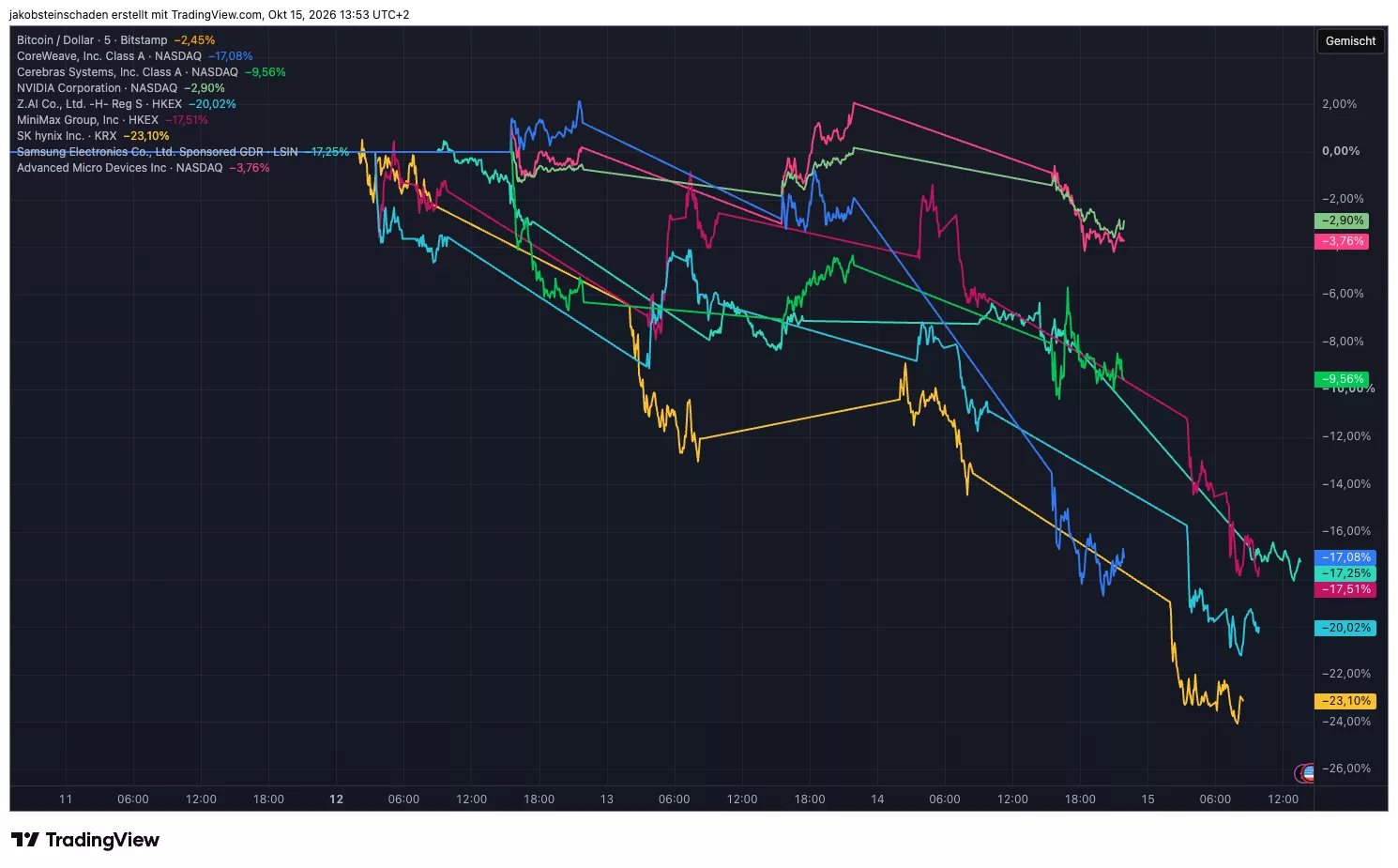
The TradingView chart, captured at midday on Thursday, ranks the losses and shows the performance of the past five days. The memory chip giants are hit hardest: SK Hynix leads the list of losers at minus 23.1 percent, and Samsung (traded as a GDR in London) is down 17.3 percent. Close behind are CoreWeave at minus 17.1 percent and the Chinese AI developers listed in Hong Kong, Z.ai (minus 20.0 percent) and MiniMax (minus 17.5 percent). The AI chip specialist Cerebras is down 9.6 percent. Nvidia, at minus 2.9 percent, and AMD, at minus 3.8 percent, are getting off comparatively lightly.
Inflation and Interest Rates as the Trigger
Economic data lit the fuse. US inflation rose to 3.7 percent in September. Since then, investors have been betting more heavily on further interest rate hikes by the Federal Reserve, which weighs especially on expensive growth stocks. According to Investing.com, the market-implied probability of a rate hike at the Fed’s next meeting at the end of the month climbed to almost 32 percent, up from a good 22 percent. At the same time, many investors are fleeing into government bonds: the yield on 10-year US Treasuries fell to 5.08 percent, the lowest level in three weeks.
The Debt Question Behind the AI Boom
The inflation numbers hit nerves that were already frayed. The AI boom is financed with debt on a massive scale, and that financing is now in the spotlight. Barclays equity strategist Emmanuel Makonga sees the central worry in when the extraordinary AI investment cycle will peak. He describes a de-rating of the entire AI trade. Broadcom CEO Hock Tan also warned, according to Investing.com, that some AI investors are practically gambling.
CoreWeave is seen as the warning signal. The price of protection against a default on its five-year bonds (credit default swaps) rose above 11 percentage points on Wednesday. Investors are now paying more than $11 per $100 of debt to insure against a default. The stock fell as much as 17 percent, and the bonds due in 2032 traded below 78 cents on the dollar, even though they were issued at full face value four months ago. Doubts persist over whether the company can fund its spending by renting out computing power to Big Tech groups. SMBC strategist Hank Calenti calls it a sell-off driven by the business model.
Anthropic Grows More Slowly Than Expected
A number from the AI industry added to the unease. The AI lab Anthropic told investors, according to the FT, that its third-quarter revenue rose by almost 50 percent to $16.8 billion. That is less dynamic than at the start of the year and below the expectations of some backers. For a market that has priced in unbridled growth, even a slight flattening of the curve is enough to cause nerves.
China Raises the Pressure
Competition from China is another factor. The Chinese DRAM maker CXMT said at the start of the week that it had made progress on cutting-edge technology. Société Générale strategist Charles de Boissezon says that if competitive pressure from China grows, margin forecasts for US tech companies would have to be revisited. He names inflation and rate expectations as the immediate trigger of the latest selling.
Fundamentals Remain Strong
Some data point against a retreat from the AI boom. The contract chipmaker TSMC reported its sixth record quarter in a row, according to Investing.com. Third-quarter net profit rose 68.7 percent and beat expectations, driven by demand for AI chips. The stock still slipped 2.2 percent in Taiwan. Anthropic, for its part, says it reached adjusted profitability, and its revenue growth points to still-rising demand for AI services, which in turn need computing power and therefore chips.
What happens next will depend on how the Fed reacts to the inflation data and on whether worries about financing for data centers harden or fade. Until then, the chip sector remains a market in which single numbers can trigger large price moves.