Almost Fable 5 Performance for 60% Less: GPT-5.6 Finally Gets The Green Light


Set Trending Topics as a preferred source on Google.
OpenAI has made GPT-5.6 broadly available after the U.S. government signed off on a wide release. Before that, the model had been accessible for weeks only through a tightly restricted preview. In the independent benchmarks published by Artificial Analysis, the new model ranks just behind the current front-runner — at significantly lower cost. The following overview summarizes its capabilities, pricing, the approval process, and how it compares with the competition.
Three Models Instead of One
GPT-5.6 is not a single version but a family of three tiers. Sol is the flagship, Terra a cheaper mid-tier option for everyday enterprise use, and Luna the fastest and cheapest tier for high-volume tasks. This tiering is as much a commercial decision as a technical one: it lets OpenAI charge very different prices for the same model family — from high-performance to cost-optimized.
All three tiers introduce a new “max reasoning effort” mode that gives the model more time for difficult problems. OpenAI describes Sol as particularly strong in coding, biology, and cybersecurity.
What It Costs
According to Artificial Analysis, the three models are priced at $5/$30, $2.50/$15, and $1/$6 per million input/output tokens (Sol, Terra, Luna). GPT-5.6 also introduces so-called cache-write pricing at OpenAI for the first time: writing tokens to the cache costs 1.25 times the input price, while cache reads remain discounted by 90 percent. With this, OpenAI follows a model that Anthropic also uses.
More telling than the raw token price are the weighted costs per task in the Intelligence Index. At maximum reasoning effort, GPT-5.6 Sol costs around $1.04 per task. Terra and Luna come in at roughly $0.55 and $0.21, about 50 and 80 percent below that.
How Capable It Is
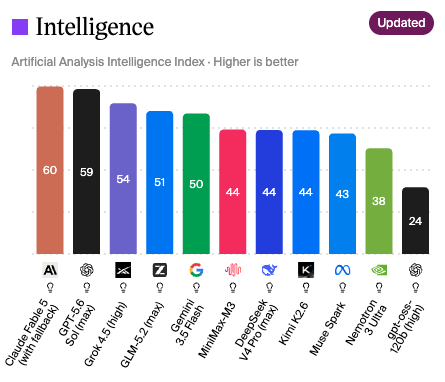
In the Artificial Analysis Intelligence Index, GPT-5.6 Sol (max) scores 59 points, placing it just one point behind the leading model, Claude Fable 5 (60 points, evaluated with fallback). Terra and Luna reach 55 and 51 points respectively.
Beyond the raw intelligence score, the model proves strong in several specialized disciplines:
- In the new Coding Agent Index, Sol (max) leads with 80 points in the Codex harness and comes out on top in all three underlying coding benchmarks.
- In the AA-Briefcase benchmark, which tests realistic knowledge work, Sol ranks second behind Fable 5 — but achieves the highest “Presentation Elo” ever measured, meaning particularly well-designed outputs in formats such as PowerPoint and Excel. On analytical quality, however, Fable 5 is clearly ahead (rubric score of 56% versus 42%).
- Sol (max) uses about 15,000 tokens per task, fewer output tokens than most models of comparable intelligence.
One point of criticism: on the AA-Omniscience knowledge benchmark, GPT-5.6 offers only a slight improvement over its predecessor GPT-5.5 — and the somewhat higher accuracy comes with a slightly increased hallucination rate.
Why the U.S. Government Had a Say
The point that sets GPT-5.6 apart from earlier releases is the approval process. The model was the first American frontier model to undergo a formal government review before it could be broadly released.
The basis is a framework introduced by the Trump administration on June 2, 2026. It provides for a voluntary pre-release review of the most capable models — an executive order asks AI companies to give the government up to 30 days of advance access to models with advanced cyber capabilities. In the case of GPT-5.6, it went further still: the voluntary review became a government-managed access list. For weeks, the model was available only to about 20 partners whose names the government had individually approved.
What prompted the closer scrutiny were, according to reports, exactly the strengths OpenAI touts: the model’s capabilities in biology and cybersecurity. The additional testing ran through the Center for AI Standards and Innovation at the Commerce Department; according to Axios, OpenAI sent technical experts to Washington to answer the agency’s questions. Those involved included Commerce Secretary Howard Lutnick, Treasury Secretary Scott Bessent, and National Cyber Director Sean Cairncross.
OpenAI has made clear that it views this precedent with unease. The company took part this time but does not consider such a government access procedure to be the appropriate long-term default. The background: a government that can approve a launch can also block one — a power the administration, according to media reports, has already used elsewhere in the industry. Because the same framework applies to competitors, the process is likely to become the template for how the next frontier model from a U.S. provider reaches the public.
Comparison with the Competition
The two overviews below are based on the Artificial Analysis rankings. The first shows the intelligence score (higher is better), the second the weighted costs per task (lower is better).
Intelligence Index (points):
| Model | Points |
|---|---|
| Claude Fable 5 (with fallback) | 60 |
| GPT-5.6 Sol (max) | 59 |
| Grok 4.5 (high) | 54 |
| GLM-5.2 (max) | 51 |
| Gemini 3.5 Flash | 50 |
| MiniMax-M3 | 44 |
| DeepSeek V4 Pro (max) | 44 |
| Kimi K2.6 | 44 |
| Muse Spark | 43 |
| Nemotron 3 Ultra | 38 |
| GPT-oss-120b | 24 |
Cost per task (US dollars):
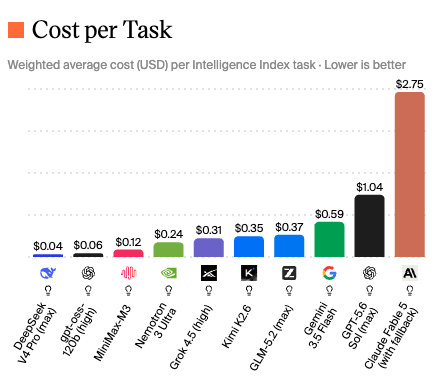
| Model | Cost |
|---|---|
| DeepSeek V4 Pro (max) | $0.04 |
| GPT-oss-120b (high) | $0.06 |
| MiniMax-M3 | $0.12 |
| Nemotron 3 Ultra | $0.24 |
| Grok 4.5 (high) | $0.31 |
| Kimi K2.6 | $0.35 |
| GLM-5.2 (max) | $0.37 |
| Gemini 3.5 Flash | $0.59 |
| GPT-5.6 Sol (max) | $1.04 |
| Claude Fable 5 (with fallback) | $2.75 |
The overall picture: GPT-5.6 Sol reaches almost the level of the front-runner Claude Fable 5 with 59 points (versus 60) — but at $1.04 per task, it costs only about one-third of Fable 5’s $2.75. This positions OpenAI in the upper performance range without the usual price premium.
At the same time, Sol remains the most expensive model in the field after Fable 5. Those who need less top-end performance will find cheaper alternatives: Grok 4.5 scores 54 points for $0.31, GLM-5.2 reaches 51 points for $0.37, and Gemini 3.5 Flash sits at 50 points for $0.59. At the low end of the cost scale, models such as DeepSeek V4 Pro ($0.04) or MiniMax-M3 ($0.12) offer far lower prices with a correspondingly lower intelligence score. Within its own family, Terra and Luna cover the cheaper segments.
The assessment therefore depends on the use case: for tasks that demand maximum model intelligence, GPT-5.6 Sol delivers a better performance-to-cost ratio than the market leader. For cost-sensitive, high-volume applications, many models in the field remain considerably cheaper.