Anthropic Launches Fable 5, based on Mythos, With Sweeping Capability Restrictions



Set Trending Topics as a preferred source on Google.
On Tuesday, Anthropic unveiled two new AI models: Claude Fable 5 for the general public and Claude Mythos 5 for a restricted circle of trusted partners. Both models are built on the same technical foundation but differ significantly in their usage restrictions. Fable 5 is the deliberately limited, “safe” variant of the Mythos model, which Anthropic had made accessible only in a limited capacity since April 2026.
Background: Why Mythos Remained Under Wraps for So Long
Back in April 2026, Anthropic had already released the original Claude Mythos Preview as part of the so-called Project Glasswing, but exclusively for a small group of cybersecurity experts and operators of critical infrastructure in collaboration with the US government. The restricted availability was justified by the model’s exceptional capabilities, particularly in the field of cybersecurity.
Since then, three explanatory approaches have circulated within the industry regarding the delayed release: first, the official justification that the model was too dangerous for broad release; second, the theory that Anthropic simply did not have sufficient computing capacity; and third, the assumption that the company wanted to protect its most powerful capabilities from competitors, particularly open-source projects and Chinese AI labs.
What Fable 5 and Mythos 5 Can Do
According to Anthropic, both models surpass all previously released Claude versions in nearly every tested performance area. Capabilities in the following areas are particularly highlighted:
- Software development: The company Stripe reported that Fable 5 completed months of migration work on a 50-million-line codebase within a single day.
- Knowledge work: On Hebbia’s Finance Benchmark for complex analytical tasks, Fable 5 achieved the highest score of all tested models.
- Image processing: The model can precisely extract data from scientific graphics and solve complex visual tasks without additional tools.
- Life sciences: According to Anthropic, Mythos 5 accelerated internal processes in the area of drug design by a factor of ten and generated novel scientific hypotheses in molecular biology.
- Genomics: Over the course of more than a week of largely autonomous work, Mythos 5 developed its own machine learning model that outperformed a model recently published in the journal Science.
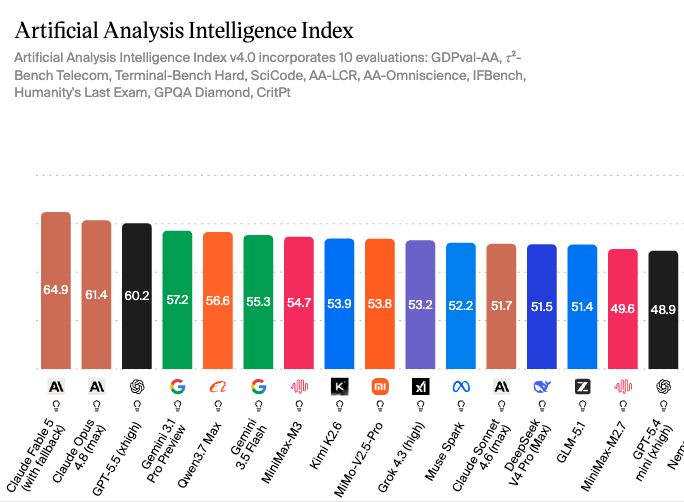
That Fable 5 represents a significant leap forward is demonstrated by Artificial Analysis in benchmarks that place Anthropic’s new AI model clearly ahead of the previous frontrunner Claude Opus 4.8:
How Fable 5 Was Made “Safe”
In order to release the model to the general public, Anthropic has built in a multi-layered system of restrictions. At its core are so-called classifiers: separate AI systems that analyze requests in real time and automatically switch to the weaker model Claude Opus 4.8 when potentially dangerous content is detected. Users are informed when such a redirect occurs. According to Anthropic, this affects fewer than five percent of all sessions.
Cybersecurity
Mythos-class models are capable of discovering and exploiting software vulnerabilities and independently carrying out complex multi-stage cyberattacks. Fable 5 is configured so that it does not provide actionable responses to such requests. External security tests, including a bug bounty program with over 1,000 hours of testing, have so far revealed no universally applicable methods for circumventing these safeguards.
Biology and Chemistry
Given the demonstrated ability of Mythos models to independently carry out biological research tasks, Anthropic has deliberately cast the safeguards in this area broadly. Requests relating to biology and chemistry will largely be redirected to Opus 4.8 for the time being. A separate access program for Mythos 5 is set to open for selected biomedical research institutions in the coming weeks.
Distillation
According to Anthropic, the company has in the past detected large-scale attempts to extract the capabilities of Claude models through systematic querying and use them to train competing models. Requests classified as such distillation attempts are also redirected to Opus 4.8.
Criticism from the Research Community
One further restriction in particular sparked discussion shortly after the release: according to the system document for Mythos 5 and Fable 5, the models are intentionally made less helpful when responding to requests related to the development of large language models. Unlike the other classifiers, there is no transparent redirect to a different model. Instead, according to Anthropic, responses can be influenced through techniques such as the silent modification of user requests.
“Anthropic’s latest model will NOT help if it thinks your ML research is interesting, and will secretly throttle its intelligence so that the average developer won’t notice,” writes SemiAnalysis, an AI research firm, on X.
Availability and Pricing
Claude Fable 5 is available worldwide immediately. Claude Mythos 5 will initially remain restricted to Glasswing partners and is set to be gradually opened to additional cybersecurity organizations and life scientists through an expanded access program.
Both models are offered at a price of $10 per million input tokens and $50 per million output tokens, which is less than half the previous price for Mythos Preview. For subscribers to existing plans, Fable 5 is available at no extra charge until June 22, 2026, after which usage will be tied to additional credits.
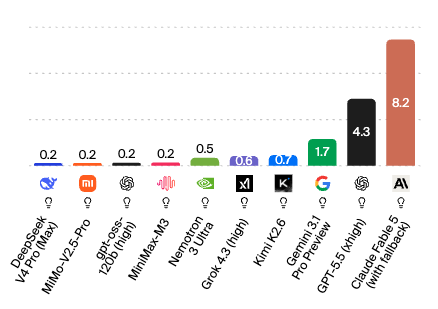
Compared to other AI models, Fable 5 is significantly more expensive, making it by far the most expensive LLM on the market at present: