Apollo’s Chief Economist Sees No A.I. Payoff Outside Big Tech



Set Trending Topics as a preferred source on Google.
Hundreds of billions of dollars are pouring into data centers, yet almost none of it is showing up on the balance sheets of the broader economy. That is the sobering conclusion of Torsten Slok, the chief economist of the asset manager Apollo Global Management, in his latest analysis. His central argument: The A.I. story will ultimately be decided by the “S&P 493,” the 493 companies in the S&P 500 index that are not part of the “Magnificent 7” (Alphabet, Amazon, Apple, Meta, Microsoft, Nvidia and Tesla). And among those companies, Mr. Slok sees no financial payoff so far.
Big Tech Takes Off While Everyone Else Stalls
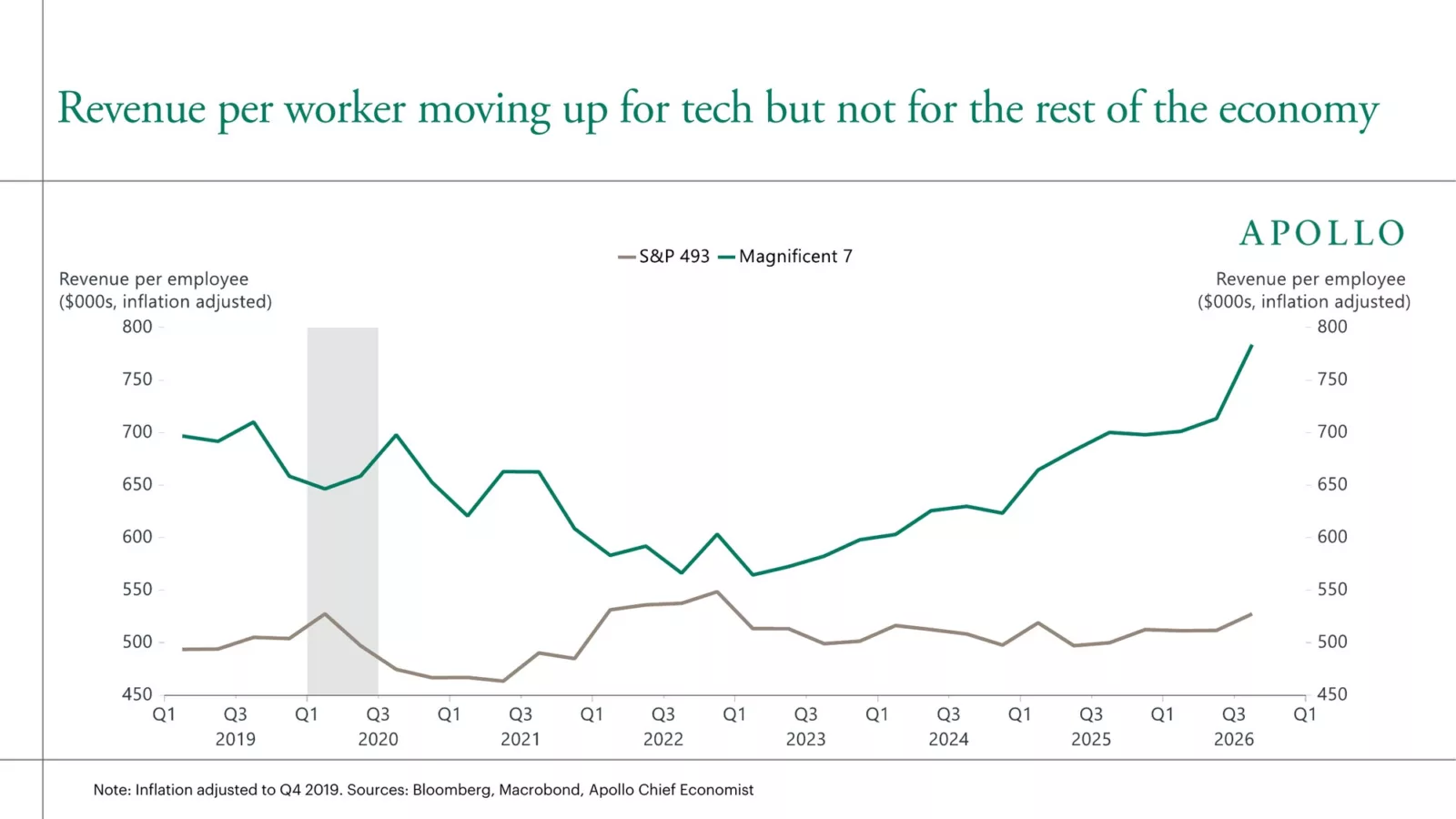
The data Mr. Slok draws from Bloomberg and Macrobond shows a widening gap. Inflation-adjusted revenue per employee at the Magnificent 7 has climbed to roughly $780,000 (about €696,000), up from a low of around $565,000 in 2022 and 2023. At the S&P 493, the figure has hovered between $500,000 and $550,000 for years and now stands at about $527,000 (about €470,000).
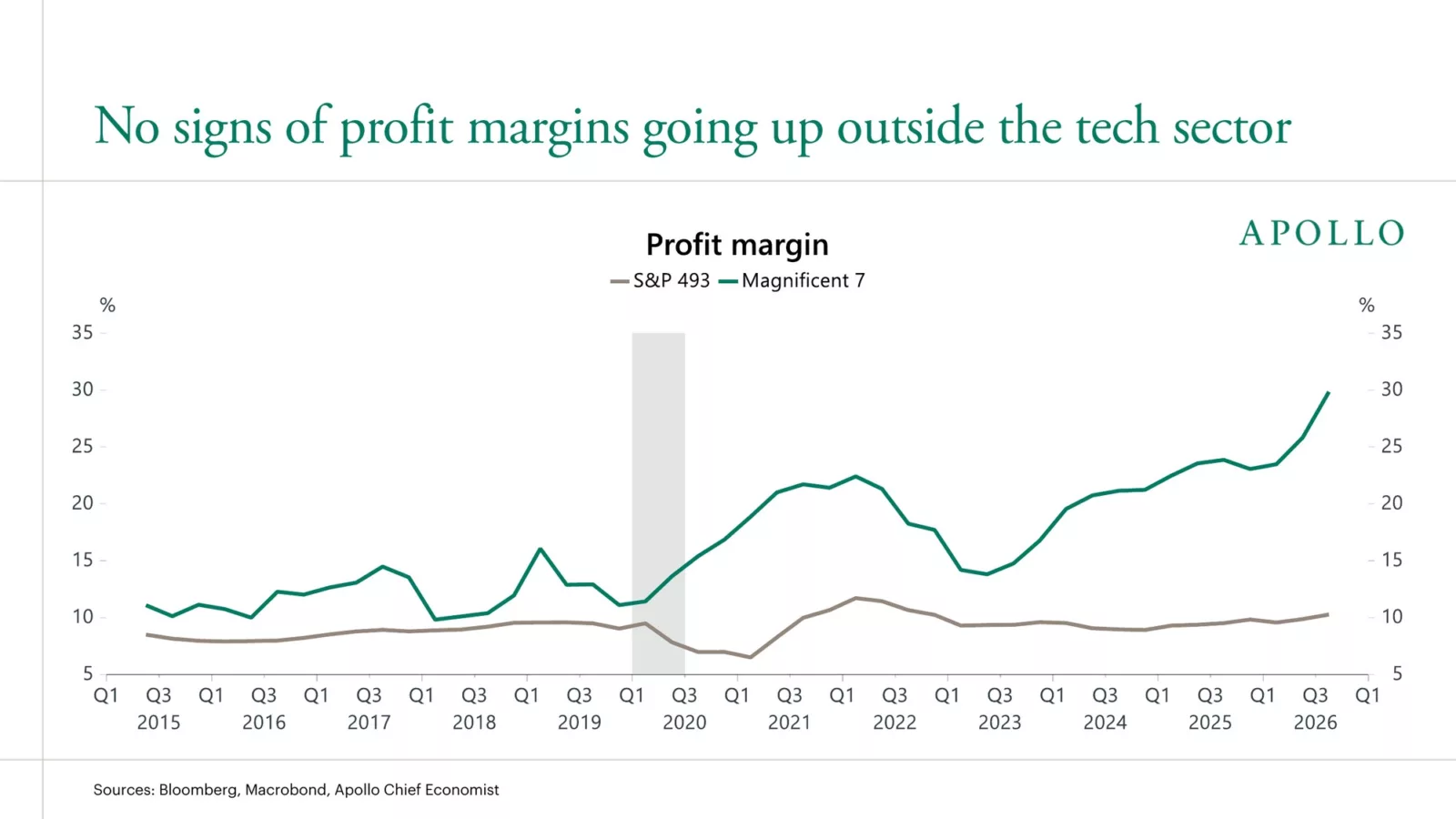
The difference is even starker for profit margins. The Magnificent 7 now earn a margin of almost 30 percent, the highest in the period covered. The other 493 companies have been stuck at 9 to 10 percent since 2023, roughly where they stood before the pandemic.
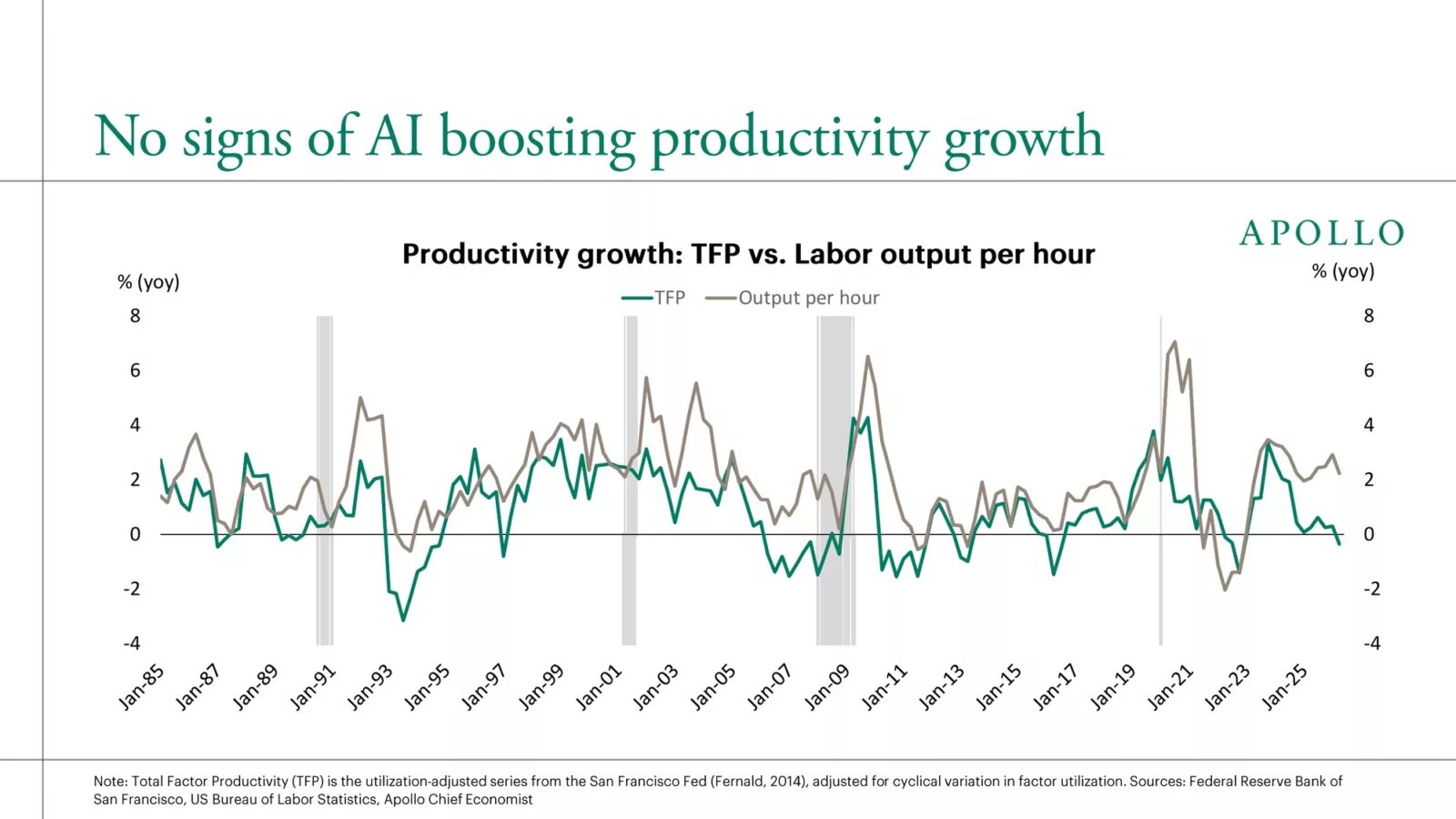
Mr. Slok finds no trace of an A.I. boom in the wider economy either. Utilization-adjusted total factor productivity, as measured by the Federal Reserve Bank of San Francisco, has fallen to around zero and recently dipped slightly into negative territory. Output per hour is growing by about 2 to 2.5 percent a year, a historically unremarkable rate.
Reason 1: The Money Flows to Very Few Companies
A key reason for the gap, according to Mr. Slok, is how extremely concentrated A.I. spending is. He relies on data from the U.S. fintech Ramp, which analyzes corporate spending at tens of thousands of businesses. The top 10 percent of firms account for 95.6 percent of spending on OpenAI and Anthropic, and for 99.5 percent of spending on model serving and inference. According to Ara Kharazian, Ramp’s chief economist, roughly 80 percent of OpenAI and Anthropic spending comes from just 1 percent of companies. As long as agentic A.I. and token spending stay confined to such a small slice of the economy, Mr. Slok argues, the macroeconomic effects will remain limited.
Reason 2: A.I. Companies Buying From A.I. Companies
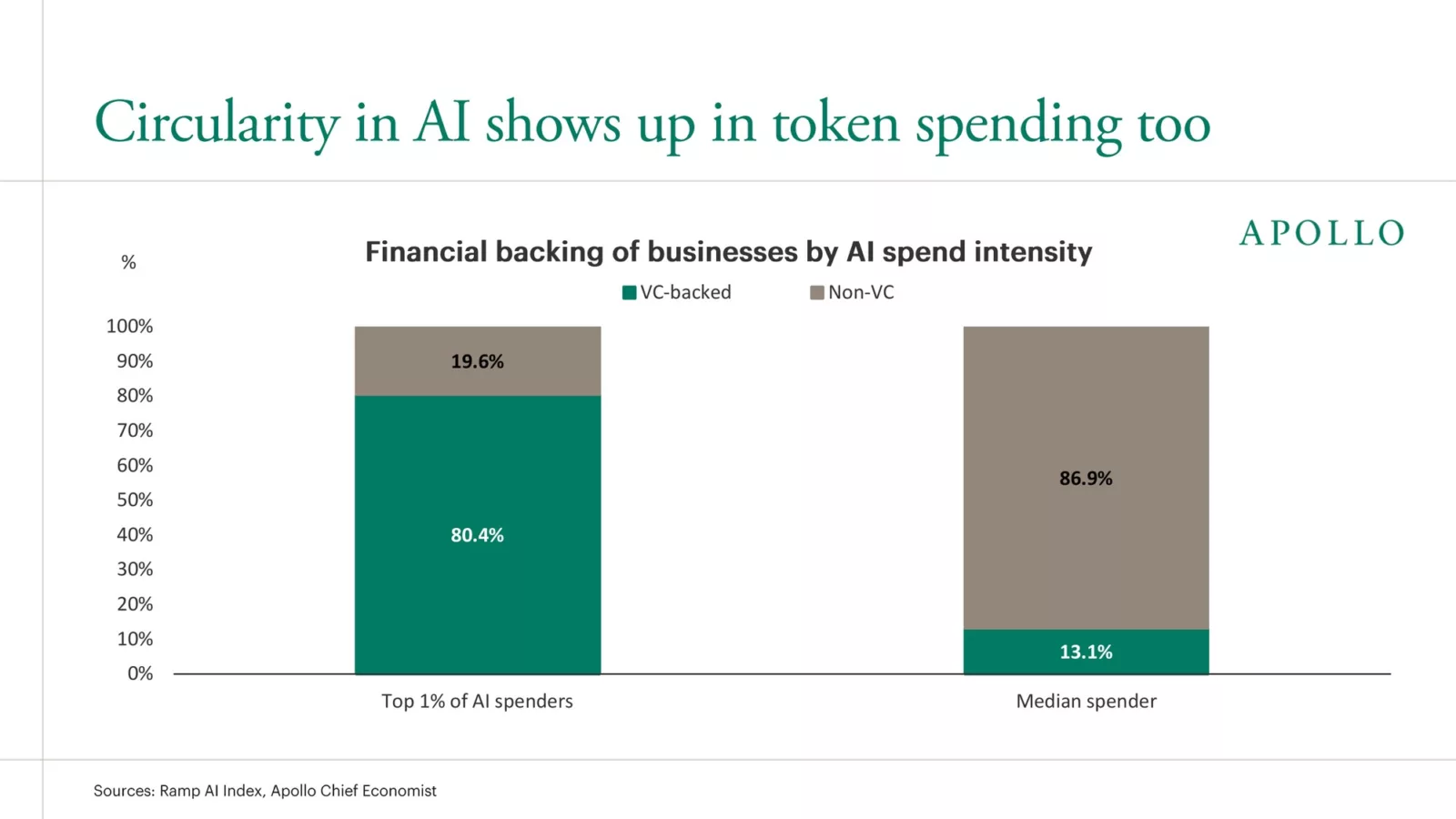
Then there is a problem that has been debated for some time under the label of circularity. Among the 1 percent of firms with the highest A.I. spending, 80.4 percent are backed by venture capital, according to Ramp. For the median company, the share is just 13.1 percent. In other words, investor money flows into start-ups that use it to buy tokens from OpenAI and Anthropic, which are themselves funded by investors. The Bank for International Settlements has also warned that more than half of the investment in A.I. companies comes from other A.I. companies. The International Monetary Fund even sees the risk of a debt spiral driven by loans for data centers.
Reason 3: Tokens as a Cost Center
According to Mr. Slok, mainstream companies increasingly view token spending as a cost that weighs on margins, and less as a driver of growth. They are unwilling to pay for the newest and most expensive models. That fits Ramp’s latest data: 55.9 percent of businesses on the platform now pay for A.I., but new customers have become scarce. Token spending stalled in August and September even as the volume of tokens used kept rising, meaning prices are falling faster than usage is growing. Ramp’s chief economist suspects that A.I. adoption is already nearing the top of the classic S-curve.
Reason 4: Calculating Is Not Judging
Mr. Slok’s most fundamental objection concerns the technology itself. Even as models keep getting cheaper, he is skeptical that companies can turn increasingly cheap intelligence into higher revenue growth and higher profit margins. “A.I. may be a great calculator, but in business, intelligence is mostly judgment,” he writes. In his view, A.I. does not understand accountability, trust, culture, unwritten rules, ethical trade-offs or fairness, yet these are exactly the factors that shape reputational risk and, ultimately, revenue and margins.
Reason 5: New Technologies Take Decades
Ming Lu, a senior advisory partner at the investment firm KKR, recently struck a similarly skeptical note in an essay for Fortune. Markets assume that growth from the infrastructure build-out will turn into A.I.-driven efficiency gains starting in 2027, a timeline the KKR adviser considers too optimistic. The U.S. economy is now dominated by services that depend on human judgment and are hard to transform. Consumers adopt new technologies quickly, while companies move slowly, and usually only a handful of pioneers lead the way. Historically, railroads, electrification and the internet also delivered their full impact only after painful crashes. At the same time, the bet on A.I. is enormous: The Magnificent 7 account for about 35 percent of the S&P 500, and hyperscalers are expected to spend about $800 billion (about €714 billion) on chips, data centers and power this year.
The Counterargument: Early Gains Across the Board
Some data paints a friendlier picture, though. A study by the Federal Reserve Banks of Atlanta and Richmond and Duke University surveyed 734 chief financial officers at U.S. companies. Based on their figures for revenue and employment, the researchers calculate A.I.-driven labor productivity growth of about 0.6 percent in 2025, and the companies expect about 1.8 percent for 2026. In high-skill services and finance, the figures already exceed 2 percent. The authors attribute the fact that these effects barely appear in official statistics partly to a lag before improvements show up in revenue. And for the economy as a whole, the A.I. boom is already a major factor: LinkedIn co-founder Reid Hoffman has even called it the only reason the United States is not in a recession.