A.I. Boom Is ‘the Only Reason We’re Not in a Recession’



Set Trending Topics as a preferred source on Google.
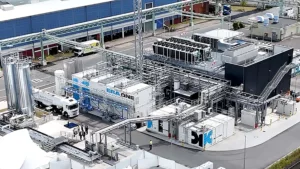
The American economy is riding on the construction of A.I. data centers, at least if you ask Reid Hoffman. On the Newcomer podcast, the LinkedIn co-founder and investor said the build-out of A.I. infrastructure is “the only reason we’re not in a recession.” Tech giants are not the only beneficiaries, he argued: construction workers, electricians, carpenters, real estate agents and lawyers across the country profit as well. “Most of that’s more distributed across the country. That’s great,” Mr. Hoffman said.
Mr. Hoffman is hardly a neutral observer. He is a partner at the venture capital firm Greylock, sits on Microsoft’s board and has co-founded and backed several A.I. start-ups himself.
The Case for Hoffman’s Thesis
Mr. Hoffman is not alone in his view. The Harvard economist Jason Furman calculated last year that investment in computer equipment and software made up only about 4 percent of U.S. economic output but accounted for 92 percent of growth in the first half of 2025. Without that investment, the economy would have grown by just 0.1 percent over that period. Mr. Furman acknowledged, however, that without the A.I. boom, lower interest rates and electricity prices would have offset part of the gap.
The hedge fund Bridgewater also sees a large effect. It estimates that A.I. investment will lift U.S. growth by about 1.4 percentage points this year and 1.5 percentage points next year, comparable to the contribution of business investment during the dot-com bubble. Economists at the Federal Reserve found that A.I. investment contributed about 0.6 percentage points to growth in the first quarter of 2026, when the economy grew 1.6 percent overall.
The Case Against
Other economists think the math is overstated. Jan Hatzius, the chief economist at Goldman Sachs, said earlier this year that A.I. had contributed “basically zero” to U.S. growth. His argument: Roughly three-quarters of a data center’s costs go to imported components, mainly chips and servers from Asia. Because imports are subtracted from gross domestic product, much of the spending never shows up in the American economy. At the end of 2025, for example, 0.75 percentage points of A.I. investment shrank to just 0.14 percentage points once imports were deducted, according to calculations by Axios.
The effect on the labor market is also disputed. Bridgewater points out that a $1.5 billion (about 1.3 billion euros) Meta data center in Texas creates only about 100 permanent jobs, while a battery plant of similar cost creates more than 1,600. A.I. spending could also drive up the cost of capital and weigh on other, more labor-intensive industries. And the U.S. economy is in decent shape even beyond data centers: Unemployment is low, the economy grew at an annualized rate of 2.2 percent in the second quarter, and consumer spending is holding up.
A Reason for Trump’s A.I. Course?
If A.I. investment really is propping up the economy, that could also help explain why President Trump has put few obstacles in the industry’s way. Shortly after taking office, he revoked Joe Biden’s executive order on A.I., and in December he ordered a task force to challenge state A.I. laws. When even the chiefs of Anthropic, OpenAI and xAI recently called for slowing the pace of development, Mr. Trump rejected any regulation. “Whoever wins A.I., wins,” he said. He is betting on self-regulation instead: At the White House, he recently unveiled a voluntary accord with Google, Meta, Anthropic, OpenAI, Nvidia and xAI that contains no legally binding commitments. Mr. Trump himself justifies his approach mainly with the race against China. Yet an A.I. brake would also dampen the very investment that, in Mr. Hoffman’s telling, is keeping the United States out of a recession.
Resistance to Data Centers Is Growing
At the same time, opposition to new data centers is mounting. Half of Americans in rural areas now consider data centers harmful to the environment, up from 32 percent in January. Governors from both parties are already restricting construction. OpenAI’s chief executive, Sam Altman, recently suggested moving data centers to remote areas such as deserts. The debate has reached Europe as well: Researchers at TU Wien recently warned that the A.I. boom could lead to a comeback of fossil fuel power plants unless data centers make their power consumption more flexible.