A Touch From a Healthy Neighbor Can Revive Bleached Coral


Set Trending Topics as a preferred source on Google.
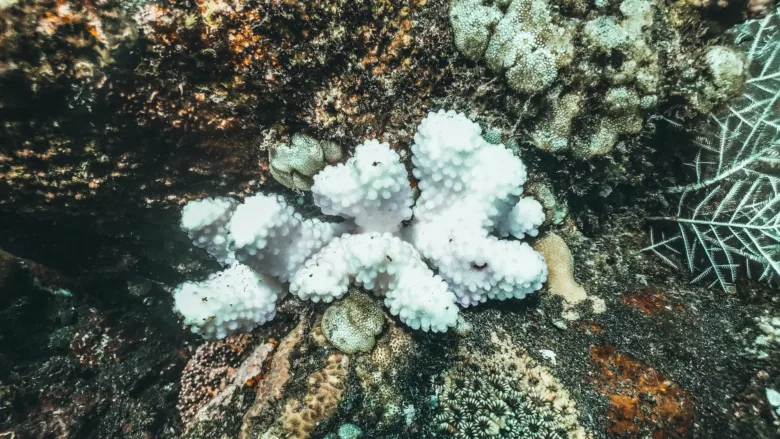
First aid under water apparently works through physical contact: Bleached corals recover within days when they touch a healthy neighbor. That is the finding of a study by researchers at Stanford University, published in the journal Science Advances. According to the researchers, it is the fastest recovery documented so far.
A Lucky Find in the Lab
The effect was discovered by chance. In a lab at Hopkins Marine Station in California, the marine biologist Steve Palumbi noticed two pieces of coral that had tipped against each other in a tank, one healthy and one bleached. Where they touched, the bleached piece was regaining its color. The Ph.D. student Danny Collins had previously studied how harmful bacteria spread between corals through contact, and he flipped the question: What happens if contact transmits something beneficial?
For the experiment, Mr. Collins set up 10 pairs of fragments of the species Pocillopora damicornis, each made up of a healthy and a bleached piece from the same colony. In five pairs, the pieces touched. In the other five, they were kept a few millimeters apart. After seven weeks, all five bleached corals with contact had recovered, while all five without contact had died, Nature reports.
A Bridge for Algae
Under the microscope, the mechanism became clear: The genetically identical corals recognize each other and fuse. Nutrients and symbiotic algae travel from the healthy piece to the bleached one through tiny channels in the tissue. “Their tissues are growing and creating a nutrient bridge,” Mr. Collins said. The first algae arrived within three days. After about a week, some of the bleached corals had enough of them to keep recovering on their own. In the second week, the number of algae doubled every four days, about 10 times as fast as in wild corals. “They flood in and start dividing at the fastest rates seen in corals,” Mr. Palumbi said.
Corals depend on these algae, which supply most of their energy. When the water gets too warm, corals expel them, turn white and risk starving. Recovery usually takes months or years, and often it never happens. “Bleached corals are often considered a lost cause,” said the marine ecologist Fiorenza Micheli, a co-author of the study.
A Race Against the Heat
The pressure is enormous. During the global bleaching event in 2023 and 2024, live coral cover fell by almost 9 percent, according to the Global Coral Reef Monitoring Network, the largest single-year decline on record. Mass bleaching now occurs roughly every five to six years, leaving reefs less and less time to recover. Coral reefs cover only about 0.01 percent of the ocean floor, yet they are home to about a quarter of all marine life.
Still a Long Way From the Reef
The researchers themselves caution against high expectations. The study covers only 10 pairs of a single species and took place in a lab. Above all, the method works only between genetically identical corals. Every reef would need healthy clones of each individual coral on hand in advance, which is hardly feasible in the wild. The effect also offers no protection from the heat itself. Mr. Palumbi stresses that this is a story about recovery after a heat wave and that heat waves still need to be curbed.
As a next step, the team wants to transfer the algae without direct contact: They are to be grown in the lab and then applied to bleached corals. The first field trials are planned in Hawaii and Palau.