CardioMirror: This Smart Mirror Knows Your Pulse, Breathing and Stress Level

Set Trending Topics as a preferred source on Google.
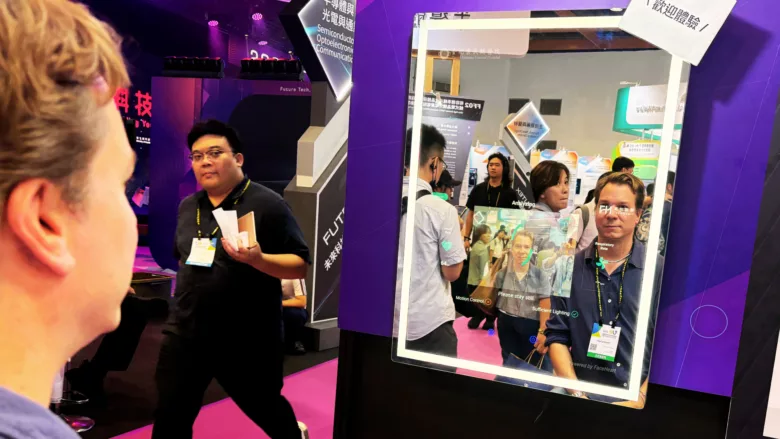
“Mirror, mirror on the wall, how is my health after all?” That is the question the CardioMirror sets out to answer. The smart mirror comes from Taiwanese health tech startup FaceHeart, which presented it at the Taiwan Innotech Expo in Taipei this week. A camera built into the mirror records the user’s face for about 40 seconds and calculates vital signs from the footage, with no chest strap, finger clip or blood pressure cuff required.
Trending Topics tried out the mirror at the expo. In a quick check, its readings closely matched the data from the Oura smart ring on the tester’s finger. Pulse and stress levels appeared to be in good shape. Sleep and overall health scores, which are closely linked, looked noticeably worse: the jet lag from the trip from Austria to Taiwan was clearly showing.
How rPPG Works
The mirror is built on a technique called remote photoplethysmography, or rPPG. Conventional photoplethysmography is familiar from pulse oximeters and smartwatches: a sensor shines light into the skin and measures how light absorption changes with each heartbeat, as every pulse wave pushes more or less blood through the vessels.
rPPG applies the same principle using an ordinary camera and ambient light. The software detects tiny changes in the color of facial skin, invisible to the naked eye, that are caused by blood flow. According to FaceHeart, the method requires no infrared light, wearables or physical contact.
FaceHeart’s process runs in three steps:
- Face detection: The software detects and tracks the face in the camera image.
- Signal extraction: The physiological signal is derived from the color changes in the skin.
- Motion and light correction: Deep learning models compensate for head movement and changing lighting so the signal stays stable in real-world settings outside the lab.
The company markets the technology as FaceHeart Vitals. Beyond the mirror, it is available as an SDK for telehealth platforms, wellness apps and clinical workflows, as well as in a smartphone app. FaceHeart says it has been trained and validated on more than 400 million datasets covering diverse populations, skin tones and environmental conditions.
From Pulse to Heart Failure
The CardioMirror measures heart rate, respiratory rate, blood pressure, oxygen saturation, heart rate variability and a stress index, among other metrics.
The bigger ambition lies in screening for heart failure. FaceHeart points to a study published in the Journal of Cardiology in which its 40-second scan reportedly achieved an AUC of 0.90 and an accuracy of 89.71 percent. The sample, however, was small at 68 participants. The company also claims to be the first in the world to estimate the blood marker NT-proBNP using a camera. This biomarker is normally measured with a blood test and is an important indicator of heart failure for physicians. In this analysis of 246 people, FaceHeart reports an AUC of 0.90 as well as a coefficient of determination (R²) above 0.743.
Regulatory Clearances and Clinical Trials
For a startup, FaceHeart has made considerable regulatory progress. The company describes itself as the only one worldwide with two FDA clearances for rPPG technology.
An important caveat: the FDA clearances cover pulse rate and respiratory rate. The heart failure screening and the NT-proBNP estimate are so far backed by study data and have yet to receive regulatory approval. The company does not mention a CE marking for the European market.
According to FaceHeart, the system has been tested at several sites, including Taipei Veterans General Hospital, rural care facilities in Pingtung in southern Taiwan and, under a non-disclosure agreement, the Chang Gung hospital network. The company rates its technology readiness at TRL 7, meaning a prototype demonstrated in a real operational environment.

Who Is Behind FaceHeart
FaceHeart was founded in 2018 by Bing-Fei Wu and Meng-Liang Chung. Wu is a Fellow of the engineering association IEEE and has long worked in image processing and computer vision. The company has exhibited at CES in Las Vegas several times and won CES Innovation Awards in 2024 and 2025. In Taiwan, FaceHeart has also received the SNQ and NHQA quality awards and the National Innovation Award, and it cites a listing on a “Forbes Asia 100” list.
Use Cases
FaceHeart is primarily targeting healthcare systems that want to capture vital signs contactlessly and at scale. Possible settings include hospital waiting rooms, nursing homes, pharmacies and telemedicine services where patients record their readings at home with a smartphone camera. In rural and underserved regions in particular, the screening is meant to help detect heart problems earlier and prevent emergencies.
To connect with existing systems, FaceHeart relies on the FHIR health data standard via Microsoft Azure. Data processing is designed to comply with both the US health privacy law HIPAA and the European GDPR, which in principle makes the technology relevant for providers in Europe as well.