ChatGPT Ads Hits $1 Billion Run Rate, But Advertisers Are Not Sold


Set Trending Topics as a preferred source on Google.
OpenAI has announced the first major milestone for its advertising business: less than 200 days after launch, ChatGPT Ads has reached an annualized revenue run rate of $1 billion. Tens of thousands of advertisers are already using the platform, according to the company. At the same time, OpenAI is opening up self-service access, so campaigns can now be booked directly through Ads Manager in India, Europe, the Middle East and North Africa.
The figure is a snapshot rather than a full-year picture. The run rate is calculated by multiplying current monthly ad revenue by twelve, and it reflects present performance instead of confirmed bookings, as Digiday points out. For context, OpenAI entered the market with a $60 CPM and a $200,000 minimum spend, as Trending Topics reported. Analysts at the time expected $500 million to $800 million in the first year.
Advertising as One of Four Pillars
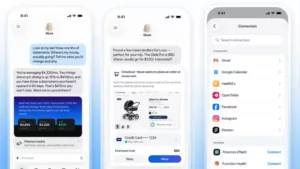
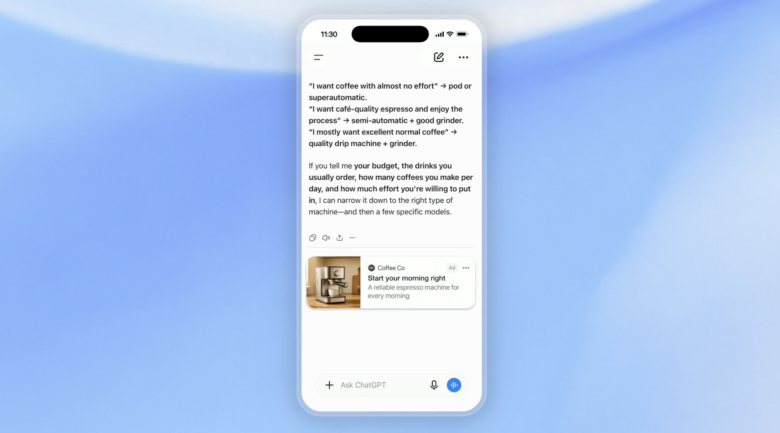
OpenAI positions advertising within a diversified model alongside consumer subscriptions, enterprise offerings and usage-based APIs. The ad-supported free tier is meant to keep ChatGPT accessible to more than 1 billion weekly active users. Ads appear below the answers, carry a sponsored label and, according to the company, have no influence on the answers themselves. Advertisers receive no access to private conversations.
In Europe, advertising went live recently across 31 countries, including Germany and Austria. It runs on the Free and Go tiers, while Plus, Pro, Business, Enterprise and Education accounts stay ad-free. Delivery is contextual for now, based on the topic of the current conversation, approximate location, device type and language. OpenAI cites legitimate interest as its GDPR basis, with Ireland’s Data Protection Commission as the competent supervisory authority, as Trending Topics reported ahead of the rollout. Personalization is set to follow later and only with active opt-in.
Reports of Weak Performance
Alongside the growth, reports of disappointing campaign results are piling up. An analysis by search intelligence provider Adthena, covered by Campaign, found a click-through rate of 0.91 percent for one brand, roughly seven times below the 6.4 percent benchmark for traditional Google search in the same sector. One enterprise advertiser reportedly spent just three percent of a $250,000 budget over several weeks. Adthena executive Ashley Fletcher also flagged reporting glitches in Ads Manager and concluded that the platform is still finding its feet.
An analysis by SE Ranking covering more than 50,000 prompts, summarized by eMarketer, arrived at similar conclusions: 14.35 percent of ads were off-topic relative to the prompt, a share that climbed above 50 percent in categories such as news and politics. In 96.37 percent of placements, the advertising brand went unmentioned in the answer text. Fewer than 20 percent of eligible users saw an ad on any given day.
Practitioners report comparable numbers. Several agency executives told MediaPost about campaigns with click-through rates around 0.6 percent, click prices of roughly $7 and no conversions. Multiple accounts also describe discrepancies between the click counts in OpenAI’s reporting and the sessions recorded in Google Analytics.
OpenAI Points to Its Own Case Studies
OpenAI cites different figures. One ecommerce advertiser achieved a 3x return on ad spend across its campaigns over 28 days, and a technology partner reports that more than 80 percent of ad-driven ChatGPT traffic comes from new customers. Metrics on trust, relevance and overall experience have held up throughout the global rollout, the company says.
The ecosystem now spans more than 50 technology and measurement partners, and ads run in over 40 countries. As next steps, OpenAI is promising additional markets, more formats and bidding options, and expanded measurement capabilities. The company also plans to explore more native ways for businesses to interact with consumers inside ChatGPT.