Cloudflare OS is a Stripped-down Version of OpenClaw for Companies


Set Trending Topics as a preferred source on Google.
Cloudflare aims to move AI agents beyond the role of general-purpose chatbots and turn them into tools for everyday business work. With Cloudflare OS, the US company is introducing an open-source platform that allows employees to work with agents, use internal data, build their own applications, and automate processes.
The idea is that AI should do more than draft text or summarize information from the internet. It should understand a company’s language, processes, and data—and use that understanding to carry out concrete tasks. Cloudflare therefore describes its platform as an operating system for working with agents.
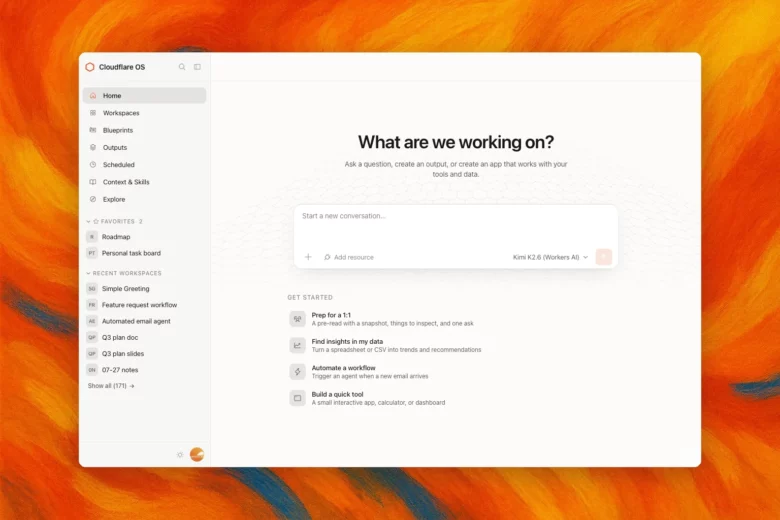
Employees receive their own workspace in the browser. There, they can ask questions, store files and results, access approved data sources, and assign tasks to an agent. A request can become a document, presentation, spreadsheet, small application, or automated workflow.
For example, rather than repeatedly asking the finance team about revenue in individual regions, an employee could request a dashboard. The agent accesses the data made available for that purpose, prepares it, and creates an interface that can then be shared with colleagues.
Company knowledge as shared context
According to Cloudflare, the key difference from general AI tools lies in the context. Companies can store their own terminology, policies, work instructions, and established best practices. If a team finds a better way to handle a recurring task, that knowledge can be made available as a shared capability for other users.
Cloudflare OS is therefore not aimed solely at developers. Business teams can also describe processes, analyze information, or create tools for their teams without having to develop software themselves. Agents can write and execute code to search, filter, or connect large data sets, for example. The aim is to avoid having to load entire databases into a model.
Alongside research and document creation, Cloudflare highlights two further use cases: internal apps and automated processes. An app generated by an agent is intended to be more than a clickable prototype. It can have its own user interface, server logic, and separate storage. It can remain private, be shared with others, or be distributed as a template.
Companies can also define workflows for recurring tasks. Predictable steps are handled by code, while the AI model is used only where judgment or writing is needed. These workflows can run on demand, on a schedule, or in response to events in connected systems.
AI access under strict controls
The more closely an AI agent works with internal systems, the more important it becomes to define who can view and change which data. Cloudflare OS therefore uses a restrictive permissions model: agents and apps start with no access to company resources. Permissions must be granted for specific data, systems, or actions.
The platform manages this through an intermediary layer called Gatekeepers. These hold credentials, enforce policies, and document what information an agent has accessed. An agent could, for instance, receive access to open issues in a particular project without also gaining access to an entire GitHub account or its source code. Actions that write data—such as merging code or sending information externally—can additionally require human approval.
The original permissions are also meant to remain in place when results are shared. If an agent uses sensitive data from a data warehouse to create a dashboard, only people who can access the underlying data should be able to open that dashboard. Cloudflare aims to prevent apps or summaries from becoming a back door for sharing protected information.
Open to customization and different models
Cloudflare is releasing Cloudflare OS as open-source software. Companies can deploy the platform in their own Cloudflare account and adapt it to their systems, policies, and ways of working. Cloudflare separates the software’s core from an example deployment based on its own internal setup. Companies can build their own integrations, interfaces, and workflows without having to alter the core product.
Cloudflare says it chose the open-source approach because no two organizations work in exactly the same way. The platform is not meant to be a rigid product, but an adaptable foundation for company-specific AI workspaces. The company also points to partners that can support implementation, integrations, and security design.
Cloudflare OS is designed to work with any language model. According to the company, all requests pass through Cloudflare AI Gateway, where organizations can decide which models are available for particular tasks, what cost limits apply, and how usage is billed. Kimi K2.7 appears as an example in the interface, but Cloudflare OS is not limited to that model.
Cloudflare lists Gmail, Google Docs, BigQuery, Linear, and Notion among possible applications and data sources. Existing MCP servers can also be integrated, allowing agents to use additional tools and services.
Technically, Cloudflare OS is built on Cloudflare Workers. Agents and applications run in isolated environments, while access is controlled through Cloudflare Access and Gatekeepers. The company positions the platform as a combination of AI workspace, development environment, and security framework for businesses that want to integrate agents into their day-to-day operations in a controlled way.