DeepSeek Ban: China Threatens the U.S. With Countermeasures


Set Trending Topics as a preferred source on Google.
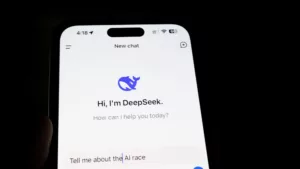
Washington locks DeepSeek out, and Beijing strikes back with words: After the U.S. government banned the Chinese A.I. lab from federal agencies, China is demanding that the decision be reversed immediately. At the same time, there are signs that DeepSeek may be only the beginning.
Beijing Calls It Discrimination
Two ministries responded on Tuesday to the order from the U.S. Department of Homeland Security. Mao Ning, a Foreign Ministry spokeswoman, accused the United States of overstretching the concept of national security and politicizing technology and trade. China will “resolutely safeguard” the legitimate rights and interests of Chinese companies, she said.
The Ministry of Commerce was even sharper, according to the state-run newspaper Global Times. The United States ignored a consensus between the two heads of state and imposed discriminatory restrictions on Chinese A.I. companies under the banner of national security, the ministry said. It called the move an “abuse of administrative means to suppress Chinese enterprises” and demanded that the measures be withdrawn immediately. The ministry said it was closely monitoring developments and would take “all necessary measures” against actions that substantively harm Chinese interests. So far, Beijing has not named any specific countermeasures. DeepSeek itself has not commented on the ban.
The Ban Has Been in Force Since the Summer
What is new about the order is mainly that it has become public. Markwayne Mullin, the homeland security secretary, signed it at the end of July. It requires all federal civilian agencies to remove products from DeepSeek and affiliated companies, as well as third-party software built on DeepSeek, from their systems. The stated reason is that DeepSeek’s servers are in China, where authorities could gain access, allowing sensitive U.S. data to leak. Agencies had 60 days to apply for exceptions. According to an analysis by VentureBeat, that window closed around Sept. 22, before the public even knew about the ban.
The ban does not apply to companies outside government business. But anyone working for U.S. agencies must remove DeepSeek from their products even if the model runs on their own servers in the United States. According to VentureBeat, procurement rules follow the developer of a model, not the data center that runs it. That could also affect Microsoft, which is currently integrating DeepSeek V4 Flash into Windows.
More Chinese A.I. Models in the Crosshairs
Washington is already discussing next steps. The Senate Armed Services Committee’s draft of the 2027 defense budget would extend the Pentagon’s ban to 10 more Chinese A.I. companies and their derivative models. According to VentureBeat, the White House also considered restrictions on Moonshot’s Kimi and Alibaba’s Qwen after Kimi K3 launched in the summer. Such plans are justified in part by U.S. officials’ accusation that Chinese labs are copying American models on a large scale through distillation. Beijing rejects that claim.
China Builds Its Own Barriers
At the same time, China is tightening its own grip. Just last Friday, the commerce and science ministries presented a draft of export controls on 23 A.I. technologies, including large language models, A.I. agents and chip designs. The rules would cover the weights and source code of models with at least 2 trillion parameters or those ranked among the world’s top 10. Open-source code and published research would be exempt, and Chinese companies could continue to offer their models abroad through apps and interfaces. The comment period runs until mid-November, and the ministry stressed that the rules do not target any particular country.
DeepSeek, meanwhile, is betting on openness: Shortly after the ban became known, the lab released its DeepInfer inference engine as open source.
Showdown at the Shenzhen Summit
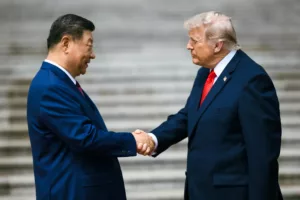
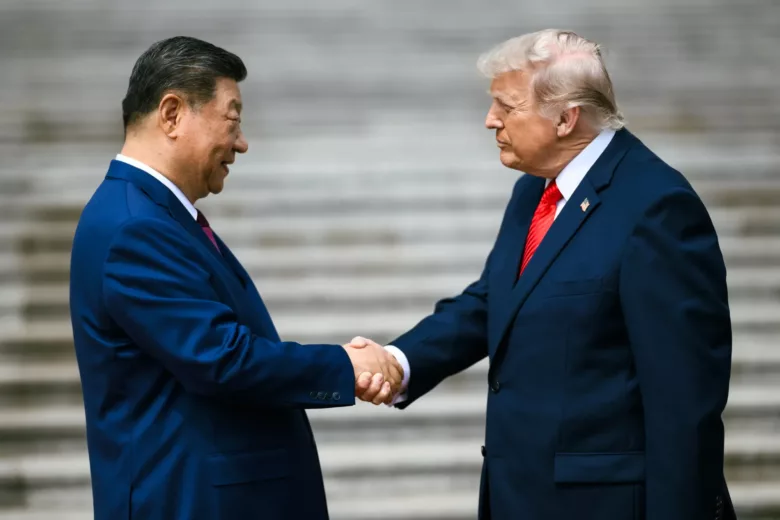
How serious Beijing’s threats are should become clear in mid-November, when President Trump and China’s leader, Xi Jinping, meet on the sidelines of the APEC summit in Shenzhen, China, with A.I. expected to be on the agenda. The two countries are not entirely at odds on the issue: In September, there was talk of a “red phone” for A.I. crises, and the United States has proposed a notification system for security-related A.I. incidents.