With Its New Arctic Strategy, the E.U. Wants to Secure Trade Routes and Critical Raw Materials


Set Trending Topics as a preferred source on Google.
While China, the United States and Russia have long been jostling for position in the Arctic, Brussels is now weighing in too: The European Commission and Kaja Kallas, the E.U.’s foreign policy chief, have just presented a new strategy for the Arctic. It focuses on security, climate change, the economy and the people who live there. “New shipping routes and resources are driving strategic competition,” said Ursula von der Leyen, the president of the European Commission. The Arctic, she said, is “Europe’s Northern Neighbourhood.”
Melting Ice Is Opening New Routes
Climate change is the reason for the new attention. According to the E.U., the Arctic is warming nearly four times faster than the global average. The melting ice is opening up new shipping routes and making mineral resources accessible that were previously locked beneath the ice. For the E.U., the region is not a distant concern: Three member states, Denmark, Finland and Sweden, have territory in the Arctic, and more than half a million E.U. citizens live there.
The change is most visible along the Northern Sea Route off Russia’s coast. The Chinese shipping company Sea Legend completed eight container voyages from China to Europe via the Arctic this year, carrying more than 14,000 containers, mainly batteries, energy storage systems and electric vehicles. According to Chinese authorities, the trip to Northern Europe takes 18 to 20 days, roughly half as long as the route through the Suez Canal.
China, Russia and the U.S. Are Already There
The three major powers have taken up their positions:
- Russia: Moscow controls most of the Northern Sea Route and has been expanding it for years. The state operator Atomflot expects more than 40 million tons of cargo on the route this year, about 10 percent more than last year. Trade with China alone exceeded 5 million tons in the first half of the year, and the goal is 20 million tons a year by 2030.
- China: Since 2018, Beijing has described itself as a “near-Arctic state” and wants to integrate the region into its trade routes as a “Polar Silk Road.” The new container services are the most tangible expression of that so far.
- United States: At the start of the year, President Trump threatened to take over Greenland, setting off a dispute with the E.U. (in German). In September, the United States, Denmark and Greenland finally signed a security agreement that allows the U.S. two new military bases on the island. Countries outside NATO and the E.U. may not establish a military presence there or invest in sensitive sectors. Mr. Trump also recently announced that large-scale exploration for oil, gas and minerals would soon begin in Greenland.
What the E.U. Is Planning
The strategy sets out four priorities:
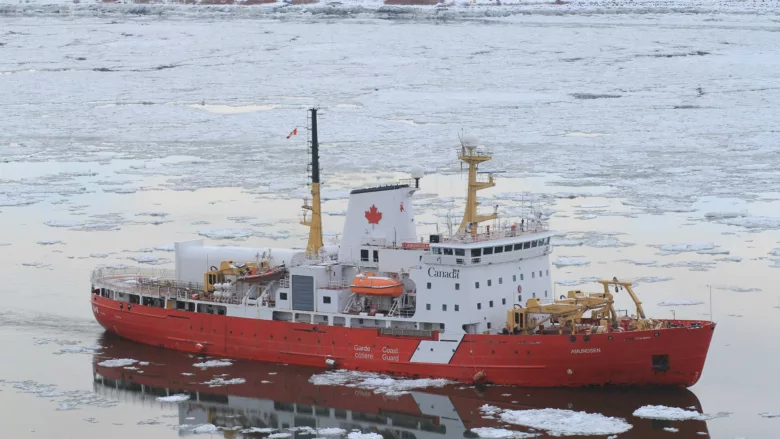
- Security: Together with member states and in complementarity with NATO, the E.U. wants to build up more of its own icebreaker capacity and protect critical infrastructure. A new Maritime Security Hub is to monitor shipping in the Arctic; as a first step, an Arctic Cable Hub will help monitor, protect and repair undersea cables in the North Atlantic and the Arctic. Later, it is also supposed to track vessels of Russia’s shadow fleet.
- Climate: Research, observation and data sharing are to be expanded, for example through OceanEye, the E.U.’s new ocean monitoring initiative, and a new E.U. Polar Research Hub.
- Prosperity: Ports, rail lines, energy terminals and satellites are to be connected to the new Arctic trade routes, including through the Rail Nordica rail project. A Pan-Arctic Cable is to link Greenland directly to Europe, along with secure satellite communications through IRIS².
- People: More Erasmus+ exchanges for young people from the Arctic, a youth advisory board in Greenland and closer cooperation with local communities and Indigenous Peoples. More than €1 billion in E.U. cohesion funds is already flowing into the region in the current funding period, which runs through 2027.
On natural resources, the E.U. is drawing a clear line that sets it apart from Mr. Trump’s plans. Brussels wants to support renewable energy and the mining of critical raw materials that Europe needs for batteries and wind turbines, for example. Oil, coal and gas, by contrast, are to stay in the ground, including in the Arctic.
Criticism: Too Late, Too Little Security, Too Much Hype
Critics accuse the E.U. of having treated the Arctic mainly as a climate and environmental issue for too long. Over the summer, the European Policy Centre think tank called on the E.U. to drop the vision of a “peaceful” Arctic from its 2021 strategy and put security and defense at the center. On Greenland, it said, the E.U. should back the island against U.S. pressure with money rather than words. With its focus on security, the new strategy moves in that direction, but it does not name concrete sums for new icebreakers or defense projects.
There are also doubts about the story of a booming Arctic trade. Cargo on the Northern Sea Route reached about 37 million tons in 2025, far below Russia’s target of 80 million tons, which was originally meant to be reached in 2024. The routes can only be used by smaller ships carrying 2,000 to 4,000 containers, while giants with more than 24,000 containers pass through the Suez Canal. On top of that come expensive icebreaker escorts, higher insurance premiums and a season that lasts only a few months a year. MSC, the world’s largest container shipping company, has already said it will not use the Northern Sea Route.