After 300 Lobby Meetings, E.U. Countries Trim the EU Inc to a Bare Minimum


Set Trending Topics as a preferred source on Google.
The EU Inc is still alive, but it lost a few feathers on its way through Europe’s capitals: The Council of the European Union has just adopted its negotiating position on the planned European legal form for start-ups and scale-ups. The core remains intact: Founders should be able to register a company online in about two days for no more than €100 and operate across the entire E.U. single market. In several places, however, member states have watered down the European Commission’s proposal.
What the Council Agreed On
The EU Inc is meant to become a so-called 28th regime alongside the 27 national corporate law systems, and companies can opt into it voluntarily. It goes back to the reports by Mario Draghi and Enrico Letta, which called for a unified legal framework for start-ups operating across borders, and it is part of the E.U.’s “One Europe, One Market” agenda. According to the Council, member states support the proposal’s goals but want to simplify it, streamline the rules on digital processes and stock options, and tighten controls. The Council’s position, negotiated under the Irish presidency, at a glance:
- Incorporation: Online registration in about two days for a maximum of €100. According to Germany’s Startup Association, the transfer of shares without a notary is also preserved.
- Simplification: Interactions with national authorities are to be kept to a minimum, the digital share register has been simplified and trademark rules have been refined.
- Controls: The Council wants stricter checks at every stage of an EU Inc’s existence to prevent abuse. Member states may refuse registration under national law on grounds such as money laundering, terrorist financing or other criminal activity.
- Employee participation: The rules of the country where the company has its registered office apply. If it exceeds the participation thresholds in another member state where it operates, that country can enforce its national rules through an optional mechanism. Companies remain free to decide how to comply.
- Stock options: The E.U. employee stock option plan proposed by the Commission stays, but it now applies only to smaller companies with up to 750 employees and €150 million in annual revenue.
- Implementation: Member states get 21 months instead of the 12 months proposed by the Commission.
Ireland, which currently holds the Council presidency, is celebrating the agreement as a success. “This is a measure that will make a real and practical difference to start-ups and SMEs looking to scale up across the EU,” said Micheál Martin, Ireland’s prime minister. He added that he hoped talks with the European Parliament would now move forward swiftly. Peter Burke, Ireland’s enterprise minister, called the EU Inc “a foundational pillar in Europe’s ambition to change the dial on its competitiveness and productivity” and the agreement “a significant milestone.” The E.U. commissioner responsible for the proposal is Michael McGrath.
The Flaws From a Start-Up Perspective
Germany’s Startup Association welcomes the agreement and the pace, but sees a clear need for improvement. Its managing director, Christoph J. Stresing, said it gave hope that key elements such as notary-free share transfers and the rules on employee ownership had survived. The biggest sticking point is the cap on employee stock options. In the early stages, when cash is tight, equity is often the strongest argument in the competition with large employers for talent.
Successful scale-ups cross the thresholds quickly and lose the advantage just when they need it most, Mr. Stresing warned. That, he said, runs counter to the very idea of the EU Inc, which is supposed to be open to all companies and to reward growth. The association sees the Commission’s proposal as a “minimum viable product” and argues that every further restriction would create a legal form that is useless in practice. It also warns against new requirements on employee participation: The Commission’s proposal leaves labor law and worker participation to member states, which the association considers a reasonable approach.
The criticism comes as no surprise. Only recently, the EU-INC initiative led by the Austrian investor Andreas Klinger warned in an open letter that the legal form was being hollowed out in the negotiations. Without a broad solution for stock options, the initiative argued, the U.S. Delaware Inc would remain the better choice for many founders.
More Weak Spots
Beyond stock options, several other points could make the EU Inc less attractive for start-ups:
- Later start: With a 21-month implementation period, the EU Inc would not be available before 2028, even if negotiations wrap up quickly.
- Patchwork on employee participation: The optional mechanism lets member states enforce their own rules as soon as a company grows there. That risks recreating the very legal fragmentation the EU Inc is meant to eliminate.
- More national hurdles: The new option to refuse registrations gives national authorities additional leeway.
Unions See It Differently
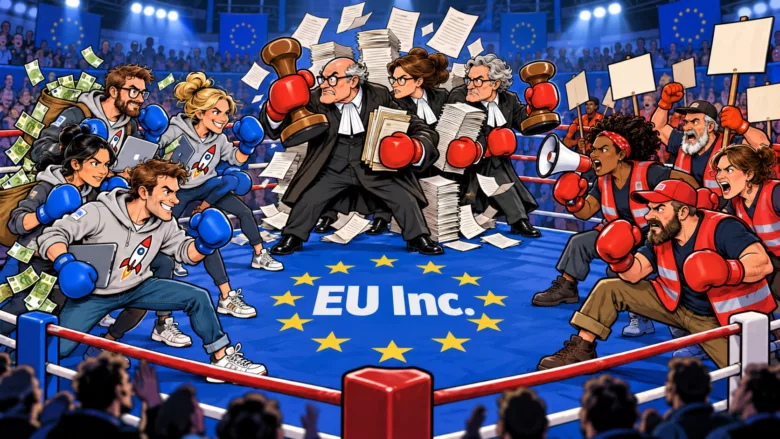
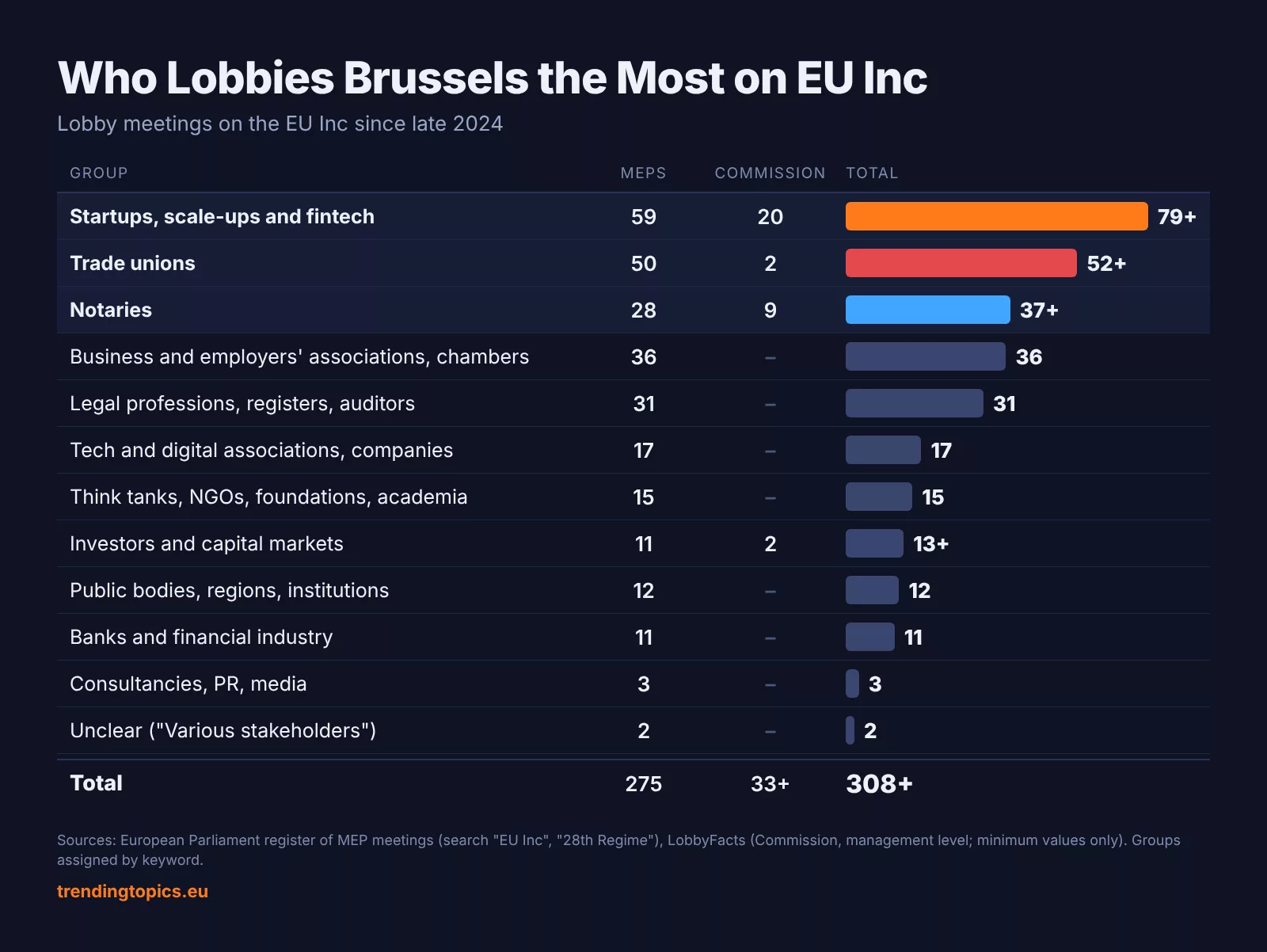
What start-ups criticize as dilution does not go far enough for labor representatives. The European Trade Union Confederation demonstrated against the EU Inc in Brussels in September. Unions fear that companies could use the new legal form to circumvent national labor and social standards and criticize the lack of binding safeguards for collective bargaining, union rights and worker participation. Notaries also lobbied heavily ahead of the decision, warning of straw-man incorporations and money laundering. In total, Trending Topics counted more than 300 lobby meetings on the EU Inc, led by start-ups (at least 79 meetings), unions (at least 52) and notaries (at least 37).
Now It’s Parliament’s Turn
Before trilogue negotiations can begin, the European Parliament has to agree on its own position. Lawmakers there are still divided: The Legal Affairs Committee recently canceled a planned vote on a compromise because of the dispute over employee participation, Table.Briefings reported. The rapporteur is René Repasi, a German Social Democrat. The Startup Association is pushing for speed so that negotiations can be concluded this year. The coming weeks will decide whether the EU Inc becomes the breakthrough Europe needs or joins the list of missed opportunities, Mr. Stresing said.