Fonio CEO Daniel Keinrath: “We Need to Get Rid of Notaries”


Set Trending Topics as a preferred source on Google.
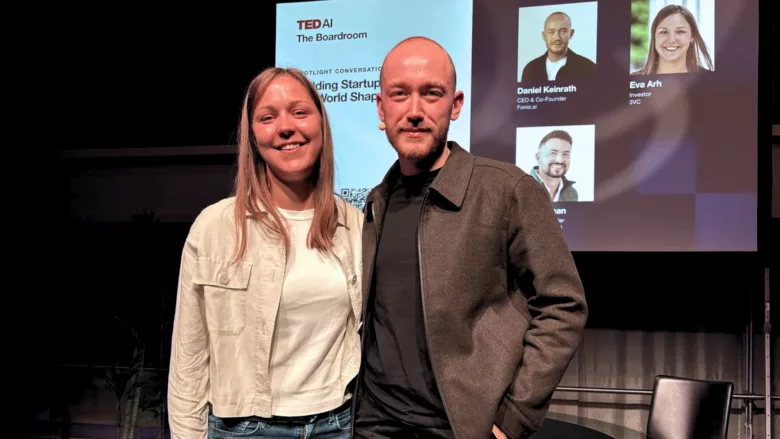
Fonio is the AI startup of the year in Austria and beyond, and you can say that with confidence already. So it is no surprise that it drew a crowd at the TEDAI conference in Vienna this week. In a stage conversation with moderator Vlad Gozman and Eva Arh, general partner at the Vienna-based fund 3VC, Fonio CEO Daniel Keinrath talked about building AI companies, and he shared plenty of detail on his business model, key metrics and growth.
From Bootstrapped Product to $19 Million in ARR
Fonio builds AI phone agents for small and medium-sized businesses. According to Keinrath, the company started about two years ago, was bootstrapped for a long time and grew from a bit more than $1 million in annual recurring revenue (ARR) at the beginning of the year to $10 million in the summer. On stage he put the current figure at $19 million, with $250,000 to $300,000 in ARR added every day and $30 million or more possible by year-end. All figures come from the company and have not been independently audited. Trending Topics previously reported on the jump to $10 million in ARR and the climb to $15 million in 60 days. The growth is funded by a seed round of 14.6 million euros led by 20VC, preceded, as Keinrath says, only by a $3 million angel round.
The surge followed a rebuild mid-flight. At the start of the year, Fonio switched from usage-based billing to subscriptions. “We’re going to do it anyway, at the risk that the company would die,” Keinrath recalls. “I don’t f***ing care, we need to nail this.” In parallel, he brought in local founders for several markets and gave each of them $150,000 in budget. Today more than half of revenue comes from outside the home markets, even though the first new market opened only in spring. The team grew from eight people at the start of the year to about 140.
The Moat: Speed, Volume and Margin
When software gets cheaper in the age of vibe coding, investors ask about the moat first, says Keinrath. “It is easier than ever to start a company.” But, he adds, “if you just throw something together, you essentially have zero” moat. He named two levers: product velocity, and brand and market presence, meaning being the loudest voice in the room, paired with unit economics that put pressure on competitors. On speed he leaves no room: “You just need to be faster [than everyone already is], and you can’t be late for a single month.”
Fonio also builds its own margin. Telephony initially ran through providers such as Twilio. Later the team built its own infrastructure and signed deals directly with telecom carriers. A minute now costs about 1.7 cents, he says, and is sold for 8 to 10 cents, while the market often sits around 25 cents because providers add their margin on top of model and infrastructure costs. Pricing follows outcomes. Keinrath deliberately wants many users in the product, which rules out per-user pricing.
Arh added the investor view: starting a company has become easier, picking the winners harder. The question is whether a company will still matter in five to ten years, and that comes down to execution, speed and brand building. Seat-based pricing will come under pressure over time because AI reduces headcount at customer companies. The trend points toward outcome-based pricing, where customers pay for finished work, along with usage-based and task-based models.
Churn, NRR and the 100-Minute Rule
Keinrath was open about metrics. Fonio’s churn is concentrated in the first month, for instance because customers never activate the agent or their callers do not want to talk to an AI. After six months, there are almost no departures. Customers who use more than 100 minutes a month rarely leave later, which makes usage the best early indicator in his view. Net revenue retention (NRR) most recently stood at 99 percent, and the goal is above 100 percent through upselling new products. Enterprise companies often reach 120 to 150 percent. Why he looks at product numbers despite the growth frenzy: “Short term you can pump up the company with revenue, but the product numbers never lie. Someday you will get the receipt for what you’re doing.”
Arh stressed that how meaningful churn is depends on the go-to-market model. With fast sales cycles, what counts is whether individual segments stay for good. With enterprise customers, long cycles and high acquisition costs make retention weigh more, and the market there has become louder and harder.
Why Fonio needs so many people despite an AI product, Keinrath explains with the customer base: “They are so non-technical that they just need to talk to a human for like 30 minutes before they buy. […] You just need a lot of humans.” In one week, he says, about 1,500 such demos were on the calendar, across 11 markets by now.
Small Teams, Big Names
Fonio relies on very experienced engineers. “90 percent of our engineers actually were CTOs and co-founders before. And they work in very small teams, often just like two people on one product,” says Keinrath. The output matches that of “a team of like 20, maybe 50 people.” Each team has its own usage and revenue targets, and there are no hierarchy layers filtering customer knowledge. According to Keinrath, the teams work like mini-companies inside the company.
When OpenAI and Others Come Calling
The competition is massive. In voice, enterprise providers such as Parloa and PolyAI compete alongside platforms such as ElevenLabs. A market analysis by Sacra also points out that phone system and software vendors such as RingCentral can bundle an AI receptionist as an add-on, since they already own the phone number and the customer relationship.
Arh and Keinrath see the risk too: building on top of the big models always carries the danger that a lab builds the product itself. In the consumer mass market, an 80 percent solution from the labs could be good enough. With large customers, Keinrath says, forward-deployed engineers who integrate on site win the day, something the labs find hard to match. He also points to inertia: many companies simply want a solution that works.
Europe: Notaries, Taxes and Dollars Flowing Overseas
After an earlier startup, Keinrath first moved to the US, where he saw the best conditions for building a company. Today he builds from Vienna again, and he explains why with a role model from Sweden: a company that grew into one of the largest in the world and whose early employees went on to found more companies in Stockholm. That, he hopes, will repeat itself in Europe in the AI era. “The only thing that Europe really lacks is actually this ambition to think and change,” says Keinrath.
Why Europe has to get stronger? Because every company that uses AI otherwise sends its efficiency gains to US corporations. “And do you want U.S. companies to own the communication of potentially Europe?” he asked. If providers like Fonio see the communication data of thousands of companies, that data should sit in Europe, he stressed. Fonio does not sell or share data.
He named two brakes in concrete terms. The first is sluggish company formation and shareholder processes: “We need to get rid of [notaries]. […] Every time you do something like a decision with a shareholder, it takes long. […] In this hyper growth game, in four weeks we’re a different company.” The second is employee equity. Virtual shares are a workaround in Europe: Keinrath cannot give employees a real percentage of the company, only an agreement that it is deducted from the purchase price at an exit and paid out. Employees would then pay around 55 percent in taxes, he says, while founders pay around 27 percent. “It’s truly unfair,” he says, “[unfair] to everyone who works at [startups] in Europe,” and a clear disadvantage in the race for top talent against US firms.
Keinrath’s demand has a current backdrop: Brussels is negotiating the EU Inc, an optional European legal form that would let startups incorporate quickly and digitally, without a notary under the Commission’s proposal. But that core is being watered down in the negotiations, according to its backers. The EU-INC initiative around Austrian investor Andreas Klinger recently warned in an open letter to Europe’s heads of state and government that the EU Inc the governments themselves had backed “no longer exists.” What remains is a faster way to start a company, and that is too little. Unions and notaries take issue above all with the free choice of registered seat, and they have lobbied the institutions intensively.
Arh welcomes founders who aim at all of Europe, though she understands the move to the US as well. Both, she says, matter in the long run.