Germany now Europe’s “Crypto Valley,” Holding the Most MiCA Licences



Set Trending Topics as a preferred source on Google.
A decisive deadline arrives this week for a large part of Europe’s crypto industry. When the MiCA transition period expires on 1 July 2026, every provider that has not obtained a proper licence under the EU’s Markets in Crypto-Assets (MiCA) regulation by then loses its authorisation to operate. Any firm that continues to offer crypto services to customers in the European Economic Area (EEA) without authorisation after that date is no longer doing so legally.
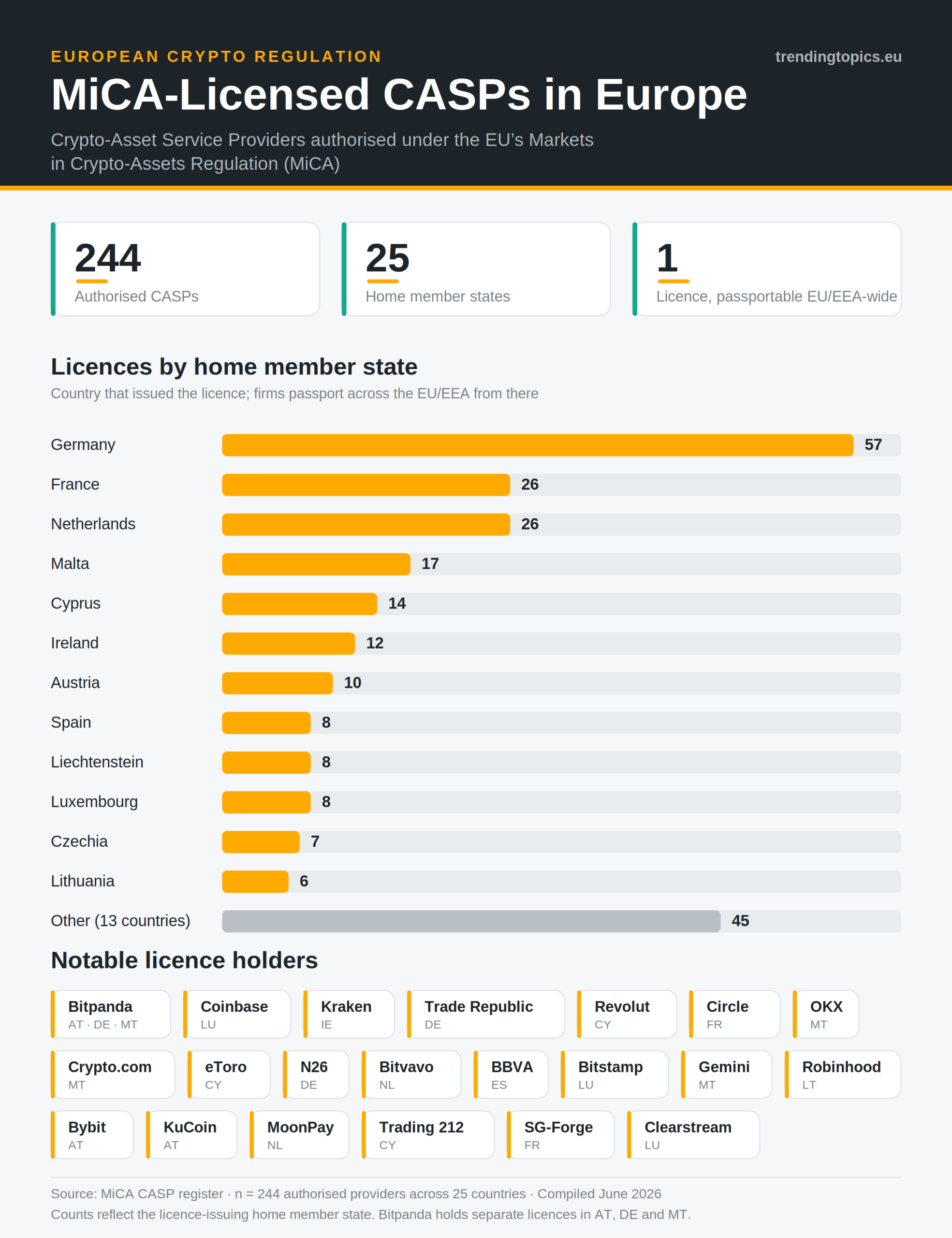
244 CASPs instead of 3,000 VASPs
The figures show the scale of the shake-out. Before MiCA, Europe was estimated to have more than 3,000 registered Virtual Asset Service Providers (VASPs) — Poland alone accounted for well over 1,400 registrations. Today, by contrast, only 244 MiCA-authorised Crypto-Asset Service Providers (CASPs) across 25 countries are listed in the official register maintained by the European Securities and Markets Authority (ESMA).
MiCA first took effect on 30 June 2024 with rules governing stablecoins; the full body of regulation followed six months later. Firms with existing national registrations were allowed to keep operating until 1 July 2026 (“grandfathered”). A MiCA licence is issued by a national regulator and — through so-called passporting — permits operation across the entire EEA, meaning the 27 EU member states plus Norway, Iceland and Liechtenstein.
ESMA, the EU’s securities watchdog, has already called on unauthorised providers to wind down their business in an orderly manner while safeguarding the interests of their customers.
Market clean-up or brake on innovation?
How many firms will actually disappear remains unclear. Erald Ghoos, CEO of OKX Europe, expects that around 80 percent of crypto players will not survive the transition. He attributes this not to MiCA alone but to the combined weight of European regulatory requirements: anyone wanting to handle stablecoins, for instance, also needs a payment-institution (PI) or e-money-institution (EMI) licence. Several firms, Ghoos said, have already asked OKX whether it would acquire them because they cannot bear the compliance costs.
The assessment allows for two readings. On the one hand, MiCA is doing exactly what regulation is meant to do: raising the bar and filtering out providers that cannot meet it. On the other, there are concerns that compliance costs are squeezing out smaller companies and stifling innovation.
The best-known licence holders by country
Germany leads the field by a wide margin — largely because numerous banks and brokers applied early for BaFin authorisation. The most important licence holders at a glance (country, total number of licences granted, best-known names):
- Germany (57): Trade Republic, N26, Commerzbank, Scalable Capital, Boerse Stuttgart Digital, Bitpanda Asset Management, BitGo Europe
- France (26): Circle, Société Générale-Forge, SwissBorg, Coinhouse, Deblock, Bpifrance
- Netherlands (26): Bitvavo, MoonPay, BTC Direct, Coinmerce, Vivid Money, ClearBank
- Malta (17): OKX, Crypto.com, Gemini, Bitpanda, Blockchain.com, Gate
- Cyprus (14): Revolut, eToro, Trading 212, capital.com, Trading.com
- Ireland (12): Kraken, Ramp Network, Skrill/NETELLER, Interactive Brokers, CoinJar
- Austria (10): Bitpanda, Bybit, KuCoin EU, WhiteBIT EU, 21bitcoin, Coinfinity
- Spain (8): BBVA, CaixaBank, Openbank, Bit2Me, Cecabank
- Liechtenstein (8): LGT Bank, Bank Frick, Bitcoin Suisse (Europe), Wyden Capital, RULEMATCH
- Luxembourg (8): Coinbase, Bitstamp, Clearstream, Swissquote, Banking Circle
- Other countries: among others Robinhood (Lithuania), Safello (Sweden), Firi and K33 (Norway), Kriptomat (Croatia), Coinmotion (Finland), as well as LHV Pank and Lightyear (Estonia)
While established exchanges such as OKX, Coinbase, Kraken, Bybit and Crypto.com — along with European fintechs like Bitpanda, Trade Republic and Revolut — have made the leap into the regulated market, some global heavyweights are still missing from the register. Binance, for example, says it has begun the application process, and Bitget filed a CASP application with Austria’s Financial Market Authority (FMA) in June 2026 — but as of now neither is among the authorised providers.