Germany’s Neura Robotics Launches Its Own A.I. Model for Robots


Set Trending Topics as a preferred source on Google.
A robot that can only see is half blind: Neura Robotics, based in Metzingen, Germany, has just unveiled Neuron AI, its own A.I. model for its robots, which uses touch, hearing and memory in addition to cameras. The model was developed and trained entirely in Germany. With it, the robotics unicorn is betting on its own brain for its machines while the big U.S. tech companies position their own robotics models. Just recently, Google introduced Gemini 4 Argon, a model that is also meant to control robots.
Seeing, Feeling, Hearing, Remembering
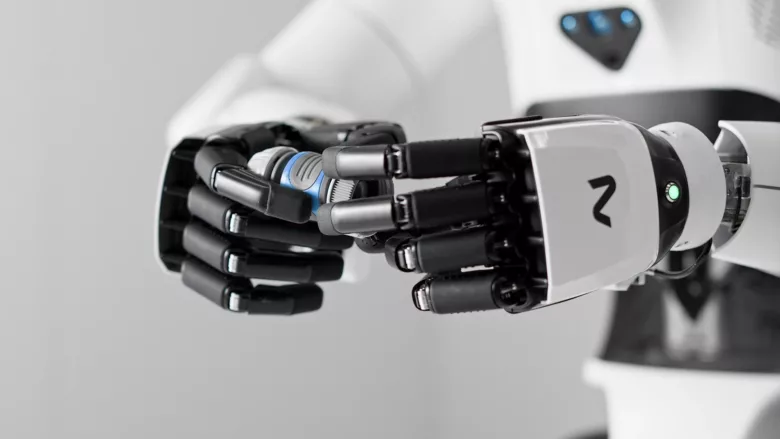
Neura calls the architecture a perception-language-action model (PLA). It processes 3D images, touch and force data, sounds, the robot’s own state and language together and translates them directly into movements. The idea behind it: Cameras capture shape, color and position, but not touch or force. When a robot opens a lock, only the click and the tangible resistance reveal that it is really open. A welding robot is meant to hear whether the seam is coming out right.
Memory is also new. Neuron AI is designed to remember objects that have moved out of view and to keep track of the consequences of its own actions over longer periods. “An intelligent robot needs a brain that brings its senses together and remembers what has happened,” said David Reger, Neura’s founder and chief executive.
The model is trained on three sources of data:
- Real robot data: Robots perform tasks in Neura’s training halls, the so-called Neura Gyms, and in real-world environments, producing synchronized data on vision, touch, force, sound and movement.
- Simulations: A simulation environment generates additional variations of tasks and environments.
- Human movement: People wearing suits packed with sensors record typical everyday movements.
The goal is a single model that works for all Neura robots, across five form factors and with different grippers and hands. Customers can train Neuron AI on their own tasks through the Neuraverse platform and roll out new skills to entire robot fleets. Neura names “time-to-skill” as its most important metric, meaning how quickly a robot reliably learns a new task. Next week, at Nvidia’s GTC developer conference in Berlin, Neura plans to show its humanoid robot 4NE1 spending 11 minutes fully autonomously sorting laundry, loading the washing machine and then moving the laundry to the dryer.
Why a Model of Its Own Matters
With Neuron AI, Neura is making itself less dependent on the A.I. models of the big U.S. companies. That is not a given in robotics: The Munich-based company Agile Robots, for example, relies on a partnership with Google DeepMind for its industrial robots. Companies that source the brains of their robots from another provider give up some control over further development, pricing and data.
Data in particular is a sensitive issue in industry. Neura trains with data partners including Schaeffler and Bosch, and according to Neura, customers can keep their process know-how to themselves. If they choose to share skills or deployment data, these feed into future models. Neura argues that Germany’s industry, with its complex manufacturing processes, offers the right environment for such a model.
Neura is not entirely on its own, however. Nvidia and Amazon took part in its Series C round of up to €1.2 billion, which the stablecoin company Tether led in the middle of the year. Media reports put the valuation at about €6 billion. Neura has also not published any benchmark results for Neuron AI, so an independent comparison with other robotics models is still pending.
Google, Nvidia and Others: The Competition
The competition is large and well funded. Google recently made its new flagship model, Gemini 4 Argon, widely available and at the same time presented it as a model for robotics. Argon is designed to control robots directly, build simulations from camera footage, videos of people or even hand-drawn sketches, and let robots practice in those simulations. On the ERQA benchmark, which tests spatial reasoning in 3D environments, Argon scores 87 percent, according to Google, putting it ahead of all other frontier models. In one test, Argon watched a person play cornhole and taught the movements to a humanoid robot from Apptronik, which then sank seven throws in a row.
There is also a whole range of other robotics models:
- Nvidia: Isaac GR00T for humanoid robots and the Cosmos world models, both openly available.
- Physical Intelligence: The U.S. start-up is developing its π series of models, which are meant to control a variety of robots.
- Figure AI: The robotics start-up built its own model, Helix, and dropped OpenAI in the process.
- Skild AI: The U.S. start-up is building Skild Brain, a model meant to run on very different robot bodies.
- Tesla: It controls its humanoid robot Optimus with its own model, which is not publicly available.
Competition is growing in Europe, too. The Paris-based start-up Genesis AI develops foundation models for general-purpose robots, and Nvidia has just invested in it.