Nvidia Takes Stakes in Doctolib, Pigment, Genesis AI and Entalpic


Set Trending Topics as a preferred source on Google.
Jensen Huang brought his checkbook to Paris: Nvidia is investing in four French tech companies, including the health care scale-up Doctolib. The chipmaker announced the deals in a blog post about its activities in France. Besides Doctolib, the investments go to the robotics specialist Genesis AI, the planning software maker Pigment and the materials research start-up Entalpic. Neither Nvidia nor the start-ups disclosed how much money is involved or how large the stakes are. According to Les Echos, they are minority stakes.
The Four New Investments
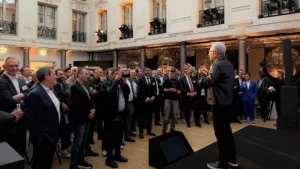
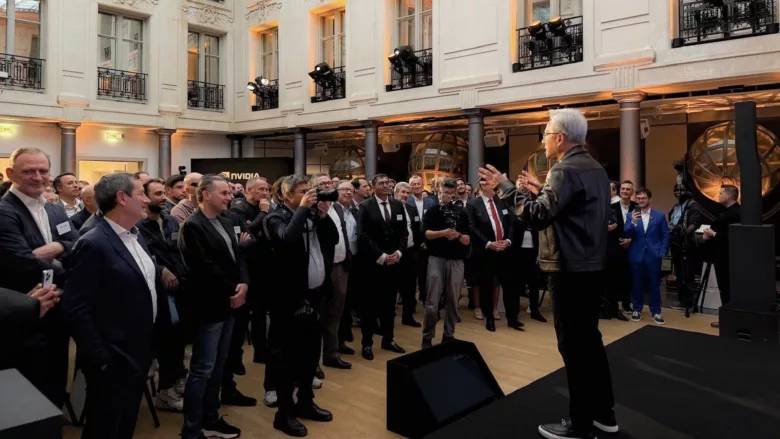
Mr. Huang announced the deals at a reception on Place Vendôme, which France’s economy minister, Roland Lescure, also attended. The four companies cover very different fields:
- Doctolib: The medical appointment platform was valued at €5.8 billion in a 2022 funding round. Doctolib now builds A.I. agents that take work off doctors’ hands and a digital health companion for patients. According to Doctolib, Nvidia’s investment is meant to support its work on these A.I. tools.
- Genesis AI: The robotics start-up, with offices in Paris and the San Francisco Bay Area, develops foundation models for general-purpose robots, along with simulation software and its own hardware. It was founded by Zhou Xian and Théophile Gervet, a former Mistral researcher. In 2025, Genesis AI raised a $105 million (about €93 million) seed round, and in the summer, Bloomberg reported talks to raise about $500 million (about €445 million) at a valuation of roughly $3 billion (about €2.67 billion).
- Pigment: The Paris-based software helps companies with financial planning, forecasts and scenarios and is seen as a challenger to Excel. Pigment was founded by Eléonore Crespo and Romain Niccoli, a former chief technology officer of Criteo, and its customers include Unilever, Datadog and Kayak. Pigment last raised $145 million (about €129 million) in a Series D round in 2024.
- Entalpic: The Paris start-up uses A.I. to develop new materials at the atomic scale, for example for semiconductor manufacturing and next-generation electronics. In 2024, Entalpic raised a seed round of €8.5 million.
$10 Billion for Europe
Nvidia is no newcomer to the French ecosystem. The company already holds stakes in the quantum computing start-up Alice & Bob, the audio A.I. start-up Gradium and the photonic chipmaker Scintil Photonics. In total, Nvidia says it has committed nearly $10 billion (about €8.9 billion) to Europe’s tech ecosystem.
Paris was only the first stop on a European tour that will also take Mr. Huang to London and Berlin, where Nvidia’s GTC developer conference takes place next week. Within a week, Nvidia plans to announce another $2 billion (about €1.78 billion) in European deals, on top of the $8 billion (about €7.12 billion) it invested over the past year, The Next Web reported. “Europe needs to get in the race,” Mr. Huang said in Paris. His prescription is open A.I. models, which he described as cheaper and more adaptable.
Corporations as Major Investors
Other corporations are also buying into Europe’s A.I. scene. At Mistral, France’s A.I. champion, Samsung most recently led a €3 billion round that values the company at more than €21 billion. The previous round had been led by the Dutch chip equipment maker ASML.
Criticism of Nvidia’s Investments
Nvidia’s investments have also drawn criticism. Critics accuse the company of circular financing: Nvidia invests in A.I. companies, which in turn use the money to buy Nvidia chips, blurring the line between investment and revenue. Large deals such as those with OpenAI and CoreWeave are cited most often. The International Monetary Fund has also warned of increasing circular financing along the A.I. value chain. Mr. Huang rejects the accusations, saying the investments are too small relative to the business they generate and that each one stands on its own merits. “In A.I., compute is revenue,” the Nvidia chief said.