GPT-6.1 Sol: Nearly as Smart as Astra at a Fraction of the Cost


Set Trending Topics as a preferred source on Google.
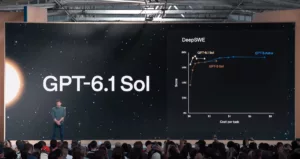
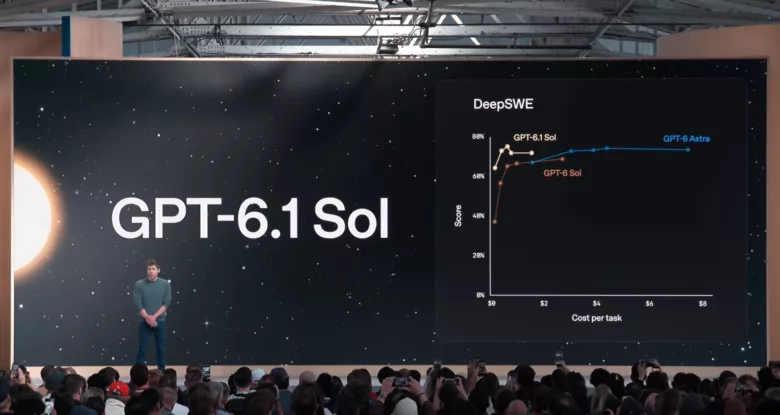
OpenAI had to halt its Astra update, so it is shipping the cheap model instead. At DevDay, OpenAI unveiled GPT-6.1 Sol, which according to the announcement delivers “near-Astra intelligence” for coding, computer use and professional work at one-fifth of GPT-6 Astra’s API prices. The independent testers at Artificial Analysis largely confirm this: Sol trails Astra by just one point but costs less than a quarter as much to run.
One Point Behind Astra
In the Intelligence Index from Artificial Analysis, which combines dozens of benchmarks into a single score, GPT-6.1 Sol reaches 52 points at maximum reasoning effort. That is four points more than its predecessor, GPT-6 Sol, which is only a week old, and one point below GPT-6 Astra. Among the 222 models tested, that puts it in 10th place.
The key figures from the evaluation:
- Cost per task: Running the index costs $0.72 (about 0.62 euros) per task with Sol, compared with $3.26 (about 2.79 euros) with Astra. That makes the new model 31 percent cheaper than GPT-6 Sol.
- Coding: In the Coding Agent Index, Sol at the second-highest reasoning level even beats Astra by one point, for less than 15 percent of the cost.
- Individual benchmarks: Sol gains 12 points on Terminal-Bench, 5 on Humanity’s Last Exam and 5 on the office-work test GDPval-AA.
- Hallucinations: The rate on the AA-Omniscience knowledge test drops from 60 to 54 percent. That is an improvement, but the model still makes something up in more than half the cases where it does not know the answer.
- Speed: At around 68 tokens per second, Sol is slightly slower than average, according to its model page.
Same Token Price, Cheaper Cache
According to the OpenAI documentation, GPT-6.1 Sol costs $2 (about 1.71 euros) per million input tokens and $10 (about 8.55 euros) per million output tokens in the API. Astra costs $10 and $50 (about 8.55 and 42.74 euros). The token price is the same as for its predecessor, GPT-6 Sol, whose prices OpenAI recently cut in half. Only the cache gets cheaper: previously processed input costs $0.10 per million tokens, 95 percent less than standard input. The context window exceeds one million tokens.
In ChatGPT, Sol is available on all paid plans from Plus to Enterprise, but for now only in ChatGPT Work and Codex, not yet in the regular chat. In its safety report, OpenAI rates the model as “Critical” in cybersecurity and “High” for biological and chemical capabilities.
Anthropic Leads, but Costs More
Anthropic remains at the top of the ranking. According to Artificial Analysis data, Claude Opus 5.5 scores about 58 points and Claude Sonnet 5.5 scores 56. Sonnet recently overtook GPT-6. Per token, Sonnet 5.5 and GPT-6.1 Sol cost the same, according to Anthropic. But because Sonnet uses far more tokens, a task on the index costs about $7.60 (about 6.50 euros), more than ten times as much as with Sol. Opus 5.5 comes in at $5.98 (about 5.11 euros). Google’s best model in the ranking, Gemini 3.8 Flash, scores about 41 points.
A Stand-In for the Halted Astra Update
The timing is no coincidence. Just on Monday, OpenAI cancelled the release of GPT-6.1 Astra because the model did not reliably stay within the scope and authorization of its tasks in internal tests. With Sol, OpenAI still had a new 6.1 model to show at DevDay.
On Hacker News, where the announcement reached the top spot with more than 850 points, developers see it mainly as a sign of a price war. “Ominous for the industry and investors that token price is becoming the main battleground,” one comment in the thread read. Others consider the cache pricing the real news, because it makes working with Codex much cheaper. And some remain skeptical: GPT-6 Sol was so disappointing, another commenter wrote, that they had switched to Opus 5.5 entirely.