Hansi Hansmann’s New Family Office Launches With €150M AUM


Set Trending Topics as a preferred source on Google.
For more than 15 years, Hansi Hansmann shaped the Austrian startup scene as a business angel. Now, together with Lisa Pallweber, he is evolving the Hans(wo)men Group into the Hansmann Family Office. Beyond venture capital, the investment strategy will in future also encompass private equity, real estate and public markets, complemented by a philanthropic pillar. In this interview, the two discuss the evolution of their strategy, their long-term orientation, and why entrepreneurship, for them, goes far beyond investing.
Was there a concrete trigger for the shift from the Hans(wo)men Group to the Hansmann Family Office? Or is this the logical, organic evolution from a one-man show to a team?
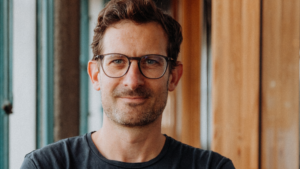
Hansi Hansmann: There wasn’t a single trigger. But we noticed that our activities had long since become broader: we no longer invest only in venture capital, but are also interested in private equity, profitable companies, and basically everything that has to do with entrepreneurship. The Hans(wo)men Group primarily represented our lead investments in the startup space. But a lot more grew up around it that was never visible under that brand.
So externally we wanted to show more clearly: we’re not just the business angel Hansi Hansmann or a super angel, but a professionally structured family office with several asset classes. We think long-term and are building an organization that doesn’t hinge on a single person. When we buy an apartment building in Spain, that doesn’t happen under the Hans(wo)men Group brand either. There are legal entities for that, but they’re part of something larger.
Whether we should call it the Hansmann Family Office wasn’t a given at first. At the same time, we wanted to benefit from the existing brand. A completely new name would have needed a year or two to establish itself. With the name Hansmann, people immediately know what we stand for.
Is there a family office in Europe you look to as a model?
Lisa Pallweber: There’s no specific role model. But we’re in a lot of exchange with other family offices, and in Europe we see many first-generation family offices: these often emerge from founders with large exits who think about how they want to manage their wealth actively and responsibly.
It’s not about pursuing a purely passive strategy, investing exclusively in ETFs and waiting. It’s about deploying capital entrepreneurially: through startup investments, but also through philanthropic themes and the question of what kind of influence you want to have in the world with your capital. In Germany there are already a number of such structures, and they’re increasingly emerging in Austria too. We don’t want to reinvent the wheel, but we bring a very entrepreneurial perspective.
It makes a difference whether wealth was built up oneself and is invested with an entrepreneurial approach, or whether it’s primarily about preserving inherited wealth as conservatively as possible. Whether our approach already exists in exactly this form — especially in combination with entrepreneurial philanthropy — we don’t know. We may actually be defining something new there.
The Hansmann Family Office spans four areas: venture capital, private equity, real estate and philanthropy. Is each area staffed with its own manager?
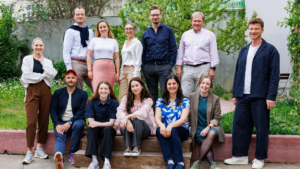
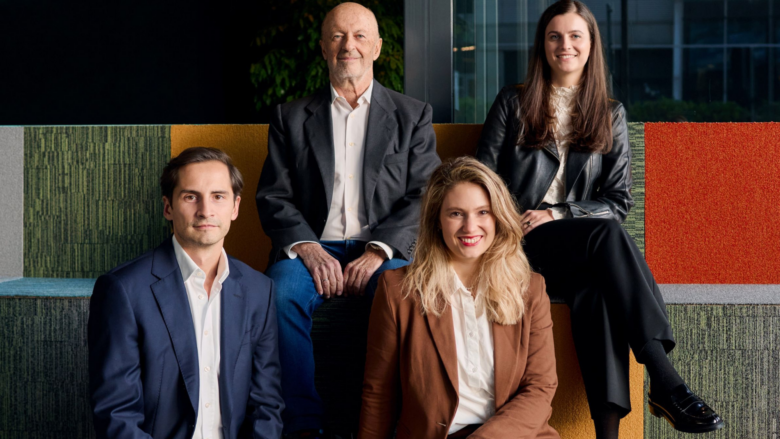
Lisa Pallweber: We continue to do this with a small team: Hansi, Laura, Andrei and me. The largest share of our time still goes into startups. Private equity we currently represent mainly through co-investments, where we can put our existing investment skills to good use.
Real estate in Spain is currently actively managed by a long-standing trusted associate on the ground; in Austria we’ll work with other partners. Philanthropy, which is very close to our hearts, we want to build up entirely in-house. Our ambition is to treat it as professionally as a startup investment: a strong focus on the people involved (the team), with clear goals and KPIs, ongoing exchange and measurable impact. Hansi, for example, sits on the advisory board of the Stiftung Unternehmerische Zukunft (Foundation for an Entrepreneurial Future).
Venture capital includes direct investments and fund investments. Can you name examples of funds people might not know?
Lisa Pallweber: One example is Sarona Ventures from Israel, a fund that originally grew out of the investments of the Deel founders’ family office. Thanks to that network, the fund has very good access to dealflow and invests primarily in founders from Israel who are building tech companies in the US.
Hansi Hansmann: The thinking behind it is what matters. We don’t make fund investments primarily for the expected returns; in our own portfolio the returns are often better than with funds. But with direct investments we can’t cover everything. There are verticals that are exciting and to which we want direct access. And there are geographic ecosystems like the US or Israel where we say: we want to be involved, but not necessarily invest directly.
In Austrian funds we’re invested with many of the relevant managers. The Emmi transaction, for example, was interesting for us precisely because we’re LPs in all three large Austrian funds. So we were indirectly involved several times over. In Israel we have access through the VC fund mentioned above. The ecosystem there is exceptional; I can only recommend that everyone take a look at it once. On top of that there are funds in the UK, the US and Germany. In total we’re currently invested in around 25 individual funds.
Do you want to expand that further — toward 30 or 40 funds?
Lisa Pallweber: Tendentially yes, but opportunistically. We look for very good general partners (GPs) who have a defensible advantage in a particular niche and can generate above-average returns there. That’s why we tend to invest smaller tickets and prefer smaller funds, especially emerging managers with a very specific focus. Very large, generalist funds with broad diversification are not our focus.
Access to funds also has strategic advantages for our own startups. When we’re an LP in a fund, we often have better access to those investors in follow-on rounds. We maintain good relationships with the GPs and make intros for fundraising to other family offices.
Critically, though, one has to say: in almost all the funds we’re invested in, the DPI — the capital actually returned — is still very weak. We still see great potential there, but so far it’s all playing out only in book values.
Hansi Hansmann: The word “exit” gets used far too loosely anyway, including by the media. The acquisition of Emmi by Mistral was fantastic and opens up enormous potential. But I wouldn’t call it an “exit”; it’s merely the switch from one hope to the next — from the hope Emmi to the hope Mistral. Until Mistral goes public (and then probably another one to two years of lockup for the investors), the investors won’t see any cash, apart from possible secondaries. Until then we’re just pleased about a high book value.
To sum up: funds provide breadth and diversification, direct investments remain the larger tickets — but in future with somewhat fewer deals?
Lisa Pallweber: The ticket sizes basically stay similar; the number of investments might decline somewhat. Currently we do about three to four lead investments per year plus a handful of co-investments. In future it will become slightly fewer, so we can place more focus on the lead investments.
That’s precisely where our big advantage over a classic VC fund lies: we normally stay in until the very end and participate at least pro rata in every round. A fund often can’t do that, because its investment period ends after four or five years. Once the money is exhausted, it can’t even bridge anymore. Especially with good companies that temporarily need bridge financing, some funds then decline. That’s very difficult for the startups, because it leads to worse terms. When all investors can participate, the terms are usually significantly better. As soon as someone with a ten percent stake can no longer or no longer wants to participate, down rounds quickly arise and in the end the founders suffer. Family offices that can top up over the long term and flexibly have a clear strategic advantage here.
On private equity: how do you approach it?
Lisa Pallweber: We cover PE primarily through co-investments. We generally want to invest directly and go less through funds. At the same time, in private equity we don’t yet have the network to structure transactions ourselves. That’s why we invest together with other befriended family offices that have a track record and experience in this area and go into the deals with their own capital.
For us that’s a good compromise: we’re active and close to the action, but we don’t have to originate and structure the deal ourselves. In the medium term I can imagine bringing someone into the team who deals exclusively with private equity.
Hansi Hansmann: One mustn’t forget: we’ve been investing in startups since 2010. Not all of them had an exit, and not all of them shut down. Some have remained in the portfolio as solid SMEs. They no longer grow exponentially, but develop stably and well. That’s essentially nothing other than a private equity investment that has grown out of the venture space.
You also invest in public markets. How do you think about the stock market and ETFs?
Lisa Pallweber: We have a public-market strategy, but we don’t even want to outperform the market there. The goal here is to capture the market performance: a relatively plain-vanilla, very low-cost, long-term-oriented ETF portfolio. No active trades, no experiments.
Hansi Hansmann: The share is relatively large especially at the beginning. When you have a certain amount of liquid capital, you don’t invest it fully into private markets within three weeks. You spread it over the next four or five years, until returns start coming in. In the meantime a portion sits in public markets. We also need liquidity at all times. When a company requires a large ticket or we want to pursue a new investment opportunity, we have to be able to free up funds. At the same time we don’t want to sit on very much cash permanently.
We hold the whole thing in our own, personalized fund in which only we are invested. That allows us to adjust the allocation, take on more risk or become more conservative.
With real estate it sounded as though it isn’t the most exciting topic for you, Hansi. You do it anyway. Why?
Hansi Hansmann: Real estate is rarely a complete write-off. The tangible value remains. It’s a very long-term, comparatively safe investment — provided you don’t take on too much debt. A house can be worth more or less, but the land and the building remain. If it’s rented out, you also get rental income, so a very reliable, regular cash flow. It doesn’t produce huge returns, but there’s the additional chance of value appreciation and hidden reserves. Over the long term, the property market has risen in many regions; some of the largest fortunes in the world are real estate fortunes.
Personally, real estate never burningly interested me. In Spain it came about almost out of a lunch whim with very good friends. By now we have a nice portfolio there: several apartments, a small hotel, an event venue and storage space that we rent out — all owned outright. Spain is a natural fit because I lived there for a long time and have very good contacts and friends. I don’t have relationships like that in any other country.
But we’ll also invest in Austria. By comparison, the Spanish market is still considerably more attractive on entry and renovation prices, while the rental income is quite comparable. As a family office you’re well advised anyway to hold part of your wealth in real estate if you do it roughly by the textbook.
A large part of the strategy is philanthropy — and it’s heavily fed by the Tractive exit. How do you approach it?
Lisa Pallweber: We see philanthropy as part of the overall strategy and approach it similarly to our startup investments. We look for the right people, strong personalities we trust to lead a project to a positive outcome. We accompany these projects with regular updates, look at KPIs and discuss the achievement of goals together. The “exit” here is not an economic sale, but the targeted impact achieved.
Hansi Hansmann: We’ll make philanthropic contributions in the seven-figure range annually.
Lisa Pallweber: We have three focus areas. First, entrepreneurship and entrepreneurial education — which is why we’re heavily involved in the Stiftung für Unternehmerische Zukunft. Second, climate competence, where we work closely with Kontext, the Institute for Climate Issues, and want to get even more involved in future. We also support Ashoka’s Changemaker programme, which helps young people solve societal challenges through social entrepreneurship.
Alongside that there are smaller engagements such as Conxious. We continue to support Female Founders, because gender equality is an important topic for us. On the philanthropic level, it’s primarily about the position of women in society.
How much in assets under management does the Hansmann Family Office have in total?
Hansi Hansmann: The Tractive sale didn’t change that dramatically, because we had already carried the value as a book value in the portfolio beforehand. Roughly, it’s around 150 million euros.
The exact breakdown is a bit delicate, because there’s currently a large cash share that I don’t want to put a figure on. What isn’t cash is for the most part still venture capital — both startups and VC funds. In funds we’re clearly overweight. Real estate in Spain is in the single-digit millions of euros, private equity currently still somewhat below that, but it’s meant to be built up.
Venture capital, in my view, should long-term not make up more than 50 percent; otherwise it’s not healthy. That’s where we want to go: VC under 50 percent, plus roughly a quarter each in private equity and real estate. Public markets aren’t even factored into that and, given the cash share, currently also make up a relevant part.
So the Tractive exit brought in the largest cash share?
Hansi Hansmann: Yes, that was my largest cash exit to date — even bigger than Busuu. And Busuu was already big.
Does the Hans(wo)men Group disappear — the one where the “wo” was deliberately introduced to make female founders visible?
Lisa Pallweber: No, the Hans(wo)men Group remains — as the group for our lead investments of around 25 to 30 companies. The Hansmann Family Office is the umbrella brand above it, of which the Hans(wo)men Group is a part. Both brands are clearly connected, and that’s important to us.
The female topic isn’t lost in the process. We continue to invest in diverse founding teams, and on the philanthropic level we explicitly want to strengthen gender equality. So the topic runs through our philosophy on several levels.
Is the Hansmann Family Office its own GmbH?
Lisa Pallweber: No. It’s not a legal entity, but the umbrella brand under which several legal entities are grouped.
To close, a look at the market: is there something that particularly preoccupies you right now?
Hansi Hansmann: When you happen to have cash, the big question is what to do with it. The markets are incredibly high, in some cases at absolute record levels. Every disaster headline sends the market down five percent, and a few days later it rises ten percent again. If you don’t invest now, you might miss the next 30 percent upside. If you invest, the crash might come at exactly that moment.
And the crash will come at some point — of that I’m convinced. I reckon with 30 to 40 percent. Rationally I can’t justify it exactly, but my entire nervous system tells me it’s coming. After such hot phases, a correction has historically always followed.
I believe an AI bubble also plays a role. There’s an incredible amount of money in the market, and we’ve had a very long phase in which it went almost only upward. If you look at history, important new technologies were often overheated at the start too. Then came the crash — and only later did those companies crystallize out that were able to deploy the technology in such a way that economic returns emerged over the long term.
With AI you see something similar: many companies don’t really work yet for the customer, there’s no real business yet, and nonetheless 20, 30 or 50 billion get raised — often above all to win users. Whether it gets cheaper, nobody knows. There aren’t enough data centers; at some point the technology hits a snag. We don’t yet know the exact trigger. But if confidence tips, that can very quickly turn into a chain reaction.
That’s why you can’t hold all your money in ETFs or stocks. Diversification is of course a part of the Hansmann Family Office. But it isn’t the actual reason we do it this way. We do it because we’re entrepreneurially driven and want to create positive impact. If it were only about making money as easily as possible, we’d do it differently.