How Cleantech Company Ineratec Plans to Turn Wood Into E-Fuels


Set Trending Topics as a preferred source on Google.
Wood residues from Normandy’s forests could soon be powering airplanes and race cars. Karlsruhe-based cleantech company Ineratec and specialty chemicals maker Haltermann Carless have recently signed a letter of intent, Ineratec said in an announcement. Under the agreement, Haltermann Carless intends to buy “a significant amount” of bio-e-SAF and bio-e-naphtha every year for at least ten years once the planned “ERA T.H2” plant is up and running. The companies did not disclose volumes or prices.
How Biomass Becomes E-Fuel
ERA T.H2 is a so-called Power-and-Biomass-to-Liquid (PBtL) project. The plant is being built near Caen and will be operated by T.H2, a joint venture between Ineratec and TERTU, a Normandy-based wood and metal processing company. The process runs in several steps:
- Feedstock: Starting in 2031, the plant is expected to process around 60,000 tonnes of residual wood a year from regional forests and industry.
- Gasification: The wood is converted into synthesis gas, a mixture made up mainly of carbon monoxide and hydrogen.
- Renewable power: Renewable energy is also fed into the process, for example in the form of green hydrogen. This allows more of the carbon in the biomass to end up as fuel than gasification alone would.
- Fischer-Tropsch synthesis: Using Ineratec’s technology, the gas is turned into at least 13,000 tonnes of liquid hydrocarbons a year, including e-SAF for aviation and e-naphtha as a feedstock for the chemical industry.
Commissioning is planned for 2029. The project is co-financed by the European Regional Development Fund and also backed by French public investment bank Bpifrance and the Normandy region.
Who Is Behind the Deal
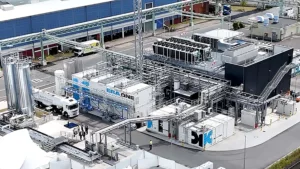
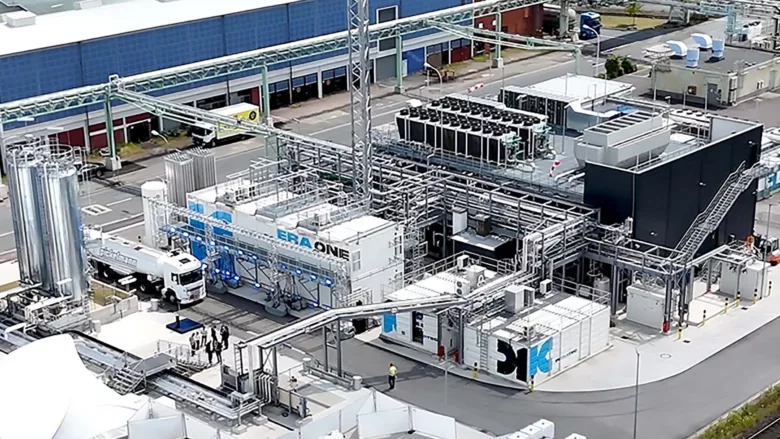
Ineratec was founded in 2016 as a spin-off of the Karlsruhe Institute of Technology and builds modular plants for synthetic fuels. At the Höchst industrial park in Frankfurt, the company already operates “ERA ONE,” a plant with a capacity of up to 2,500 tonnes of e-fuels a year that runs on biogenic CO2 and hydrogen from chlorine production. ERA T.H2 would be more than five times as large. To fund its growth and the construction of ERA ONE, Ineratec raised 118 million euros in a Series B round from investors including Piva Capital, Safran, Engie and Honda.
Haltermann Carless, headquartered in Frankfurt and owned by the investment group ICIG, makes specialty hydrocarbons for mobility, industry and life sciences. Under its ETS Racing Fuels brand, it supplies fuel for motorsport, and in France it operates a site in Bourgtheroulde in Normandy. E-fuels are “a key complement to our portfolio of renewable fuels,” said Bruno Philippon, general manager of the company’s performance fuels division. They have “an important role to play in motorsport, aviation and other applications where high energy density remains essential,” he added.
Ineratec’s chief executive, Tim Böltken, said the planned offtake “provides a strong foundation for the successful ramp-up of the plant.” In the industry, long-term offtake agreements are widely seen as a prerequisite for banks and investors to finance the high construction costs of such facilities.
The Hurdles
The deal is not yet a firm contract, however. A letter of intent is not legally binding, and without specific volumes it remains unclear how much of the plant’s output Haltermann Carless will actually take.
Then there is the cost. According to an analysis by the German think tank Agora Verkehrswende, producing e-fuels cost five to ten times as much as fossil fuels at the time of the study. The think tank also points to high energy demand: When renewable electricity is turned into synthetic fuel, only about half of it ends up in the tank. It therefore recommends reserving e-fuels for sectors such as aviation and shipping, where there are few alternatives. By that logic, motorsport remains a niche application. Porsche’s e-fuels offer a sense of how expensive synthetic fuel has been for end customers so far: In 2023, they cost almost 10 euros per liter.
Wood as a feedstock is also contested. A study commissioned by the German conservation group NABU concluded that Germany has no additional sustainable potential left for energy wood. Residues such as sawdust cannot simply be increased at will and are already used by other industries, for example for particleboard or pellets. According to Ineratec, the Normandy plant will only process sustainably sourced wood residues from the region.
On the regulatory side, E.U. rules work in the plant’s favor. Under the ReFuelEU Aviation regulation, 6 percent of jet fuel in the European Union must be sustainable from 2030, including 1.2 percent synthetic fuel. By 2050, those quotas rise to 70 percent and 35 percent, respectively. For hybrid processes such as PBtL, however, the accounting is complicated: Only the share derived from renewable hydrogen counts as synthetic fuel in the strict sense, while the biogenic share counts as biofuel.
Competition in France
Ineratec is not alone in pursuing this approach. French company Elyse Energy is planning a plant called “BioTJet” that would produce sustainable jet fuel from biomass and green hydrogen. Numerous other e-SAF projects are under development across Europe, including Norsk e-Fuel in Norway and Arcadia eFuels in Denmark. Many of them, however, are still waiting for a final investment decision because financing and offtake are often not secured.