Apple’s First Touchscreen MacBook Costs at Least €3,300



Set Trending Topics as a preferred source on Google.
Sixteen years after Steve Jobs dismissed the idea, you can finally swipe around on a Mac display: Apple has just unveiled the MacBook Pro with PROLED XDR Display, the first MacBook with a touchscreen. It also comes with a new OLED display that Apple markets as the world’s best laptop display. Getting in is not cheap: The 14-inch model starts at €3,299 in Germany and Austria.
What the Touchscreen Can Do
According to Apple’s press release, touch on the new MacBook Pro works much like it does on the iPhone and iPad. Users can scroll web pages with a finger, pinch to zoom in on photos, drag slides from one presentation to another and double-tap a window to make it fill the screen. The touch sensor is built directly into the display panel rather than layered on top, which is meant to reduce latency.
Apple is mainly targeting professionals:
- Design: Graphic designers can use the entire display as a canvas instead of being limited to the area of the trackpad.
- Music: In Logic Pro, software instruments can be played right on the screen, for example on a Multi-Touch keyboard.
- Video and 3D: In Final Cut Pro, editors can cut and place clips with their fingers, and in apps like Blender or Cinema 4D they can rotate 3D models.
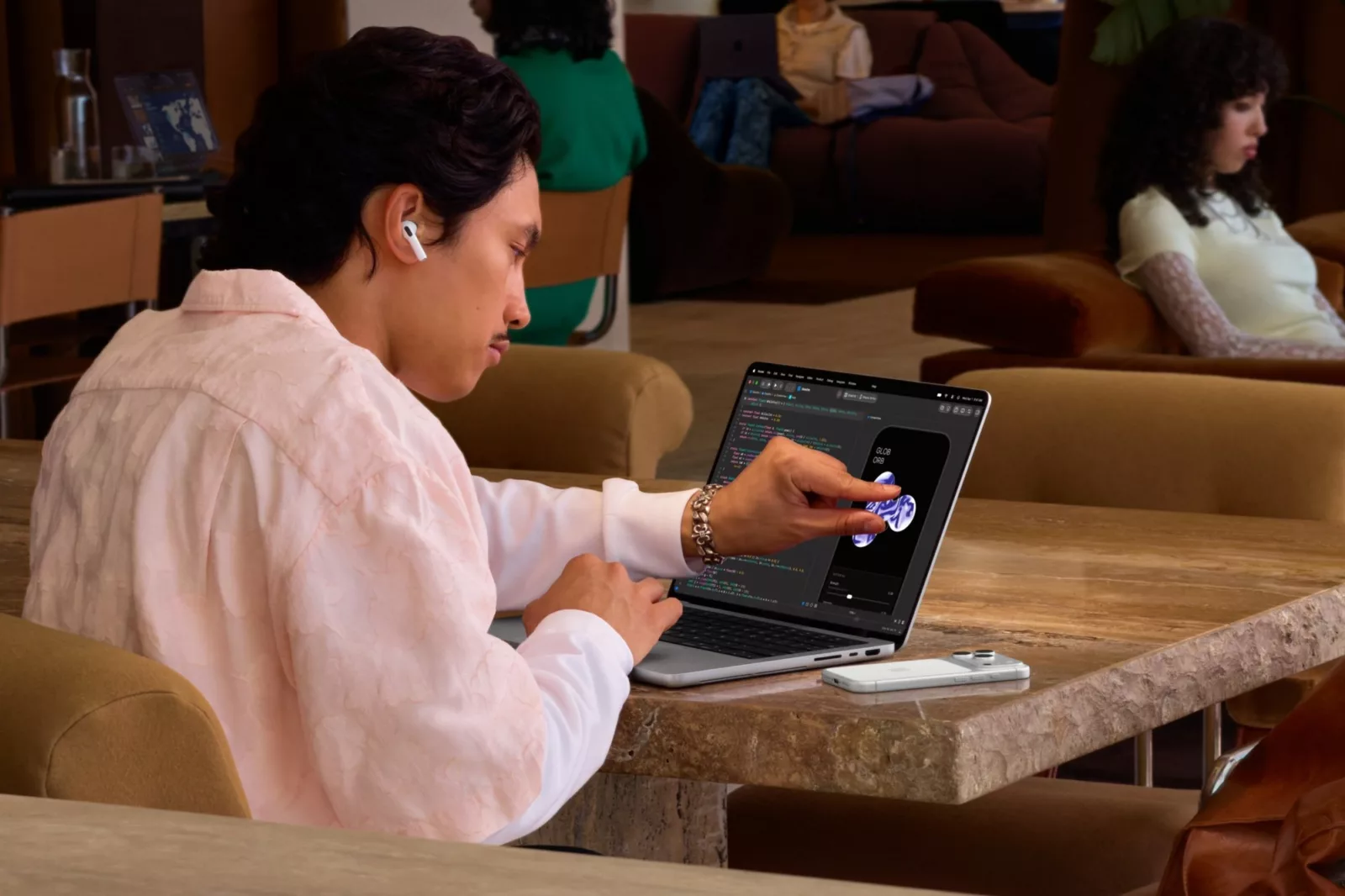
- Development: Developers can test how their iPhone and iPad apps feel with touch, directly on the Mac.
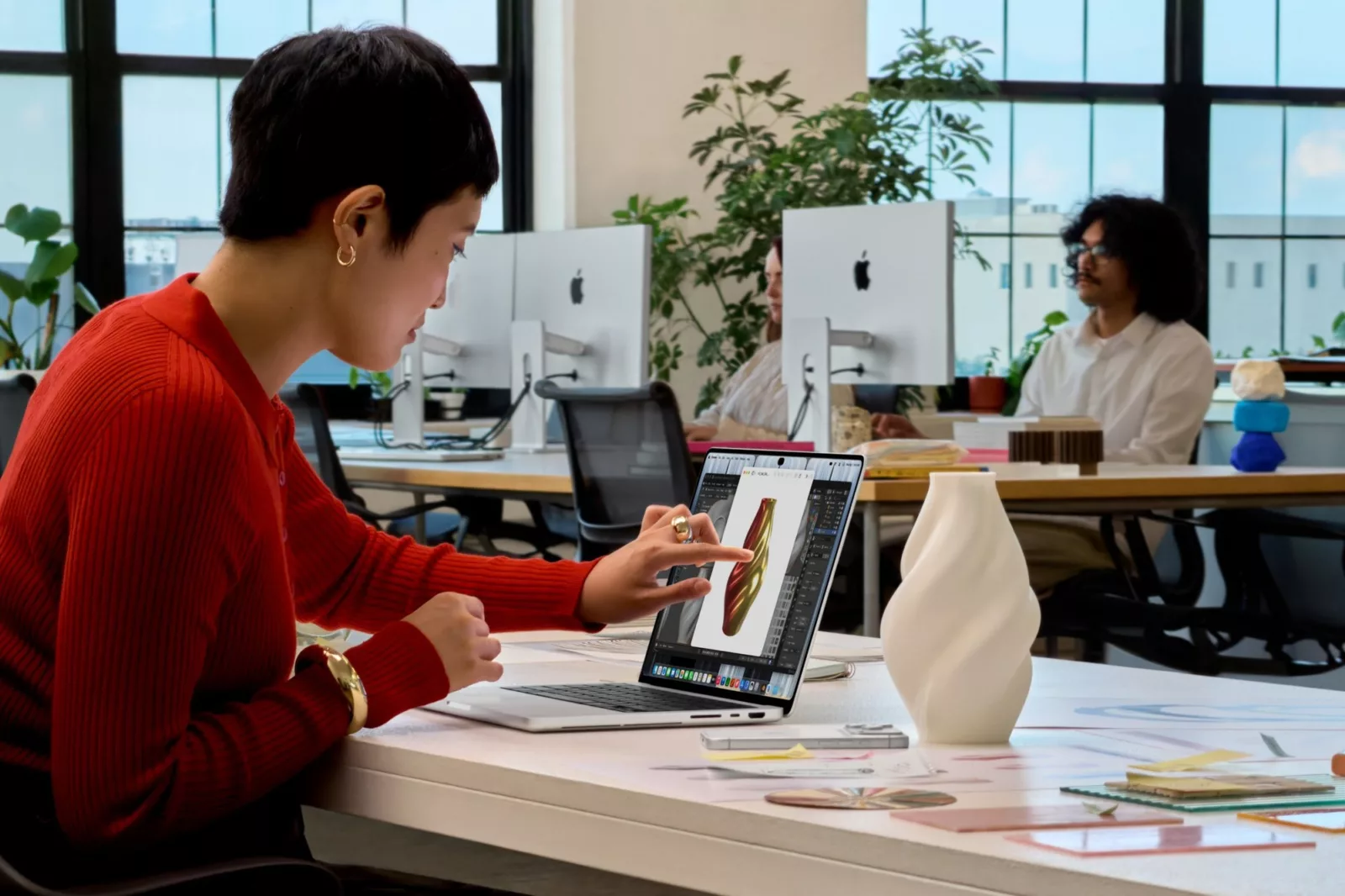
The new MacBook Pro does not support a stylus, however. Apple’s technical specifications list only Multi-Touch gesture support, and according to Cult of Mac, the Apple Pencil does not work with the device. Anyone who wants to draw on the Mac will have to use a finger.
Many existing apps work right away because macOS automatically translates touches into clicks. Apple has announced touch-optimized versions of apps including Microsoft Office, Notion, Canva, Zoom, Adobe Lightroom and DaVinci Resolve. A redesigned hinge is meant to keep the display from wobbling when tapped. Also new is the Dynamic Island from the iPhone, which on the Mac is home to Spotlight, Live Activities and Apple’s new Siri AI assistant. For now, Siri AI is available only in beta and in a handful of languages that do not include German.
OLED, a Lighter Build and M5 Chips
The second major upgrade is the display. The PROLED XDR Display uses tandem OLED technology with two self-illuminating pixel layers and, according to Apple, reaches up to 2,000 nits of peak brightness and a contrast ratio of 10,000,000:1. The panel covers both the P3 and Adobe RGB color spaces, which is meant to make it suitable as a portable reference display for photographers and colorists.

Thanks to OLED, the devices are also lighter: The 14-inch model weighs 1.38 kilograms, about 230 grams less than before, and the 16-inch model weighs 1.82 kilograms, about 320 grams less. Inside are the pro versions of Apple’s M5 chip, the M5 Pro or M5 Max, with up to 128 GB of unified memory and up to 16 TB of storage. Apple puts battery life at up to 24 hours.
What the Touch MacBook Costs in Germany and Austria
According to the Apple Store, prices are identical in Germany and Austria. Pre-orders are open now, with deliveries starting on Friday of next week:
- 14-inch with M5 Pro: from €3,299
- 16-inch with M5 Pro: from €3,899
- 14-inch with M5 Max: from €5,199
- 16-inch with M5 Max: from €5,599
According to the Apple Store, configurations with antireflective nano-texture glass start at €3,704. Students and educators get an education discount, bringing the 14-inch model with M5 Pro down to €3,129.
Touch and OLED come at a hefty premium. The classic MacBook Pro with M5 Pro and no touchscreen remains on sale, starting at €2,899 for the 14-inch and €3,399 for the 16-inch model. That makes the new model €400 to €500 more expensive. The also-new 14-inch MacBook Pro with the base M6 chip starts at €2,299, but without touch.
Windows Laptops Have Done This for Years
The idea is not new. Touchscreen laptops running Windows have been widely available since Windows 8 at the latest in 2012, and Microsoft has been building its own devices that combine a tablet and a laptop with its Surface line for more than a decade. Many Chromebooks can also be operated by touch. Apple, by contrast, long resisted and kept touchscreens for the iPad. As a compromise, it introduced the Touch Bar in 2016, a narrow touch-sensitive strip above the keyboard that it later dropped.
The skepticism goes back to Steve Jobs. At an Apple event in October 2010, he said that touch surfaces do not want to be vertical. After a while, users get tired and their arm eventually wants to fall off, he said, calling it ergonomically terrible, as Engadget reported. The industry calls the problem “gorilla arm.” Apple is now positioning touch as a complement to the keyboard and trackpad and is marketing it mainly for specific professional tasks.
Questions About the Benefit
Whether that justifies the higher price remains to be seen. Early reactions are cautious. TechRadar writer Alex Blake, for example, describes himself as a touchscreen laptop doubter and says Apple still has to convince him on the price. A 2-in-1 device that turns into a tablet would have tempted him more. That is exactly what Apple is not building, though. For that role, the company continues to offer the iPad Pro with a keyboard.