Neura Robotics Puts Robots to Work Pushing Hospital Beds


Set Trending Topics as a preferred source on Google.
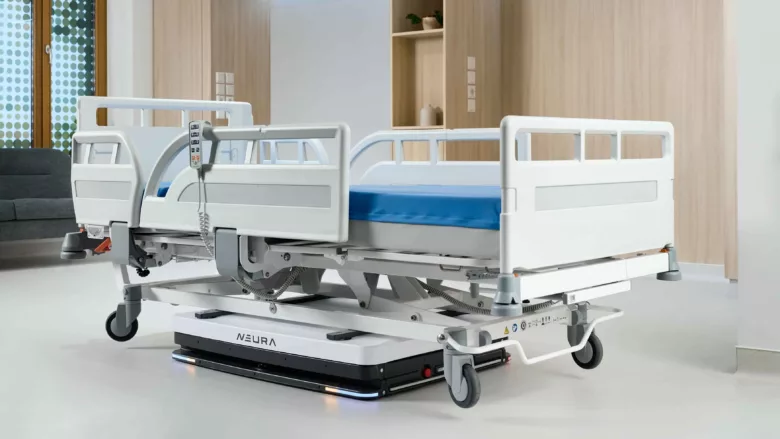
Before robots care for patients, they will push empty beds down hospital corridors. Neura Robotics, the German robotics unicorn, is moving into health care and has created a dedicated unit, Neura HealthTech, to do it. Its first product is an autonomous mobile robot that slides under empty hospital beds, lifts them and moves them on its own between wards and floors. The goal is to give nursing teams back more than 1,300 working hours a year.
A Robot for the Trips Nobody Wants to Make
The problem Neura is tackling is well known: the World Health Organization expects the European Union to be short 4.1 million health workers by 2030. At the same time, nurses spend a lot of time on tasks that have little to do with patient care, such as moving beds and other loads between wards and storage areas.
That is where the so-called Healthcare Platform comes in. At a single request, the flat robot drives under an empty bed, lifts it and takes it to its destination, including by elevator to other floors. It turns on the spot, maneuvers through narrow hallways and out of patient rooms, and keeps its safety functions active even while lifting. At about 20 trips a day, Neura expects to save more than 1,300 hours a year per hospital. Besides beds, the robot is also meant to transport sterile goods.
Neura draws one clear line itself: the robot moves only empty beds and does not transport patients. Before deployment, it is validated against each hospital’s actual floor plan, from door widths to elevator dimensions.
Rent, Don’t Buy
Hospitals cannot buy the robot. Neura offers it through partners as robotics-as-a-service: hospitals pay a fixed monthly fee that covers integration, operation, maintenance, software updates and round-the-clock support. The idea is that costs can be compared directly with staff costs. The company has not disclosed prices. Data is hosted on European cloud infrastructure. The platform is being shown publicly for the first time at the VDMA’s Smart Health Automation Summit in Düsseldorf, presented by the integration partner Auroniq Robotics, which installs the systems in hospitals.
“Societies are aging, skilled workers are becoming scarcer, and the demands on care keep rising,” said David Reger, Neura’s founder and chief executive. Physical A.I., he said, is part of the answer because it takes the physical burden off the people who provide care. “We are committed to this field for the long term.”
The Bed Robot Is Only the Beginning
All the robots are connected to the Neuraverse, Neura’s platform through which machines share skills and learning. In a connected hospital, information from rooms, devices and robots is meant to come together, from detecting a person in need of help to automatically assigning a robot. Next, Neura’s MAiRA robot arms are to assist with instruments and intralogistics, followed by the service robot MiPA, which is already being trained for tasks in patient rooms and to support medication delivery. Neura HealthTech is led by Sven Lange, with a team drawn from medical technology, health care and regulatory affairs.
The move fits the expansion strategy of the Metzingen-based company. Neura raised $1.4 billion from Tether, Nvidia and Amazon in June and has been on a buying spree since: first the logistics robot business Active Shuttle from its investor Bosch, and shortly afterward the cleaning robot maker Adlatus.
The Competition
Robots in hospitals are not a new idea. In the United States, Aethon’s TUG transport robots have been roaming hospital hallways for years, delivering medication, linens and meals. The Texas start-up Diligent Robotics also aims to relieve hospital staff with its robot Moxi, which fetches lab samples and supplies for nurses. Neura hopes to stand out through connectivity via the Neuraverse and its rental model.