Neura Robotics Teams Up With Austria’s A.I. Start-Up NXAI


Set Trending Topics as a preferred source on Google.
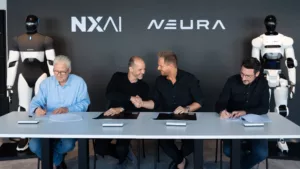
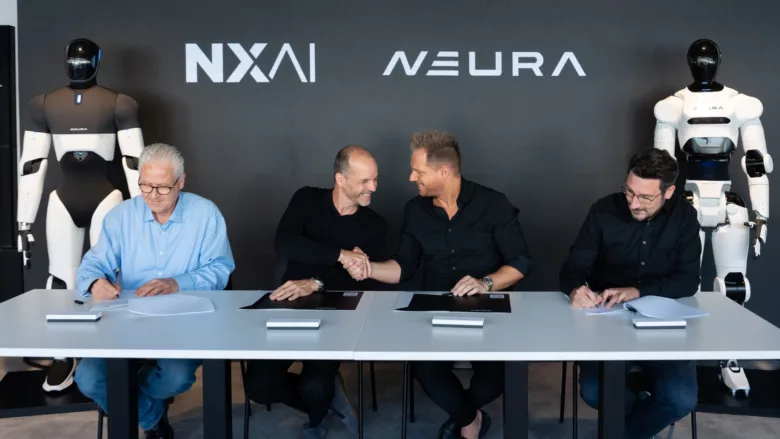
A robot that treats every situation as if it were the first is of little use in a factory: The German robotics unicorn Neura Robotics and NXAI, the A.I. start-up from Linz, Austria, around Sepp Hochreiter, have just announced a partnership to give robots a memory. To do so, they are combining Neura’s A.I. platform for robots with xLSTM, NXAI’s A.I. architecture. In addition, NXAI plans to bring a model of its own to Neura’s Neuraverse platform.
What the Two Companies Are Planning
The partnership has two parts. First, the two companies are jointly developing a memory component for Neuron AI, the A.I. model Neura unveiled just last week. It processes 3D images, touch, sound, the robot’s own state and language. Second, NXAI wants to offer its own xLSTM-based model on the Neuraverse. Companies are supposed to be able to train it there for their tasks with Neura’s tools, test it in Neura’s training halls, the Neura Gyms, and then deploy it on robots. Neuron AI remains Neura’s own model and will continue to be developed independently.
The partners explain in their announcement why memory matters so much: A chatbot answers requests one at a time, while a robot perceives, decides and acts many times per second, possibly for an entire shift. For that, it needs a working memory that keeps track of whether a component has already been installed or a door has already been opened. A longer-term, episodic memory is also meant to let it draw on experience from earlier runs. “A robot that is truly helpful in everyday life and in industry has to remember,” said David Reger, Neura’s founder and chief executive.
xLSTM: Mr. Hochreiter’s Answer to the Transformer
NXAI’s role in this goes back to Mr. Hochreiter’s research history. In the 1990s, the professor at Johannes Kepler University Linz developed Long Short-Term Memory (LSTM) together with Jürgen Schmidhuber, a neural network with built-in memory that for many years powered applications such as speech recognition on smartphones. With the rise of the transformer architecture, on which ChatGPT and similar systems are based, LSTM faded into the background.
With xLSTM, Mr. Hochreiter revived the technology in 2024. Its advantage over transformers: Computing costs grow only linearly with the length of the input, and the model maintains a compact state that it updates with each new data point instead of reprocessing the entire history. That makes xLSTM fast and efficient, and therefore attractive for machines that need to compute on site without the cloud. “xLSTM is built for this. It is fast, memory-efficient and can maintain its state over long sequences,” said Mr. Hochreiter, who is NXAI’s chief scientist.
Two Companies With Big Ambitions
NXAI was founded in Linz at the end of 2023, with the agency Netural X and Pierer Digital Holding involved alongside Mr. Hochreiter. Last year, two German investors acquired a combined stake of almost 32 percent (in German). NXAI has recently become best known for its time-series model TiRex, and it also spawned the start-up Emmi AI, which Mistral acquired this year.
Neura Robotics was founded in 2019 by David Reger in Metzingen and builds cognitive robots, from robotic arms to the 4NE1 humanoid. In the middle of this year, the stablecoin company Tether led a Series C of up to €1.2 billion, in which Nvidia and Amazon also took part. According to media reports, the round valued the company at around €6 billion.
Strong Competition From the U.S. and France
The two companies are not alone in tackling memory. Google is teaching robots to plan over many steps with its Gemini models, Nvidia offers open models for humanoid robots with Isaac GR00T, and U.S. start-ups such as Physical Intelligence, Figure AI and Skild AI are developing their own A.I. brains for robots, funded with billions. Competition is also heating up in NXAI’s second line of business, time-series models: Mistral recently unveiled Timestral, four models that predict data such as power consumption, server load or sensor readings from machines, targeting the same industrial customers as NXAI’s TiRex. On the fev-bench leaderboard, Timestral ranks well ahead of TiRex-2, which comes in only seventh, according to Mistral’s own figures. How well the joint memory component works remains to be seen: Neura and NXAI have not given any results or a timeline, and Neura has not yet published benchmark scores for Neuron AI either.