OpenClaw Ships Its Biggest Update Into a Highly Crowded Field of Competitors


Set Trending Topics as a preferred source on Google.
The open-source project OpenClaw has just shipped the largest update in its history. According to the development team, OpenClaw 2.0 contains more than 16,000 pull requests from 933 contributors, 569 of them first-timers. That amounts to roughly half of all changes ever merged into the project.
The list of new features runs from full-text search across past conversations to sessions that execute on remote machines, interactive widgets in the chat and a dedicated method for handing over credentials. The original plan was far smaller. As Hannes Rudolph writes in the release blog post, the team set out to simplify installation and rebuild the browser interface. Those two jobs turned into an overhaul that touches nearly every part of the software: installation, messaging, memory, skills, models, automations, browser and native apps, plugins and security.
A Faster Start and a New Interface
The most visible change is the first encounter. During setup, OpenClaw now looks at what is already on the machine: existing ChatGPT or Claude subscriptions, API keys and locally running models via Ollama or LM Studio. Some configuration disappears, the rest moves out of initial setup. The idea is that people reach their first conversation sooner and finish configuring the assistant by talking to it. Before anything is saved, the system checks that the chosen model access actually responds.
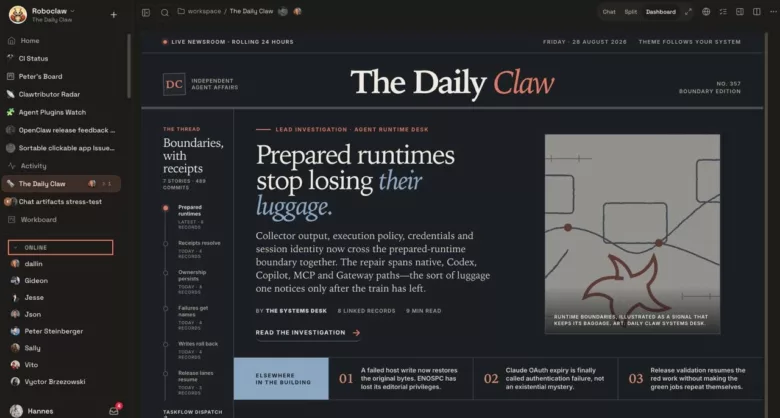
The browser app has been rebuilt around the conversation, with a sidebar for navigation in the manner of ChatGPT or Gemini. Files, Git changes and the built-in browser can stay open as docked panels next to the chat. Added to that: Markdown rendering while replies stream in, dictation, the ability to reorder queued follow-up messages, and a side-thread mode for asking a quick question without derailing the task in progress.
Under the hood, session transcripts move from file-backed storage into a SQLite database, which speeds up loading history. Downgrading to an older version therefore requires a backup first. The same foundation supports full-text search across earlier conversations: search for exact words or phrases, get results with the surrounding messages, and reopen that point in the thread. MCP servers can now be managed directly in Settings, including control over which tools are available in which session.
Sessions Leave the Local Machine
One of the bigger architectural moves concerns where work runs. Sessions can leave the local gateway and execute on paired devices or cloud workers, with the session workspace travelling along. Warm machines and prepared project seeds can be reused for later cloud sessions, which cuts startup time.
To keep the agent’s activity legible, OpenClaw 2.0 introduces a durable session progress card that survives a page reload. It shows subagent activity and the accumulating edits, in the web client as well as the native apps. In the other direction, the agent can now ask structured questions. They can be answered through cards in the web and native clients, through buttons in messaging services, or in free text, with an explicit Skip option available.
Interactive widgets in the chat are new as well, and they can be pinned to session dashboards. Specific actions or particular network origins can be granted to them individually, and rendered views can be exported as images. Media now stays attached to the conversation across uploads, generated replies, playback and reloads, with native playback controls and video uploads on the Apple and Android clients.
Credentials and Recurring Work
Security, a constant companion of the project since it went viral, sees several changes. When the agent needs a password or a key, it can request one through a masked prompt, keeping the value out of the chat transcript and out of the model context. An optional proxy further limits which destinations protected secrets may be substituted into.
Automations follow a similar principle. Permission is granted once for an exactly defined operation, can be inspected and revoked later, and a fresh approval becomes necessary as soon as the job or the operation changes. For mobile access, the software distinguishes between limited and full modes, LAN connections have to be pinned explicitly, and fresh installs block an unauthenticated gateway on the network. Elevated browser scope requires administrator approval. The project lists everything in its release notes.
The macOS build is available signed and notarized as ZIP and DMG via GitHub. New iOS and Android distributions follow separately, and Android users are told to stay on their current installation channel for regular updates.
Nearly Seven Weeks Without a Release
The timeline is worth noting. The team says it had previously shipped 106 releases in 230 days, most of them within a day or two of each other. Rudolph attributes the seven-week gap to a team and a workload that grew faster than both the technical foundation and the shipping process, so both were reworked at the same time. More time went into making sure that fresh installs and upgrades of existing setups would work.
From Weekend Project to Foundation
OpenClaw stopped being a one-off some time ago. The project by Austrian developer Peter Steinberger started last autumn under a different name, went viral, and now reaches tens of millions of monthly website visits and millions of active installations, according to an analysis by Trending Topics. Steinberger himself joined OpenAI, and an OpenClaw Foundation was set up to steward the project.
Who Pays for the Foundation
The foundation is organized as a U.S. non-profit under section 501(c)(3) and holds the repository, the trademark and the associated infrastructure. Its stated goal is to keep OpenClaw MIT licensed, open and independent. Dave Morin serves as chairperson, while technical direction stays with Steinberger, who continues to make the key decisions despite his move to OpenAI. The foundation has also convened several councils working on agent identity, profiles, evaluations and enterprise deployment. In its own communication, the organization describes itself as the Switzerland of AI, meaning neutral ground between competing labs and models.
Operations are funded by donations rather than a product. The foundation names the University of Michigan as its largest donor, which is also building an Institute for Agentic Computing. Offline Holdings, the Lobster Computer Company, OpenAI, Microsoft and NVIDIA follow, several of them contributing compute and engineering resources alongside money. A number of those companies build on OpenClaw themselves: NVIDIA with NemoClaw around its Nemotron models, Microsoft with Scout. A smaller but visible share comes from roughly 300 people and organizations via GitHub Sponsors, most of them giving a few dollars a month. The foundation discloses neither concrete amounts nor tiered sponsor classes. The bulk of the money therefore comes from the very corporations the project means to stay independent of, a tension familiar to other open-source foundations.
The Field Fills Up
That success has brought a whole range of alternatives into view. The most prominent challenger on the open-source side is Hermes Agent by Nous Research, also MIT licensed. Hermes uses a Python runtime invoked for individual tasks, works directly in the project directory, and can run on a VPS or serverless. OpenClaw, by contrast, is a resident TypeScript daemon built around messaging channels. In comparisons, Hermes scores on memory, where full-text search in SQLite makes context recall dramatically faster, while OpenClaw counters with more than 20 connected messaging services and the ClawHub skill marketplace.
Alongside them sit Paperclip as an orchestrator for several specialized agents, plus the established frameworks LangGraph, AutoGen and CrewAI, which aim more at developers and multi-agent scenarios than at personal assistance.
The large platforms carry considerably more weight. Google is working on a personal agent known internally as Remy, and reportedly shut down Project Mariner to concentrate on it. Meta is testing under the name Hatch. Microsoft has presented Scout, its own approach built on OpenClaw, and is rolling out Copilot Cowork in parallel. Anthropic is on the market with Claude Code and Claude Cowork.
The most direct challenge to the same usage pattern so far comes from OpenAI. Over the summer, the company introduced GPT-5.6 together with an agent called ChatGPT Work, designed to complete tasks rather than answer questions about them. It breaks projects into subtasks, works across apps and files, stays with a job for hours when needed, and delivers finished output such as presentations, spreadsheets or small web apps. It also brings a built-in browser for research, scheduled tasks with monitoring for changes, and direct control of desktop applications through Computer Use. Billing runs through the respective subscription, with demanding jobs drawing more from a plan’s allowance than ordinary chat requests. Administrators on Enterprise and Edu plans can set spend controls.
The thrust differs from OpenClaw’s. ChatGPT Work targets departments inside companies, from sales through finance to engineering, and ships governance features with it. OpenClaw remains the locally run personal assistant, reachable through messengers, with data kept on the user’s own hardware. The line between the two categories keeps blurring, though, precisely because OpenClaw 2.0 can now move sessions into the cloud as well.
Open Questions Remain
For all the speed, security stays the central issue for the entire category. Personal agents need broad permissions over email, calendars and messages, they are vulnerable to prompt injection, and they load extensions from loosely curated directories. A survey of OpenClaw found tens of thousands of instances exposed on the internet, and only a portion of the marketplace extensions rated as safe. Authorities in China temporarily barred state agencies and banks from using the software. OpenClaw 2.0 addresses some of these points, while the question of durable standards for personal AI agents stays open.