Perplexity, Nvidia Run Chinese AI Model Locally on the “Portable Computer”

Set Trending Topics as a preferred source on Google.
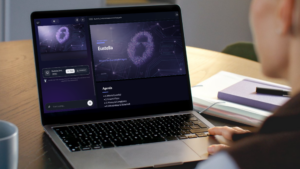
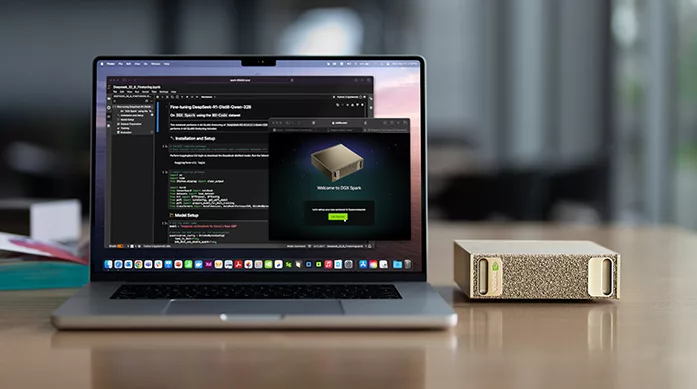
OpenClaw sends its regards: the AI startup Perplexity has just introduced “Portable Computer,” a version of its agent product Perplexity Computer that runs entirely on the user’s own machine. It was built together with Nvidia. The announcement comes at the same time as reports that Nvidia wants to buy into Perplexity at a valuation of more than 30 billion dollars.
Where the Local AI Runs
Portable Computer is available first for the NVIDIA DGX Spark, Nvidia’s desktop-sized AI computer. It is built around the Grace Blackwell GB10 platform with a 20-core Arm CPU and 128 GB of unified memory. A version for PCs with RTX GPUs is set to follow. The first release runs on Linux, with Windows support announced. Access is limited to Pro and Max subscribers, and installation happens through a one-click setup inside the app, according to Perplexity.
The device runs the models along with the entire machinery around them: orchestrator, planner, tool router, scheduler, the task queue and the local search index. As long as the work stays local, it costs no credits, which is meant to make high-volume routine tasks more attractive economically.
Which Models Are in Play
The local model options are Qwen 3.8 27B and PPLX 27B, a version of the Qwen model that Perplexity has post-trained. That post-training aims to complete as much of a task as possible on the device and to move to the cloud only when the task requires it. NVIDIA Nemotron 3.5 Lightning is set to join the model picker as well, an open 30B model with a mixture-of-experts architecture that Nvidia advertises as considerably faster than comparable open models. Dictation uses the Nemotron 3.5 ASR Model and also works locally, so audio data stays on the machine.
When local compute falls short, the orchestrator can hand a task to the cloud for current web information, browser use, connected apps, or one of more than 15 frontier models. Perplexity stresses that it asks for the user’s permission before any content leaves the device. Connectors link the agent to Google Drive, Gmail, Slack and GitHub. Code and tool execution run in isolated sandbox environments, as they do in the cloud version.
The reasoning behind it: many of the most valuable tasks for AI agents involve data that is best kept on the machine in the first place, such as private codebases, draft contracts or client files. Perplexity points to an accompanying research blog post laying out benchmark results on accuracy, speed and credit efficiency.
The Rumors Around an Nvidia Stake
Alongside the product announcement, The Information reported that Nvidia is negotiating a further investment in Perplexity at a valuation of more than 30 billion dollars. At the last funding round about a year ago, the valuation stood at roughly 20 billion dollars. According to the report, a technology licensing deal was also on the table. Nothing has been confirmed so far, and neither company has commented on the talks.
Perplexity has grown its annualized revenue to around 750 million dollars, up from less than 250 million at the start of the year, the reports say. Nvidia is already invested, alongside backers such as Jeff Bezos and SoftBank. Observers read a further investment as a form of insurance: should the architecture of AI search shift, for instance away from large cloud clusters, Nvidia would have a presence on both sides.
Nvidia’s Two Tracks
That dual strategy is easy to observe right now. On one side, Nvidia has become a major investor in the model houses whose training devours enormous cloud capacity. At OpenAI, the company has held out the prospect of an investment of up to 100 billion dollars, paid out in stages, one for each gigawatt of new infrastructure that goes into operation, covering at least ten gigawatts of data centers in total. At Anthropic, Nvidia is investing together with Microsoft, with up to 10 billion dollars at a valuation of 350 billion dollars, tied to a commitment of up to one gigawatt of Grace Blackwell and Vera Rubin systems.
On the other side, Nvidia is pushing its hardware toward local AI. The company optimizes open models from Qwen, Meta, DeepSeek and others for RTX PCs, DGX Spark and Jetson, releases its own open models for agent workloads under the Nemotron brand, and keeps expanding the software environment around the desktop machine, including clustering across several Spark systems. In its local AI blog, Nvidia presents the Perplexity collaboration as evidence that agentic workflows can now run on personal hardware.
Economically, the two tracks complement each other. If inference moves from the data center to the desk, Nvidia keeps selling chips, just in different packaging. If it stays in the cloud, the company benefits through its data center business and through its stakes in the model houses. Perplexity states its own expectation confidently: with every chip generation and every model release, a larger share of the work will get done on people’s own machines.
Whether the local version reaches beyond a technically minded audience depends on the price of the hardware, and on how often the agent has to escalate to the cloud in everyday use after all.