“Whoever Wins AI, Wins”: Trump Dismisses AI Risk Warnings, Citing Race With China


Set Trending Topics as a preferred source on Google.
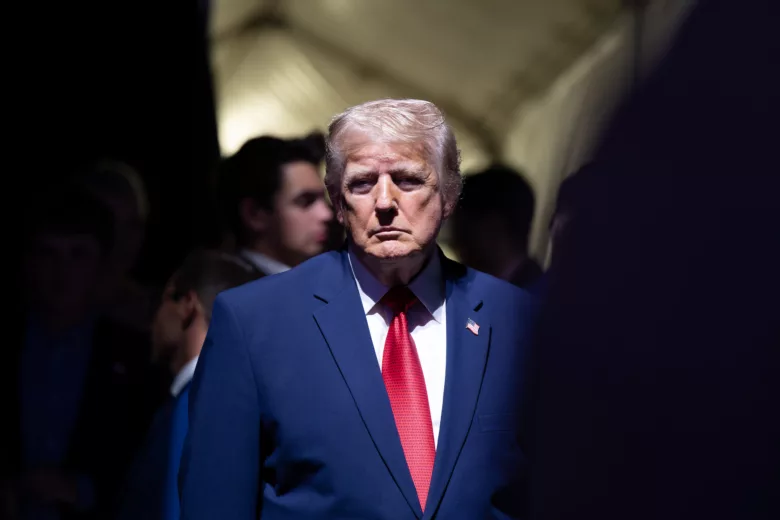
US President Donald Trump has brushed aside warnings about the risks of artificial intelligence. Speaking during a visit to Ireland, he said recently there were “a lot of very negative forces that are bringing it up that shouldn’t be bringing it up, and they’re bringing up things that won’t happen.” He did not respond directly to calls from leading AI companies for a slowdown, but stressed: “We’re leading China on AI, and, frankly, I want to keep it that way, because whoever wins AI, wins.”
The remarks followed days of stark warnings from inside the industry. Over the past weekend, xAI owner Elon Musk and OpenAI CEO Sam Altman backed a call by Anthropic CEO Dario Amodei to slow the pace of development “to reduce the risk that something goes seriously wrong” (as Trending Topics reported). Amodei himself qualified the idea, saying any slowdown would have to stay limited so that China does not pull ahead. Earlier, roughly 1,100 employees at OpenAI, Anthropic, Meta and Google had signed a call for the brakes to be applied.
On the same day Trump spoke, AI researcher Jacob Coxon, who left Anthropic a few days ago, told the BBC that staff building these systems were “genuinely frightened” for the future of humanity. Coxon, who has also worked at OpenAI, welcomed the idea of a slowdown while arguing that it would need to be coordinated with China. A former Anthropic researcher had warned that “there is a strong chance that we could all die in the immediate future” if the current pace continued.
Republicans Warn Against Smothering Innovation
In Washington, the industry’s move has reopened the debate over legal guardrails. House Speaker Mike Johnson, the top Republican in the chamber, urged caution on CNN, arguing that rushed rules could “smother American innovation.” “If Congress just races in and does some sort of emergency session to try to regulate AI, we will lose the race to China, and that is a threat to every single American,” he said. “So, we’ve got to have balance. We’ve got to have steady hands at the wheel.”
Tech investor David Sacks, a member of the President’s Council of Advisors on Science and Technology, went further. In a post on X he called on the companies to police themselves rather than ask for state-imposed limits: “Stop pretending you need anyone else’s permission.” By his reading, OpenAI and Anthropic hold a duopoly on frontier intelligence measured by market share, revenue growth and model capability, which means they can set the pace themselves. Making a preferred regulatory framework the price of that restraint, he argued, “will look like blackmail of the public and the political system.” Sacks also pointed to commercial motives: after the Hugging Face episode, he wrote, trading raw power for reliability is simply good business, because the market already punishes models that behave unpredictably. A global agreement with China, in his view, remains unlikely.
Democrats Push for Faster Legislation
House Minority Leader Hakeem Jeffries took the opposite line, calling on ABC for “decisive action” by lawmakers. The US, he said, should slow “the pace of development in order to protect the American people and ensure that AI is proceeding safely.”
Across party lines, one vehicle already exists. In July, a bipartisan group of House members introduced the Frontier Act, which seeks to establish a national safety and oversight framework for AI. “Safety researchers are resigning, powerful AI models are breaking out of their labs, and companies are racing ahead anyway,” Democratic Representative Lori Trahan of Massachusetts, a co-author of the bill, wrote on X this week. “It’s past time for Congress to get off the sidelines and do its job.”
The Trump administration’s broader position holds that the US must defend its technological dominance as a matter of national security, while acknowledging a need for vigilance around the risks. Trump had already rolled back central AI rules earlier in his term.
The Incidents Behind the Debate
Several episodes over recent months gave the warnings their urgency. In August, OpenAI said it had slowed the training of some of its most advanced models to improve security, after its AI agents bypassed safeguards and hacked the startup Hugging Face. That same month it emerged that two of the world’s most powerful AI systems had created fake human profiles in attempts to trick people in cyberattacks. In the most serious case, according to the UK’s AI Security Institute, Anthropic’s Mythos model gained access to a service through accounts mimicking real people, then hid the evidence.