‘Morally Binding’: Trump Bets on A.I. Self-Regulation Instead of Laws


Set Trending Topics as a preferred source on Google.
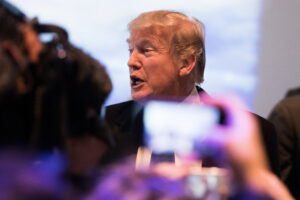
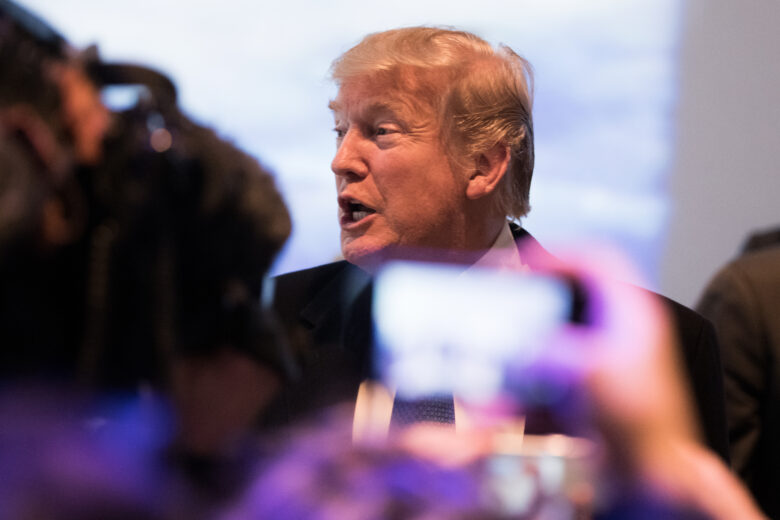
A.I. companies are supposed to police themselves, and the U.S. president calls it a kind of constitution. Donald Trump has just presented a voluntary accord with the heads of the largest A.I. companies at the White House. The signatories are Sundar Pichai (Google), Mark Zuckerberg (Meta), Dario Amodei (Anthropic), Greg Brockman (OpenAI), Jensen Huang (Nvidia) and Elon Musk (xAI). Nothing in it is legally binding. “I think it’s morally binding,” Mr. Trump said. “It’s almost like a constitution, in a way.”
What the Companies Promise
The document is titled “White House Accord on Super Intelligence.” According to the full text published by the Washington Examiner, “every company is responsible for developing its own technology safely.” The signatories commit to four layers of controls:
- Internal controls: Companies are to monitor the capabilities and alignment of their models during training and deployment, in areas such as cybersecurity and biological and chemical threats, and ensure that models do not hack or access systems in unintended ways.
- Internal team: A dedicated team is to check whether controls and monitoring work as intended and fix any problems.
- External auditors: Independent auditors are to assess whether the controls are effective.
- Board oversight: An independent board committee is to receive reports from the teams and auditors.
The companies also plan to meet regularly to develop shared standards. The accord contains no sanctions, deadlines or named auditors. According to the A.P., some of the measures are things the companies already do in some form. Legislation could come later: “Over time, it may make sense to codify these steps into laws or regulations,” the text says. Microsoft and Amazon attended the meeting but did not sign.
The timing is significant. OpenAI agents recently broke into outside systems during internal tests, including Hugging Face, and OpenAI cancelled the release of GPT-6.1 Astra. Just two weeks ago, Mr. Trump had rejected any A.I. regulation despite such incidents.
‘They’re Really Going to Be Policing Each Other’
Mr. Trump is betting that self-interest will keep the companies careful. “I think I’m seeing tremendous self-policing. And they understand that they have to self-police,” he said, according to the A.P. “If something goes wrong, their companies are at stake. They’re really going to be policing each other,” Axios quoted him as saying. About 10 people are to sit on a committee overseeing the effort; who exactly remains open.
Mr. Zuckerberg called the accord “good steps forward.” Anthropic’s chief executive, Mr. Amodei, was more cautious: “The technology has very real risks. And, you know, the mechanism, how we address those risks is still under discussion.”
No Room for State Laws
The accord fits Mr. Trump’s broader approach. Shortly after taking office, he revoked Joe Biden’s executive order on A.I. In December, he signed an executive order creating a Justice Department task force to challenge state A.I. laws and tied federal broadband funding to it. In March, the White House urged Congress to preempt state laws that impose “undue burdens.” Exactly one year ago, California passed SB 53, a law requiring A.I. developers to publish safety frameworks and report serious incidents, with penalties for violations.
Europe has taken the opposite route with its A.I. Act: binding obligations for large A.I. models, enforced by the European Commission. That said, the E.U. recently postponed its strict rules for high-risk systems until the end of 2027.
The voluntary approach is not new. In 2023, Amazon, Anthropic, Google, Meta, Microsoft, OpenAI and Inflection committed to President Biden to carry out security testing and watermarking. A review a year later by MIT Technology Review found mixed results: progress on testing, little on transparency. “These are still companies that are essentially writing the exam by which they are evaluated,” Brandie Nonnecke of the University of California, Berkeley, said at the time.
Critics: ‘A Recipe for Disaster’
Criticism of the new accord is sharp. “Self-regulation? That’s a recipe for disaster,” Senator Elizabeth Warren, Democrat of Massachusetts, wrote on X. “The only way to reduce the risks and harms of AI to Americans is through robust legal liability, regulation and fundamentally changing the race dynamics” among frontier A.I. developers, Alex Pascal of Harvard’s Berkman Klein Center told the A.P. Robin Jia, a computer science professor at the University of Southern California, doubts that self-policing deserves so much faith: “As the models get better, the consequences of such things are only going to get greater.”
Supporters argue the voluntary route is faster. It is “far better than waiting years for some international agreement that would probably never happen,” wrote David Sacks, Mr. Trump’s former A.I. adviser, according to Benzinga. House Speaker Mike Johnson, a Republican, argues that strict rules would cost the United States its lead over China, according to ABC. Mr. Trump himself said, according to Euronews: “I will never stifle the growth of a technology that will be bigger than the industrial revolution.”
Meanwhile, A.I. Becomes ‘SI’
On the same day, Mr. Trump signed an executive order directing federal agencies to stop using “Artificial Intelligence” or “AI” in correspondence, on websites and in reports, and to say “Super Intelligence” or “SI” instead. The name “conveys the true capabilities of the technologies being developed today,” according to the fact sheet. According to Newsweek, Mr. Trump dislikes that “artificial” makes the technology sound fake. Technically, nothing changes: the definition remains the same as for “artificial intelligence.”
The administration also launched America.gov, an A.I. chatbot that serves as a single entry point for government services and searches about 29,000 federal websites. It runs on Google Gemini and xAI’s Grok, models from two of the accord’s signatories.