Auto Supplier Schaeffler Cuts 3,460 Jobs While Investing Heavily in Robots


Set Trending Topics as a preferred source on Google.
Fewer parts for combustion engines, more joints for robots: The German auto supplier Schaeffler plans to cut a net 3,460 jobs in Europe, about 2,660 of them in Germany. Four German sites and a plant in Belgium are set to close over time. At the same time, the company is betting on new businesses, above all humanoid robots and defense.
Schaeffler blamed the new savings program on conditions in the auto business: Demand for parts for combustion-engine vehicles is falling, the shift to electric vehicles is taking longer than expected and competition is getting tougher. The company also pointed to above-average personnel costs per employee in Germany and an organization with too many layers of management.
The Sites Affected
In total, 16 sites in Europe are affected. About half of the cuts are in production, 30 percent in research and development and the rest in other areas.
- Dortmund and Morbach: The two plants, with 430 and 160 employees, make products for combustion engines and are set to close.
- Berlin: Activities at the site, which has about 270 employees, will be discontinued.
- Schwalbach: The site near Frankfurt will be given up. Most of its roughly 385 employees are to move to Frankfurt, and about 190 jobs will be eliminated.
- Other German sites: Toolmaking will end in Höchstadt, and special machinery operations in Erlangen and Schweinfurt will be adjusted. Capacity will also be reduced in Herzogenaurach, Bühl, Nuremberg and Regensburg.
- Abroad: Production and development will be scaled back in Haguenau and Toulouse in France and in Skalica and Kysuce in Slovakia. The plant in Herstal, Belgium, with about 15 employees, will close.
Measured against Schaeffler’s core workforce of 31,957 in Germany, about 9 percent of jobs will be cut by 2028. Including earlier programs and 1,800 partial-retirement contracts already signed, the figure rises to about 18 percent. In November 2024, Schaeffler had already announced plans to cut 4,700 jobs in Europe, including 2,800 in Germany.
Pay Cuts Up to the Executive Board
New this time is what Schaeffler calls a solidarity contribution. Among other things, it is to include a temporary, voluntary pay cut across all levels of the hierarchy, starting with the executive board. The details still have to be agreed with the relevant bodies. Without this contribution, the job cuts would have been even larger, according to Schaeffler.
Klaus Rosenfeld, Schaeffler’s chief executive, called the solidarity contribution the most important element of the program, also compared with previous ones. The program is meant to show that companies can still develop and manufacture competitively in Germany and Europe over the long term, he said, provided they consolidate sites and lower personnel costs per employee.
Schaeffler puts the one-time costs at about €480 million, most of which is to be booked as a provision this year. Starting in 2030, the measures are expected to deliver about €300 million a year. Most of the changes will take place in 2027 and 2028. Astrid Fontaine, the board member responsible for human resources, said that as a family-owned company, Schaeffler wants to carry out the measures in a socially responsible way and in close dialogue with employee representatives.
The IG Metall union is critical. At Schaeffler, one job-cutting program now follows the next before the consequences of the previous one have been dealt with, said Thomas Höhn, the union’s representative for the company, according to dpa-AFX. That is no plan for the future of Germany as an industrial location, he added.
The Nine-Month Figures
At almost the same time, Schaeffler released its results for the first nine months of the year. Revenue of €17.5 billion was nearly flat year over year at constant currency, while operating profit (EBIT before special items) rose 6.5 percent to €794 million, lifting the margin to 4.5 percent. Net income came to €11 million, after a loss of €244 million a year earlier. The divisions moved in different directions: Revenue in the combustion-engine business, Powertrain & Chassis, fell 4.6 percent, though the unit still earned a margin of 10.8 percent. The E-Mobility division grew 4.6 percent but posted an operating loss of €571 million, plus special charges of about €240 million tied to weak China projects of European carmakers. Free cash flow came to minus €40 million, and net debt stood at €5.3 billion. Schaeffler employed 108,004 people worldwide at the end of September, about 4,000 fewer than a year earlier. The company confirmed its outlook for 2026.
Schaeffler is not alone in cutting jobs. Other major suppliers such as Bosch, ZF and Continental have also eliminated or announced thousands of jobs in Germany in recent years.
Meanwhile, a Push Into Robotics
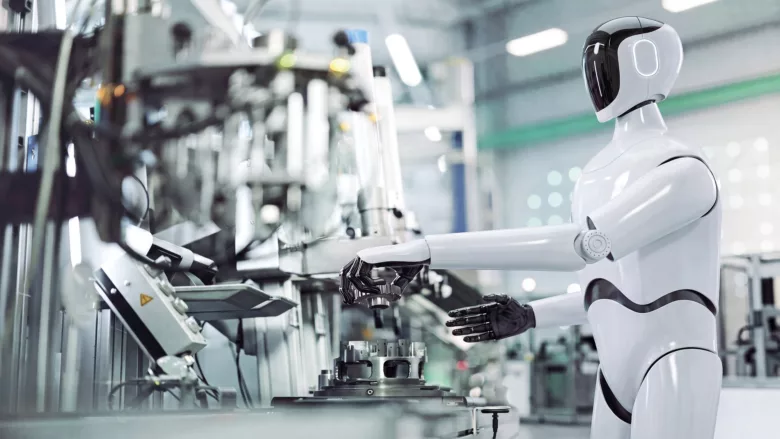
Schaeffler wants to offset part of the job losses with new positions in growth areas. Alongside the core business, the group sees promising opportunities above all in humanoid robotics and defense, said Jochen Schröder, the board member responsible for production. In both, he said, Schaeffler can draw on know-how developed in its core business.
In robotics, Schaeffler has made several investments and signed supply deals in recent months:
- Humanoid: Schaeffler took part in a €133 million funding round for the London-based robot maker, which made it a unicorn. According to Forbes, at least 1,000 Humanoid robots are to work in Schaeffler plants by 2032. The first phase starts in December in Herzogenaurach and Schweinfurt. In return, Humanoid is to buy at least one million actuators from Schaeffler.
- Neura Robotics: Schaeffler also took part in the $1.4 billion funding round (about €1.26 billion) of the German robotics unicorn. Neura trains its A.I. models in part with data from Schaeffler.
- Lighthouse factory: Schaeffler recently opened a factory in Taicang, China, where humanoids assemble joint modules for the next generation of humanoids, and where series production of these actuators is starting. In the third quarter, Schaeffler won two new customers in China, and its global order intake in humanoid robotics rose to about €400 million.
- Wandelbots: Schaeffler has formed a technology partnership with the Dresden-based start-up. Its software platform NOVA is to become the standard across all Schaeffler plants and cut automation costs by up to 40 percent.
- Components: Schaeffler’s gears, actuators, sensors and bearings account for about half of the material costs of a typical humanoid, according to the company. In the spring, Mr. Rosenfeld said Schaeffler was in talks with about 45 robotics companies worldwide.