Tesla’s New Roadster Can Fly, but It Won’t Arrive Until 2028


Set Trending Topics as a preferred source on Google.
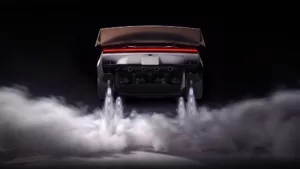
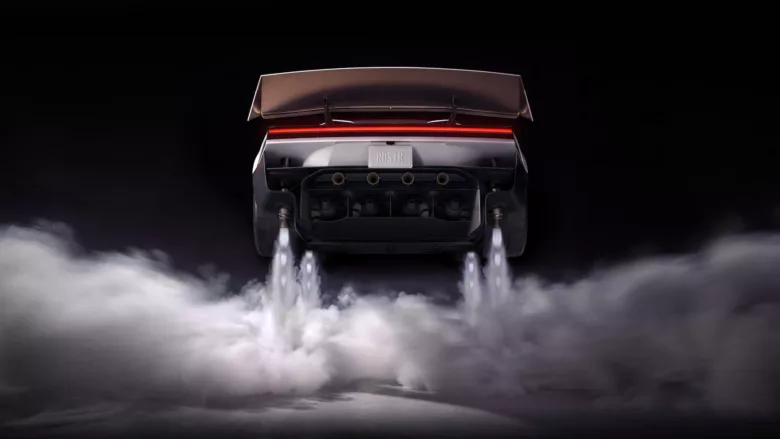
Nine years of waiting, and then it takes off: Tesla unveiled the second generation of its electric Roadster sports car overnight at a SpaceX test site in McGregor, Texas. The car drove up a curved wall, hovered on cold-gas thrusters and flipped over a row of parked Tesla vehicles. Production is set to begin in 2028. “Actually. For real,” Tesla assured the audience from the stage.
What the Show Delivered
Before the car appeared, SpaceX test-fired a Raptor rocket engine. The Roadster then drove up a curved ramp to a height of about 21 meters, nearly upside down, held in place by fans that suck air from beneath the car. It then kickflipped over a Cybercab, a Cybertruck, a Semi, a Model Y and a Model 3. A “Starman” mannequin sat behind the wheel while the car drove itself. That was “to make sure we don’t kill anyone,” Elon Musk said.
In the 0-to-60-mph (96 km/h) test, Tesla first showed a recorded run of about one second, then clocked 0.81 seconds live. Mr. Musk called the car “the best of the last of the human-driven cars” and said Tesla wants to jump it over Snake River Canyon in Idaho. The full event can be watched in Tesla’s livestream:
Three Versions, One by Invitation Only
After the livestream, Tesla published the configurations on X, as summarized by Electrek:
- Performance: The road-legal base version, with two seats, active aerodynamics and suction fans, reaches 60 mph in under 1.6 seconds.
- Thrust: The two-seat race version adds rear cold-gas thrusters and does the sprint in under 0.9 seconds. It will be built in limited numbers.
- Rocket: The single-seater, with thrusters all around the car, can lift off and rotate in the air. Tesla says it hits 60 mph in under 0.59 seconds and tops 230 mph (about 370 km/h). It is available by invitation only and is not approved for public roads.
Tesla credits SpaceX for the technology. Ten nozzles are fed by two carbon-fiber overwrapped pressure vessels with a combined 600 liters, holding about 250 kilograms of air. Thrust is said to exceed 80 kilonewtons, several times what the tires can transmit. The tanks can be refilled while driving, according to Tesla, which did not say how long that takes. The fans are supposed to allow cornering forces above 2 g. The design takes cues from the SR-71 reconnaissance plane and the F-35 fighter jet; the car is steered with a yoke via steer-by-wire, and the body is made of magnesium, titanium and carbon fiber.
Less Range and Fewer Seats Than Promised
A lot has changed since the 2017 prototype, which Trending Topics covered at the time. Tesla now quotes a range of more than 300 miles (about 480 kilometers), down from the roughly 620 miles (1,000 kilometers) it once promised. The four-seater has become a two-seater, and the top model has a single seat. The top speed of more than 230 mph is below the 250-plus mph announced back then. Acceleration, on the other hand, comfortably beats the 1.9 seconds promised in 2017. Our preview from the day before traces how long it took Tesla to get here.
Price Still Unknown
Tesla did not announce a price for any version. Reservations have reopened, however: $5,000 (about €4,500) is due immediately and a further $45,000 (about €40,100) within 10 days, or the reservation lapses. That adds up to $50,000 (about €44,600), exactly what Tesla asked in 2017. For the Thrust version, the deposit is $250,000 (about €223,000). In 2017, the base price was $200,000 (about €178,000).
Financially, the Roadster plays a minor role for Tesla. Seth Goldstein, an analyst at Morningstar, expects about 2,000 sales a year, compared with the roughly 1.6 million vehicles Tesla delivered last year. Mr. Musk himself said he was “not sure it moves the needle massively from a revenue standpoint.” He sees it as a showcase alongside A.I., robotaxis and the Optimus robot.
The Competition
On paper, Tesla’s acceleration figures beat every production car. The Rimac Nevera R, one of the fastest electric cars on the market, needs 1.72 seconds to reach 100 km/h, according to the manufacturer, and costs about €2.1 million. The top speed record is held by BYD’s Yangwang U9, at 496 km/h (308 mph). The British McMurtry Spéirling already uses the suction-fan principle and has set track records with it. Ferrari has entered the field with the all-electric Luce, starting at €550,000, though it is a four-door car with five seats.
Doubts About the Technology
Electrek, which has followed the Roadster’s delays for years, considers the demonstrations real but the performance figures unverified. In a technical analysis, the site argues that upward thrust offers no advantage while driving, because it reduces the tires’ grip. The rear and side thrusters, by contrast, could help with acceleration and cornering. Open questions remain about how often the thrusters can be used, how quickly the thrust kicks in and whether the gas jets would blow debris toward spectators on race tracks. Mr. Musk also conceded that the Roadster is “not necessarily a safety-optimized car” and is probably not road-legal in every country.