Tesla x SpaceX: Cold-Gas Thrusters Make the Roadster Fly and Fuel Merger Rumors


Set Trending Topics as a preferred source on Google.
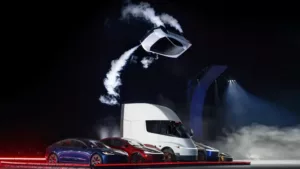
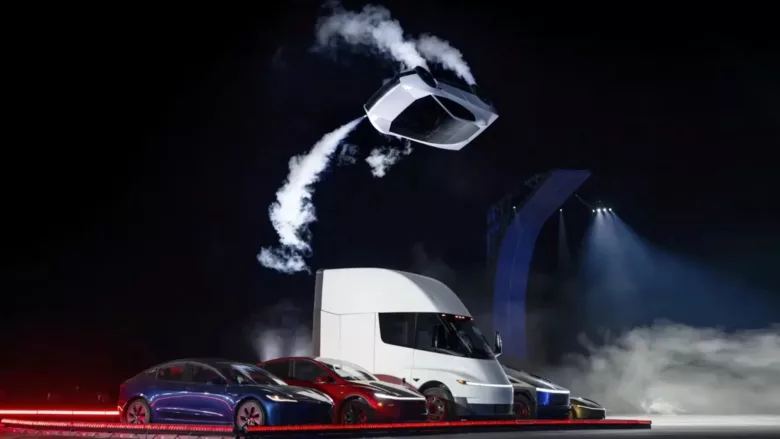
A sports car that flies because a rocket company helped build it: At the unveiling of the new Tesla Roadster, SpaceX was almost as much the star as the car itself. The show took place at SpaceX’s test site in McGregor, Texas, and opened with a test firing of a Raptor rocket engine. Elon Musk shared the livestream on X with just three words: “Tesla x SpaceX.” That was enough to reignite speculation about a merger of the two companies. The full event can be watched in Tesla’s livestream:
How the Roadster Flies
Two systems are behind the stunts. The first is a set of fans in the rear diffuser that suck air from beneath the car. The resulting vacuum presses the Roadster onto the ground, so strongly, according to Tesla, that it can cling upside down to a wall even when stationary. As the car drove up the curved ramp, the display showed 4,700 kilograms of downforce. In corners, the system is said to allow more than 2 g, according to Lars Moravy, Tesla’s vice president of vehicle engineering.
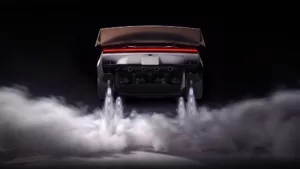
The second system is a set of cold-gas thrusters. Nothing is burned: Compressed air is stored in two carbon-fiber overwrapped pressure vessels, known as COPVs, which together hold 600 liters, or about 250 kilograms of air. Tesla says it used every usable void in the car for them. The air escapes through 10 nozzles. Four sit at the rear and push the car forward; the others, at the four corners, fire downward for liftoff and soft landings. Electric actuators fine-tune the nozzles and stabilize the car in the air.
Thrust is said to exceed 80 kilonewtons, enough, according to Tesla, to hold more than 8,000 kilograms against gravity. That is four to five times what the tires can transmit. “Every car on the road today is limited by one thing: tire grip,” Tesla writes. The thrusters bypass that limit. How long the Roadster can fly depends on the amount of gas; Tesla speaks only of short distances. The tanks are supposed to refill while driving. The car is “literally just going to puff itself up,” Mr. Musk said. How long that takes, Tesla did not say. During the demos, a “Starman” mannequin sat behind the wheel while the Roadster drove itself.
SpaceX’s Role
Making the thrusters work in the atmosphere required new hardware and new controls, developed together with SpaceX, according to Tesla. Engineers from both companies worked closely together, TechCrunch reports. COPV tanks are a standard component in SpaceX rockets, though they have also been involved in several of its explosions. The idea itself is old: Back in 2018, Mr. Musk announced a “SpaceX package” for the Roadster, with about 10 small rocket thrusters arranged around the car.
Mr. Musk was thrilled after the show. “Flying cars are real,” he said, calling the Roadster “better than any James Bond car.” As a next goal, he floated a jump over Snake River Canyon in Idaho.
What It Means for Everyday Driving and Where It Can Fly
Drivers should not expect much from the rocket technology in daily life. The road-legal base version, Performance, has no thrusters; it relies only on the suction fans and active aerodynamics. Those provide more grip on ordinary roads too, when accelerating, braking and cornering. Tesla calls the Thrust version, with rear thrusters, “race ready,” but has not said whether it may be driven on public roads. The flying Rocket version is explicitly not approved for public roads and is available by invitation only.
Mr. Musk himself was evasive on the question of road approval. The Roadster “will be an actual car that’s on the roads,” he said at first, before adding that he was “not necessarily sure it’s legal in all jurisdictions.” Asked by an audience member, he replied: “Depends on your street.” Realistically, that leaves private grounds, race tracks and shows for the flight function. Tesla does not have aircraft certification from the Federal Aviation Administration, and it has not commented on approval of the thrusters in Europe.
There are practical limits, too. Critics at Electrek doubt the thrusters can be used more than once every few minutes and warn that the gas jets could blast stones and debris toward spectators on race tracks. Axios writes that it is hard to imagine what practical purpose a flying sports car might serve, though the aerodynamics and traction technology could find its way into other cars. Mr. Musk conceded that the Roadster is “not necessarily a safety optimized car.”
Could a Merger Come This Year?
The close collaboration comes at a time when analysts are openly speculating about a combination. According to Barclays analyst Dan Levy, a deal could come as soon as this year, Axios reports. Barclays sees an all-stock acquisition of Tesla by SpaceX, with a premium for Tesla shareholders, as the most likely structure. Tesla’s annual meeting must be held by early December at the latest. If a deal were announced in late October or early November, it could be approved there. Otherwise, Barclays expects a deal within six to 12 months.
The numbers are enormous. Barclays values SpaceX at about $2.1 trillion (about €1.87 trillion) and Tesla at about $1.5 trillion (about €1.34 trillion). SpaceX only went public in June and had already absorbed Mr. Musk’s A.I. company, xAI, in February. For Mr. Musk, it would mainly be about control: He holds about 48 percent of SpaceX and about 82 percent of its voting power, and about 20 percent of Tesla. After a merger, he would hold about 37 percent of the shares and 56 percent of the votes, according to Barclays. Mr. Musk has repeatedly said he wants about 25 percent of Tesla to steer its A.I. and robotics strategy.
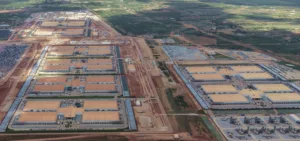
The analysts see A.I. as the main rationale. Tesla’s robotaxis and its Optimus robot could be linked with SpaceX’s A.I. model Grok, along with Starlink and Tesla’s energy storage for data centers in space. Mr. Musk’s planned chip factory, Terafab, which is meant to supply both companies with computing power, would also be easier to carry out within a single company.
What Stands in the Way
Neither Tesla nor SpaceX has confirmed any talks. A deal would require approval from the shareholders and boards of both companies, as well as antitrust authorities. Barclays cites further hurdles: SpaceX holds many U.S. government contracts, while Tesla has a large business in China, which could raise national security questions. And financially, the companies are not an easy fit. According to Bloomberg’s analyst consensus, Tesla is expected to generate about $12 billion (about €10.7 billion) in free cash flow in 2030, while SpaceX is expected to burn through about $17 billion (about €15.2 billion). Electrek, which has followed the Roadster critically for years, also sees the show as a piece of staging meant to tie the two brands more closely together ahead of a possible merger.