Trust Was the Product, And Bots Destroyed It: Digg’s Painful Second Collapse


Set Trending Topics as a preferred source on Google.
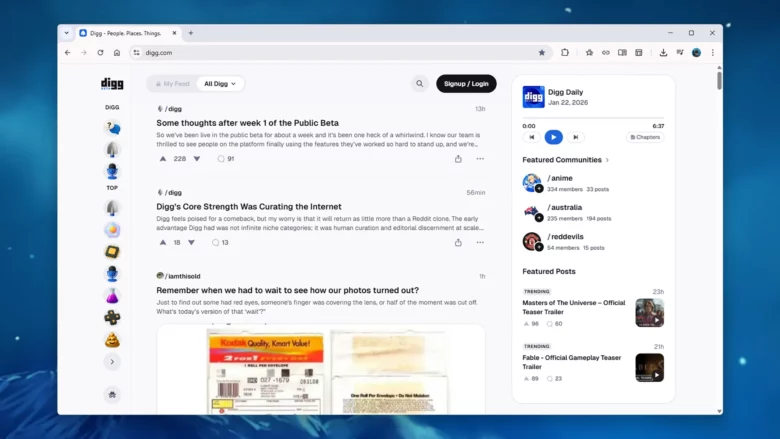
The link-sharing portal Digg, originally launched in 2004 and relaunched in summer 2025, has announced massive layoffs and removed its app from the App Store. CEO Justin Mezzell justified the move in a public statement by citing two central problems: an uncontrollable bot invasion and the crushing market power of established platforms like Reddit. However, the company emphasizes that Digg is not closing completely.
Bot problem from the start
Shortly after the beta launch, Digg was overrun by automated accounts. SEO spammers quickly recognized that the platform still possessed significant Google link authority and exploited this deliberately. The company blocked tens of thousands of accounts and deployed both internal and external security solutions, but without decisive success.
“The internet today is populated to a significant degree by sophisticated AI agents and automated accounts. We knew that bots would be part of the landscape, but we underestimated the scale, sophistication, and speed at which they would find us.”
For a platform whose core is based on user-generated voting, this was fatal. When votes, comments, and engagement can no longer be classified as genuine, the entire model loses its foundation. Mezzell summed up the problem succinctly:
“This is not just a Digg problem. It is an internet problem. But it hit us harder because trust is the product.”
Network effects as an insurmountable hurdle
Beyond the bot problem, Digg also failed to lure users away from existing platforms. The attachment to already-established communities proved too strong. Mezzell acknowledged that the original positioning as merely an alternative to Reddit simply was not enough:
“Network effects are not just a moat, they are a wall. The loyalty that users have toward the communities they have already built elsewhere is profound.”
What remains and what comes next
Despite the setback, the company is not giving up. A small team is to rebuild Digg in a fundamentally new form. Concrete plans have not yet been announced. In parallel, founder Kevin Rose, who originally launched Digg in 2004, is returning as a full-time employee. He will continue as an advisor at investment firm True Ventures, but will focus his efforts on Digg.
The company’s own podcast Diggnation is to continue appearing monthly. Mezzell directed closing words of thanks to the laid-off employees:
“You bet on a difficult problem and showed up every day. The work you did laid the foundation for what comes next, even if it doesn’t feel that way right now.”
Background
Kevin Rose and Reddit co-founder Alexis Ohanian acquired the Digg brand rights in early 2025 in a third-party financed buyout, in which True Ventures, Ohanian’s firm Seven Seven Six, and venture company S32 were involved, among others. The goal was to create a platform where communities would have more control and responsibility over their content. This goal remains unachieved for now.