Z.AI From China Confirms It Built Ox Alpha, and the Model Is Going Open Weight


Set Trending Topics as a preferred source on Google.
For about a week, an anonymous AI model kept the developer community guessing. Now the answer is out: the Chinese company Z.ai, formerly known as Zhipu AI, has confirmed to Bloomberg that the model circulating under the name “Ox Alpha” is a new iteration of its GLM series. The weights are due to be published tonight, which means the model arrives as an open weight release.
The move fits the course Z.ai has been steering for some time. Its GLM models are the reason the company registers internationally at all: they are released with open weights on a regular basis and have ranked among the strongest freely available language models for months. Most recently, though, Z.ai pushed back the weight release for GLM-5.3 by roughly two weeks, citing the model’s ability to find security vulnerabilities. During that window, full access was to remain limited to selected security partners.
How the Hype Began
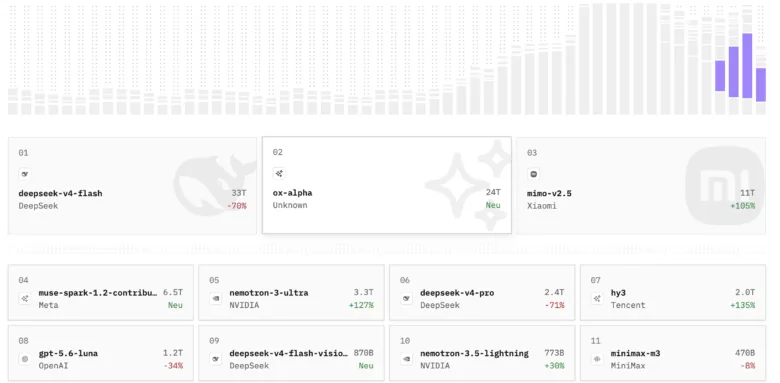
Ox Alpha surfaced last Thursday, with no announcement and no identifiable provider. On OpenRouter it simply ran under the provider name “Stealth,” and it was available in parallel through OpenCode, Cline and a portal operated by Nous Research. The terms drew attention: free to use, a context window of one million tokens, text, image and video input, plus tool calling. OpenCode spoke of capacity for 100 trillion tokens a day, and Nous Research cited even higher figures.
Then came the first measurements. On a small sample of the DeepSWE coding benchmark, the model scored 80 percent according to Decrypt, putting it ahead of Claude Fable 5 and GPT-5.6 Sol. Across the full 113-task run, the lead narrowed to roughly 63 percent, which is about the level of GPT-5.6 Sol. Stripe founder Patrick Collison called the model “very impressive” on X, which amplified the attention further. On OpenRouter’s usage charts, Ox Alpha climbed steadily, driven in part by coding agents such as Claude Code and Hermes Agent.
With no provider stepping forward, a public guessing game began. Alongside Zhipu, the candidates included Microsoft’s MAI family, DeepSeek, Xiaomi’s MiMo and Google.
Where Zhipu Stands in the Rankings
In the Intelligence Index from Artificial Analysis, GLM-5.3 in its max configuration scores 60 points. That puts it level at the top of the open model field with Moonshot’s Kimi K3, which also reaches 60. Proprietary systems still hold the overall lead: Claude Opus 5 scores 63, Claude Fable 5 scores 62, and GPT-5.6 Sol and the high variant of Claude Opus 5 score 61 each. The gap between the open and the closed frontier has shrunk to a handful of points. On estimated cost per task, GLM-5.3 sits at 0.68 US dollars, below Kimi K3 but well above its predecessor GLM-5.2, which is estimated at 0.44 US dollars and scores 53 on the index.
In the blind voting ranking at Arena.ai, formerly LMArena, glm-5.3-max holds 13th place with 1,487 points. Ahead of it are several variants of Anthropic’s Claude series, Meta’s Muse Spark, Google Gemini and kimi-k3-max, which edges past it in 10th place with 1,489 points. Claude Fable 5 leads the board with 1,508 points. Older GLM generations sit further down the field, with GLM-5.2 in 34th place.
If Ox Alpha confirms in the official rankings what the community tests have measured, Z.ai’s position among open models should firm up further. The company has aimed its recent GLM releases squarely at coding and agentic workloads, including GLM-5-Turbo for OpenClaw, and it has been a listed company since its IPO in Hong Kong. Earlier generations such as GLM-5, trained exclusively on Huawei chips, and GLM-5.2 had already shown how quickly the distance to US providers is closing.