Apple Ditches OpenAI for Google: Multi-Billion Dollar Partnership Reshapes AI Landscape


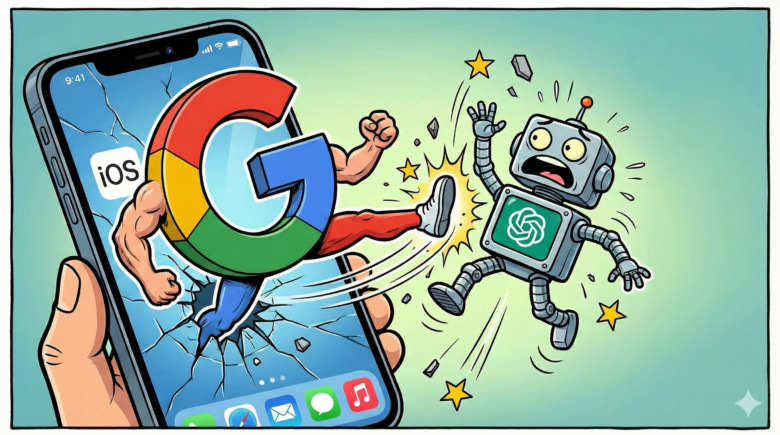


In June 2024, it was a momentous occasion for Sam Altman when his company OpenAI announced that its AI ChatGPT would be deeply integrated into Apple’s iPhone and other devices. The tight integration of the AI chatbot into Apple’s far-reaching ecosystem contributed significantly to OpenAI boasting 900 million users. But two years later, in 2026, a turning point has been reached with regard to Apple.
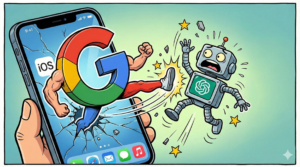
For Apple has as reported concluded a multi-year cooperation agreement with Google that has far-reaching implications for the AI landscape. The next generation of Apple Foundation Models will henceforth be based on Google’s Gemini models and cloud technology, as both companies announced in a joint statement. Meanwhile, OpenAI, partnering with former Apple chief designer Jony Ive, is taking a confrontational course and wants to bring its own AI hardware to market.
Google Technology as the Basis for Apple Intelligence
The Gemini models are set to power various Apple Intelligence features in the future, including an improved version of the Siri voice assistant, which is expected to launch later this year. According to Apple’s own statements, the company examined various options and determined that Google’s AI technology provides the most powerful foundation for its own Foundation Models.
The contract is structured as a cloud computing agreement. According to a Financial Times report, Apple could pay Google several billion dollars over time. Analysts estimate the value of the contract at up to 5 billion dollars. The launch of Apple’s second attempt at AI with the help of Gemini is expected for the second quarter of 2026.
It is important to distinguish between Google’s Gemini assistant as a standalone app and the underlying Large Language Model (LLM), which is also called Gemini. Apple uses the LLM as a technological foundation, not the consumer assistant. Users will interact with the new Siri version without directly perceiving the underlying Google technology.
Data Protection and Technical Implementation
Apple emphasizes that privacy standards will be maintained. Apple Intelligence is intended to continue running primarily directly on devices. For more computationally intensive applications, Apple relies on its own “Private Cloud Compute.” According to current knowledge, user data or sensitive information will not be passed on to Google.
Cautious Investment Strategy
The agreement reflects Apple’s cautious approach to AI investments. While Google, Microsoft, Amazon, and Meta have invested hundreds of billions of dollars in new AI data centers since ChatGPT’s launch in 2022, Apple has kept its infrastructure investments constant at approximately 3 percent of revenue over the past five years.
For fiscal year 2025, Apple spent 12.7 billion dollars on property, plant, and equipment – significantly less than the approximately 90 billion dollars Google is expected to invest. Apple sources most of its cloud infrastructure from third-party providers and focuses on smaller, specialized AI models that can run directly on devices.
Consequences for OpenAI
The agreement represents a significant setback for OpenAI. Since 2024, the company had integrated ChatGPT into Apple Intelligence features and hoped to reach millions of iPhone users through this partnership. Analysts expect that the ChatGPT integration will lose significance in light of the more comprehensive Google agreement.
A person familiar with OpenAI told the Financial Times that the company deliberately decided in the fall of last year not to become a customized model provider for Apple, and instead is focusing on developing its own AI devices.
Meanwhile, the market is seeing Google steadily narrow its gap with ChatGPT. Gemini is said to have more than 650 million users, while OpenAI reaches 900 million. In the advertising business, OpenAI wants to attack Google in 2026 with the launch of advertising.
Google’s Strengthened Position
For Google, the deal represents a significant strengthening of its market position. According to its own statements, Google has closed the performance gap with OpenAI in recent months. With the Apple cooperation, Google’s AI models are now integrated on both Android and iOS devices – essentially on the vast majority of all smartphones worldwide.
The agreement is reminiscent of the deal concluded two decades ago that established Google’s search engine as the standard on Apple devices and now brings Google approximately 20 billion dollars annually from Apple.
Apple’s AI Strategy Under Criticism
The decision is seen as an admission that Apple missed the early phase of intensive AI research. While the company worked on its own AI models, it missed the developments that competitors like Google have invested in over years.
Apple is also struggling with staff turnover: several high-ranking AI experts, including Ruoming Pang, head of the Foundation Models team, as well as senior researchers Tom Gunter and Mark Lee, switched to Meta.
Despite criticism of insufficient AI investments, Apple’s stock has gained over 12 percent in the past twelve months, supported by the successful launch of the iPhone 17 and easing tariff risks.