Infineon Puts €1.1 Billion Into a GaN Chip Factory in Austria


Set Trending Topics as a preferred source on Google.
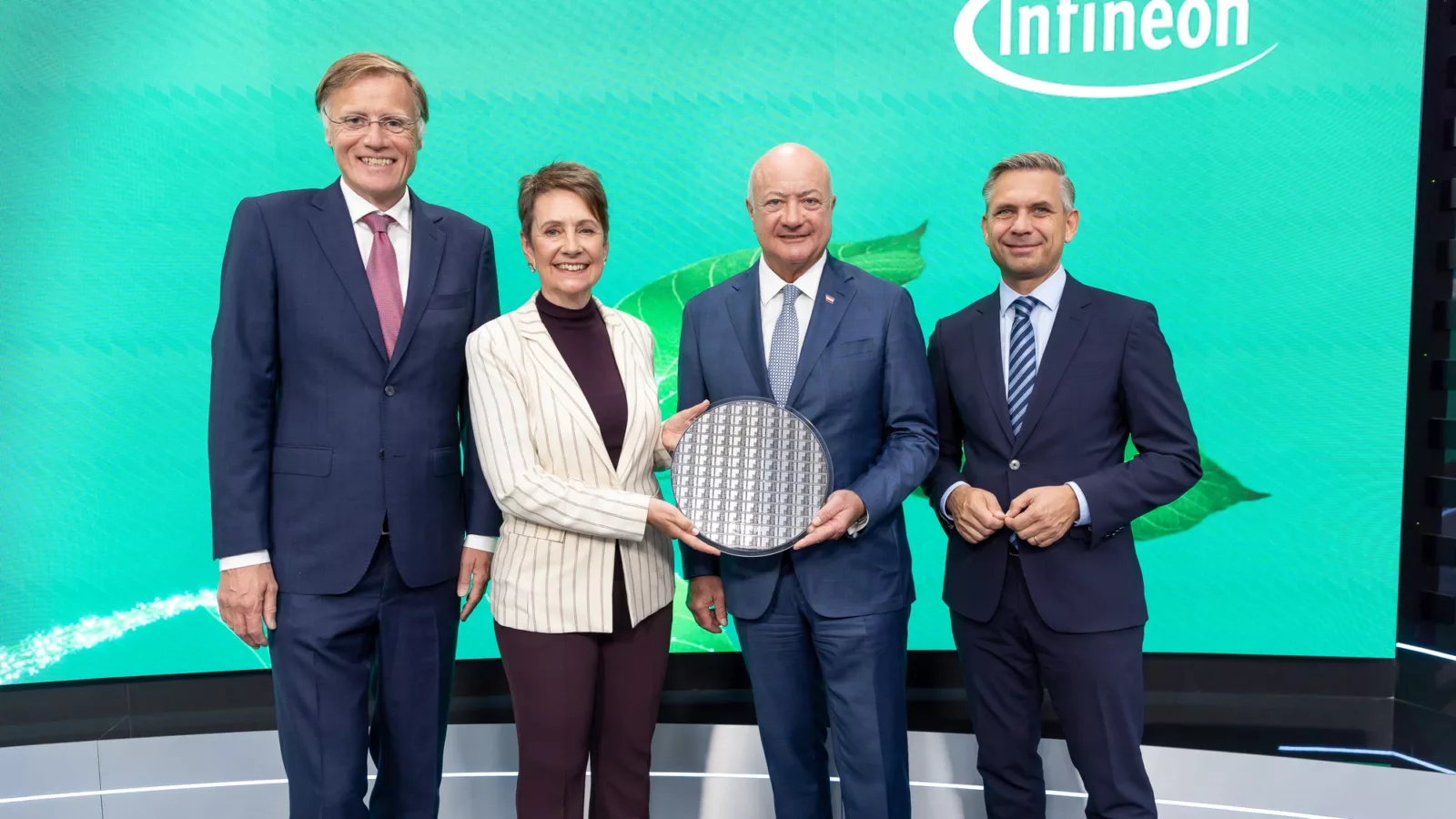
Silicon is yesterday’s material, at least in Carinthia: Infineon is building what it says will be the world’s first high-volume manufacturing facility for gallium nitride (GaN) power semiconductors on 300-millimeter wafers in Villach, Austria. The Munich-based chipmaker will invest around €1.1 billion in existing cleanroom space at the site through 2034, Infineon announced at a news conference in Vienna on Tuesday. Production is scheduled to start by the end of 2027.
Why Gallium Nitride?
Power semiconductors control how electricity flows, from phone chargers to servers. Gallium nitride can switch and convert power much faster and more efficiently than conventional silicon, making devices smaller, with lower energy losses and less heat. Infineon is targeting these markets in particular:
- A.I. data centers: More efficient power supplies for servers, whose energy needs are growing rapidly.
- Energy infrastructure: Including solar installations and grid technology.
- E-mobility and robotics: More compact drives and charging technology.
- Consumer electronics: Smaller and faster chargers.
The move to 300-millimeter wafers is the heart of the announcement. According to Infineon, a larger wafer yields 2.3 times as many chips as the 200-millimeter wafers commonly used today. Infineon processed its first 300-millimeter GaN wafers two years ago, and the technology is now moving into mass production. The ramp-up will be aligned with market demand, the company said. The market research firm Yole Group expects the market for GaN power semiconductors to grow to about $3.5 billion (roughly €3.1 billion) by 2031, an increase of around 35 percent a year.
“By establishing high-volume manufacturing on 300-millimeter wafers, we will be the first company in the world to bring gallium nitride power electronics into volume production,” said Jochen Hanebeck, Infineon’s chief executive.
€319 Million in Subsidies, but No New Jobs
The investment is being supported with €319 million under the European Chips Act. The European Commission has already approved the state aid, while formal approval from Austria’s economy ministry is still pending. Politicians celebrated the project accordingly: Chancellor Christian Stocker called it “one of the largest single investments in the history of Austria’s high-tech industry.” Wolfgang Hattmannsdorfer, the economy minister, noted that Europe accounts for only around 10 percent of global chip production and said the aid would be granted “subject to clear funding criteria for the location.”
The billion-euro investment will not create any new jobs, however. Sabine Herlitschka, the chief executive of Infineon Austria, said it would secure existing positions, according to the news agency dpa. Infineon Austria employs about 5,800 people, around 4,800 of them in Villach. Because the plant is being built into existing cleanrooms, the project is also far smaller than the new factory in Dresden that Infineon opened in the summer, which at around €5 billion is the largest single investment in the company’s history.
The announcement comes at a difficult time for Infineon on the stock market. Its shares have lost about 40 percent since mid-June, and chip stocks in general are under pressure.
The Competition
The GaN market has seen a lot of movement recently. TSMC, the world’s largest contract chipmaker, has announced that it will exit the GaN foundry business by mid-2027, partly because of price pressure from Chinese rivals, TrendForce reported. The most important of those challengers is China’s Innoscience, which describes itself as the largest GaN manufacturer on 200-millimeter wafers. Specialized GaN companies such as Navitas in the U.S. and large chipmakers such as STMicroelectronics and Texas Instruments are also working on GaN power chips. Infineon is betting that its early move to 300-millimeter wafers will give it a cost advantage over the competition.