Italy’s Nuclear Comeback Raises High Hopes Among SMR Companies


Set Trending Topics as a preferred source on Google.
Rome has barely reopened the door to nuclear power, and reactor companies are already lining up. The Italian Parliament has just given final approval to a law paving the way for the country’s return to nuclear energy, almost four decades after it abandoned atomic power in the wake of Chernobyl. The Senate passed the bill by 81 votes to 51 with 7 abstentions, following approval by the Chamber of Deputies in June. The first companies wasted no time in signaling their interest in the new market.
What the Law Does
The law does not approve any reactors yet. It is a framework law that empowers Prime Minister Giorgia Meloni’s government to set out the details by decree: the construction and operation of plants, safety standards, the handling of spent fuel and the production of hydrogen using nuclear energy. It also provides for a national program for “sustainable nuclear power” and an independent nuclear safety authority. Advanced technologies and small modular reactors (SMRs) are explicitly in focus.
According to Wanted in Rome, the implementing decrees are due within twelve months, and the first plants could come online in 2033 or 2034 at the earliest. Energy Minister Gilberto Pichetto Fratin sees nuclear power as a complement to renewables on the road to climate neutrality by 2050. The opposition is pushing back: Angelo Bonelli of the Green and Left Alliance (AVS) called the plan “economic folly” and demanded transparency on costs and financing. Italians had already voted against nuclear power in two referendums, in 1987 and 2011.
Terra Innovatum Positions Itself
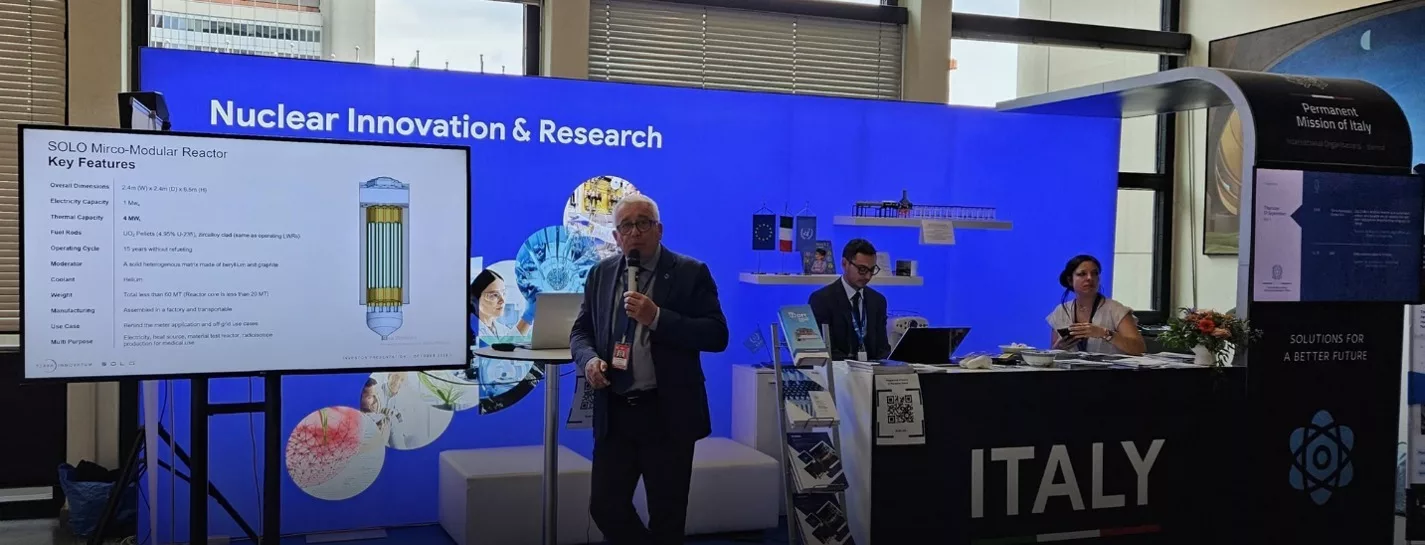
Terra Innovatum was among the first companies to speak up. The Nasdaq-listed company, built by Italian founders led by CEO Alessandro Petruzzi, is developing SOLO, a microreactor with an electrical output of one megawatt per unit. “Italy has remained an important contributor to the nuclear supply chains of both Europe and the United States,” Petruzzi said in a statement. The decision, he added, recognizes the growing role advanced nuclear technologies can play in providing reliable, carbon-free power.
At the General Conference of the International Atomic Energy Agency (IAEA) in Vienna, Italy presented SOLO as the country’s domestic microreactor solution. The company now intends to explore how to bring its technology, industrial partnerships and supply chain to the Italian market. Its main target customers are data centers, industrial facilities and other energy-intensive sites that want to generate power on-site.
Terra Innovatum says it has around $4 billion (roughly €3.4 billion) in pre-commercial commitments, although the reactor has not yet been licensed. SOLO is currently going through the licensing process of the U.S. Nuclear Regulatory Commission (NRC). The company is targeting the approvals required for a first-of-a-kind plant by the end of 2027 and commercial deployment by the end of 2028.
Italian Industry Is Already in the Starting Blocks
Terra Innovatum is far from alone. Italy’s major industrial groups positioned themselves well before the parliamentary vote: utility Enel, power plant builder Ansaldo Energia and defense and technology group Leonardo set up the joint venture Nuclitalia last year to evaluate technologies for new reactors.
Another contender is Newcleo. Founded by Italian entrepreneur Stefano Buono and now based in Paris, the startup is developing lead-cooled reactors and is seen as a favored partner of the government in Rome, which, according to World Nuclear News, considered a stake of around €200 million through state-controlled entities. French state-owned utility EDF has also announced SMR partnerships through its Italian subsidiary Edison, together with Ansaldo and engineering group Maire. International players such as Westinghouse and GE Vernova Hitachi are likely to be watching the process closely as well.
The Open Questions
Whether the bet pays off remains to be seen. Hardly any SMR design worldwide has made it into commercial operation so far, and critics have long pointed to high costs per megawatt hour and lengthy development times. Investor enthusiasm has cooled too: according to the Financial Times, the SMR sector has lost around $30 billion (roughly €26 billion) in market value since its peak in October 2025. Italy also has yet to solve the question of nuclear waste, as the country has been searching for years for a site for a national radioactive waste repository. For the companies, the real work starts now, as the technologies, sites and financing models that make the cut will only be decided through the decrees of the coming months.