US Opposition Stalls 120 Data Center Projects Worth Nearly €170 Billion


Set Trending Topics as a preferred source on Google.
The AI boom needs concrete, power and water, and a growing number of American communities are saying no before anyone even asks. According to the latest quarterly report from the research project Data Center Watch, at least 45 data center projects worth around €58 billion ($68 billion) were blocked or delayed between April and June. That amounts to more than half of all large-scale projects newly proposed during the quarter.
Fewer Stalled Projects Than in the First Quarter
Compared with the start of the year, the number of blocked projects did not rise. It fell. In the first quarter, Data Center Watch had counted at least 75 stalled or delayed projects worth around €111 billion ($130 billion). According to the report, that was the largest single-quarter concentration of blocked data center projects on record, roughly matching the volume for all of 2025.
By comparison, the number of affected projects dropped by 40 percent in the second quarter, while the investment volume at stake nearly halved. Taken together, disruptions in the first half of the year add up to around 120 projects and nearly €170 billion.
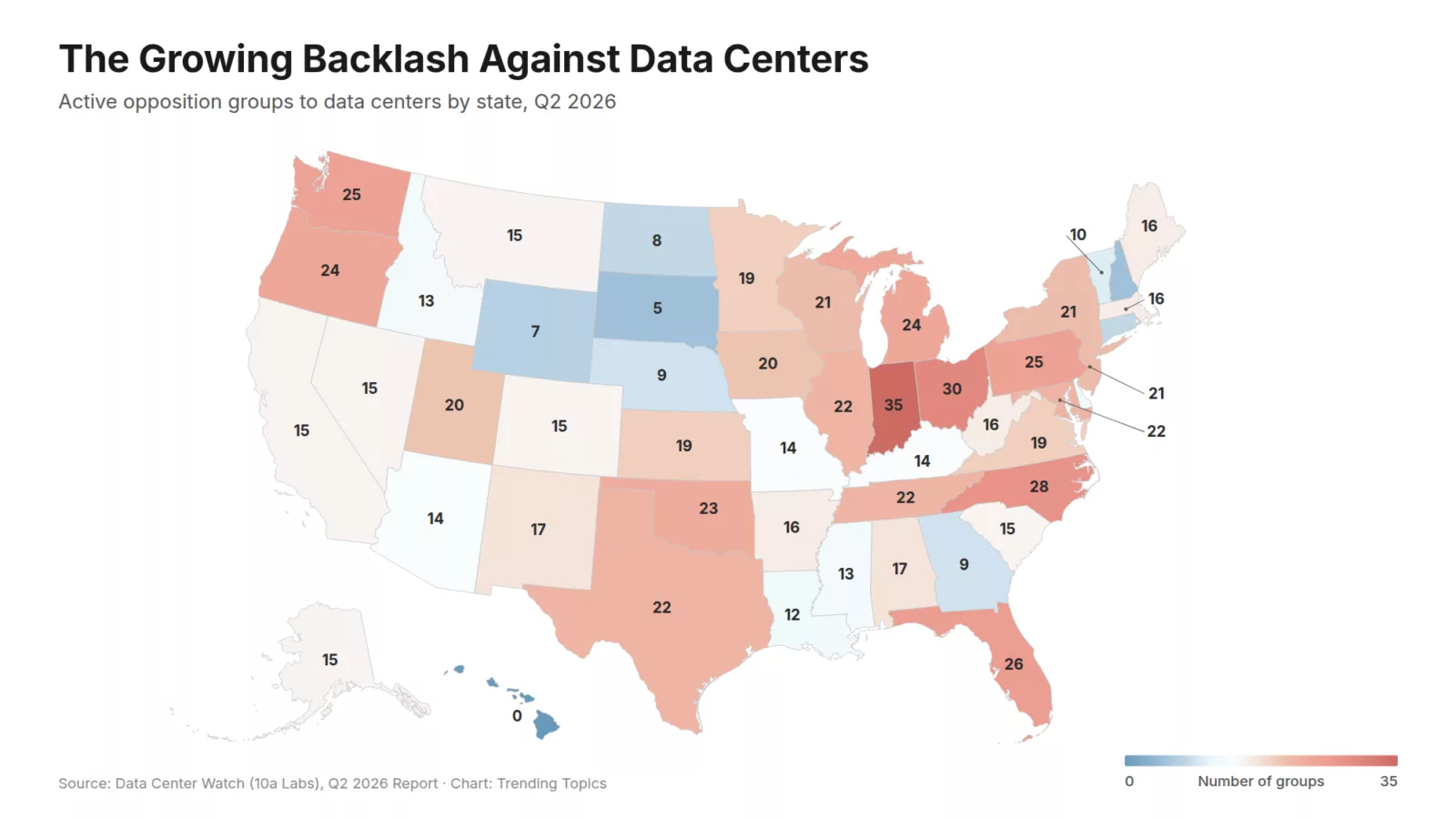
The number of organized opponents, meanwhile, ticked up slightly. Data Center Watch now counts 843 local opposition groups across 49 states, up from 833 at the end of March. The big jump came earlier: at the end of 2025, the figure stood at 396. The report’s authors describe project disruption as remaining at an “elevated level,” with opposition becoming increasingly local and focused on individual permitting and infrastructure decisions.
Moratoriums in Advance
What has changed is the nature of the response. Local and state governments are no longer only reacting to specific applications but are regulating ahead of time. Moratoriums and temporary restrictions give officials time to draft rules on land use, water, electricity and infrastructure, often before developers have even signaled interest.
Examples from the report:
- Santa Fe County, New Mexico: The county adopted the state’s first preemptive data center moratorium, pausing new construction for 18 months while officials develop land-use and environmental standards.
- Superior, Wisconsin: The city enacted a one-year moratorium after Google proposed a hyperscale data center worth around €1.7 billion in neighboring Hermantown, Minnesota.
- Harpersville, Alabama: The town council approved a six-month pause even though the town itself had not received a proposal. The trigger was developers approaching neighboring communities.
- Jefferson, Texas: After Gov. Greg Abbott ordered a statewide pause on grid connections along with an audit, the city council unanimously came out against new data center development.
- Independence County, Arkansas: Officials imposed a moratorium through 2031, citing limited water supplies, again without any specific project on the table.
Statehouses also stayed busy as legislative sessions wound down. Through legislation, executive orders and regulatory directives, states debated or adopted rules on construction, tax incentives, utility costs and how those costs are allocated. According to the report, around 30 state legislatures introduced or passed such measures.
Data Centers Head to the Ballot Box
The issue is also reaching voters directly. Seventeen data center-related ballot measures have advanced during the current election cycle, while another 10 were proposed but did not make it. They cover zoning, requiring voter approval for new projects, energy and water use, noise limits and financial guarantees tied to tax abatements.
The political front is notably broad: both Republican- and Democratic-led states are advancing targeted rules. According to Data Center Watch, there is little evidence so far that positions on data centers actually decide elections. Still, candidates in both parties are increasingly treating the topic as a campaign issue ahead of the midterms. Public sentiment gives them cover: a Gallup poll found that seven in 10 Americans oppose building AI data centers in their area, with 48 percent strongly opposed.
Power Bills and Secrecy in Focus
The debate is shifting toward infrastructure costs. Communities are increasingly asking who pays for new power plants and transmission lines and how that affects utility rates. Trending Topics has already examined how AI data centers are driving up electricity prices for US consumers.
Transparency is another point of contention. Undisclosed contract terms, tax incentives and nondisclosure agreements (NDAs) with local governments have fueled calls for greater disclosure. Some states have since started restricting the use of such NDAs.
The Other Side: Tax Revenue and Jobs
Supporters point to the economic upside. In Oregon, for example, data centers generate around €51 million ($60 million) in statewide tax revenue, according to a recent study reported by KPTV. For hyperscalers such as Google, Microsoft, Amazon and Meta, the buildout also remains strategically essential to meet the computing demands of AI models.