A.I.’s Gas Rush: Now Even Old Jet Engines Are Being Pressed Into Service


Set Trending Topics as a preferred source on Google.
The A.I. boom is raiding the aircraft boneyard: Because new gas turbines take six years on average to deliver in the United States, data center operators are buying used turbines and aircraft engines converted into power plants. That is the finding of a Reuters analysis published on Monday. At the same time, the A.I. labs are stocking up on gas power themselves: Anthropic is paying $3.4 billion (about €3.05 billion) for gas generators, and SpaceX has bought nearly $3 billion worth of turbines.
A Six-Year Wait for a Turbine
The market for large gas turbines is dominated by Siemens Energy, GE Vernova and Mitsubishi Heavy Industries, and all three say A.I. demand exceeds their capacity. The numbers, according to Reuters:
- Lead time: In the United States, delivery takes six years on average, and conversations center on deliveries in 2030 and 2031, according to the research firm Wood Mackenzie.
- Shortfall: Worldwide, orders exceed 100 gigawatts, while production capacity is 60 to 70 gigawatts. Even in 2028, demand of 129 gigawatts is expected to far outstrip the 87 gigawatts that could be built by then.
- Prices: New turbines cost $2 million to $2.5 million per megawatt, well-maintained used ones $1.5 million to $1.7 million, and refurbished ones about $1.3 million.
U.S. data centers alone account for nearly 17 gigawatts of demand this year, the investment bank Jefferies estimates, and that could more than triple by 2028. The United States is already planning nearly three times as much gas power as in 2023.
From Jumbo Jet Engine to Power Plant
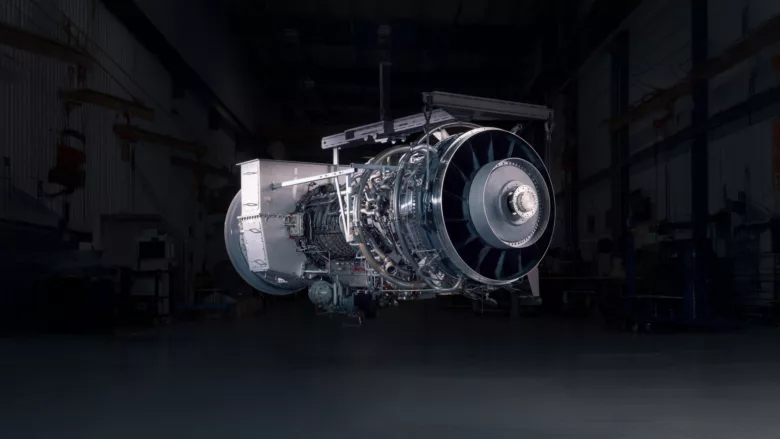
Those who do not want to wait until 2031 turn to aeroderivatives, turbines derived from aircraft engines. Several companies now convert retired engines:
- ProEnergy: The American company turns CF6-80C2 engines, the kind that power the Boeing 767, into power turbines of up to 48 megawatts. Crusoe, the data center builder constructing the Stargate campus in Texas for OpenAI, ordered 13 of them in April, for a combined 650 megawatts.
- FTAI Power: The subsidiary of the engine specialist FTAI Aviation converts CFM56 engines, of which more than 22,000 have been built. One unit delivers about 25 megawatts. FTAI has contracts for more than 100 units for 2027 and 2028, according to the trade publication AeroTime, and an unnamed cloud company placed a $1.465 billion order (about €1.32 billion) in July.
- xAI: Elon Musk’s A.I. company, now part of SpaceX, is running eight converted jet-engine turbines in Mississippi, according to The New York Times, as TechCrunch reported.
With such units, a data center can be up and running in 24 months, according to the research firm Rystad.
Boom Supersonic: A Supersonic Start-Up Turned Power Plant Builder
Boom Supersonic has taken the most unusual path. The American start-up is developing the supersonic jet Overture and, since late 2025, has been selling the core of its Symphony engine as a 42-megawatt gas turbine called Superpower. At the launch, Boom raised $300 million and announced an order from Crusoe for 29 turbines with 1.21 gigawatts, worth $1.25 billion.
That came to nothing: In September, Boom’s chief executive, Blake Scholl, announced that the two companies were no longer launching Superpower together. He gave no reasons. Boom still plans to deliver about 250 megawatts to other sites in 2027 and to reach 1 gigawatt in 2028.
The Gas Deals of the A.I. Companies
The A.I. labs themselves are buying, too:
| Company | Deal | Size |
|---|---|---|
| Anthropic | Gas generators from Caterpillar | 1.7 gigawatts for $3.4 billion |
| SpaceX (xAI) | Gas turbines, according to its I.P.O. filing, plus a 41-turbine plant in Mississippi | Nearly $3 billion, 1.2 gigawatts |
| Crusoe | 13 converted jet engines from ProEnergy | 650 megawatts |
| Unnamed cloud company | More than 100 CFM56 units from FTAI | $1.465 billion |
| U.S. data centers | Gas engines from Wärtsilä | About 3 gigawatts since spring 2025 |
The most recent deal is Anthropic’s. As The Financial Times reported over the weekend, the maker of Claude is paying $3.4 billion for generators with up to 1.7 gigawatts of capacity. According to TechCrunch, Anthropic is taking over an order placed about two years ago that the Texas-based provider OnePWR Solutions could not finance. Delivery will take place over the next two years. The Financial Times called it the largest single purchase of power generation equipment by an A.I. lab so far. The timing is delicate: Anthropic is about to go public and has nearly $900 billion in commitments for computing power.
SpaceX has agreed with regulators in Mississippi to remove all 69 mobile turbines at its Southaven site by July 2027. A permanent 1.2-gigawatt plant is to replace them. Mr. Musk has also bought APR Energy, an operator of mobile gas and diesel turbines, according to Electrek. Google, Amazon, Microsoft and Meta have likewise announced gas plants of their own at their sites.
What It Means for Aviation
The demand is reaching aviation, for now mainly in the secondhand market. FTAI’s chief executive, Joe Adams, told investors that retired CFM56 engines are worth more as power units than as parts. AerFin, a British parts trader that dismantles old engines, now competes with buyers from the data center industry, AeroTime reported. And at Pinal Airpark, an aircraft boneyard in Arizona, inquiries from energy developers are piling up, according to The New York Times.
The investment bank Alderman & Co even sees the shift toward energy contracts as a strain on engine makers. There is no evidence so far, however, that airlines are short of engines because of it. The orders of magnitude differ widely: GE Aerospace delivered nearly 2,400 commercial engines in 2025, while just over 1,300 units of the LM6000, the power turbine derived from the CF6, have been built in its entire history.
Fast Power With Side Effects
The stopgap comes at a price. Converted jet engines are less efficient and emit more pollutants than regular power plant turbines. Aurora Tenorio of Wood Mackenzie warns that used turbines can come with unclear maintenance histories and limited remaining life, and that converted engines raise the question of whether they are suited to continuous operation. Noor Qureshi of Enverus Intelligence Research doubts that the secondhand market can meaningfully offset the delays, because permits and grid access are missing, too.
Then there is local resistance. The N.A.A.C.P. is suing xAI over turbines that ran without permits and, according to the lawsuit, emit more than 5,000 tons of nitrogen oxides a year. A federal court recently allowed the case to proceed. Since the Democrats’ election victory, political pressure on new data centers has been growing as well.
Supporters counter that there is no way around gas. Nvidia’s chief executive, Jensen Huang, told The New York Times that the A.I. industry would use a lot more fossil fuel for now. A case from England shows how tight things get without on-site power: Microsoft pulled out as the anchor customer of a data center in Loughton because the grid operator cannot deliver the electricity until the 2030s.