Anthropic I.P.O.: $64 Billion From the Market, $26 Billion From Nvidia, Google and Others


Set Trending Topics as a preferred source on Google.
First leaked, then retracted, now official: Anthropic aims to raise as much as $64.4 billion (about €57.9 billion) in its initial public offering, well short of the $100 billion that had been floated. That is according to the updated prospectus the maker of Claude has just filed, Reuters reported. Another $26 billion is coming from tech giants including Google, Nvidia and AMD, which are investing through a private placement. Together, that would add up to as much as $90.4 billion (about €81.2 billion).
The Key Terms
With the new figures, Anthropic is starting its roadshow, the marketing tour for investors. The main points, according to Reuters:
- Price range: $70 to $78 a share (about €63 to €70). The shares are being sold by Anthropic itself and by some existing investors.
- Size: As much as $64.4 billion at the top of the range.
- Private placement: $26 billion (about €23.4 billion) from seven cornerstone investors: Google, Nvidia, AMD, Broadcom, Micron, Microsoft and TSMC.
- Total: As much as $90.4 billion.
- Banks and exchange: Goldman Sachs and Morgan Stanley are leading the underwriting syndicate, and the shares will trade on the Nasdaq under the ticker “ANT.”
From Leak to Official Number
The figures have a turbulent backstory. On Monday, Anthropic emailed its banks a filing that listed 866.7 million shares at $70 to $80 each, or as much as $69.3 billion, Reuters reported. Shortly afterward, a second email declared the pricing details inaccurate. At the top of the range, the official version now comes in about $5 billion lower.
| Metric | Previously floated | Monday’s leak | Current prospectus |
|---|---|---|---|
| Size of the I.P.O. | $80 billion to $100 billion | Up to $69.3 billion | Up to $64.4 billion |
| Price range per share | Open | $70 to $80 | $70 to $78 |
| Private placement | Not known | $26 billion | $26 billion |
| Total | Up to $100 billion | Up to $95.3 billion | Up to $90.4 billion |
The $100 billion figure had been circulating in reports for weeks. As recently as last week, reports citing The Wall Street Journal said Anthropic might raise only about $80 billion. The prospectus comes in lower still.
That also leaves SpaceX’s record untouched. Elon Musk’s space company raised $75 billion in June at a valuation of nearly $1.75 trillion, according to Reuters; including the additional shares allotted to the banks, the total was $86.2 billion. Anthropic clears that mark only with the private placement.
More Than a Quarter From Chip and Cloud Companies
The $26 billion from the cornerstone investors changes the picture. More than a quarter of the total would come from chip and cloud companies rather than from the stock market. Google is also among the partners with which Anthropic has locked in computing capacity for the coming years, according to Reuters. Among the growing concerns of investors in the A.I. industry, Reuters lists circular financing arrangements, the risk of infrastructure overcapacity and the question of how quickly A.I. investments turn into revenue.
What It Means for the Valuation
The Reuters report does not state a valuation. Estimates so far are based on the leaked range: Shay Boloor of Futurum Equities arrived at about $1.4 trillion, according to Stocktwits, and the Seoul Economic Daily, a South Korean newspaper, reported $1.18 trillion to $1.35 trillion. With the ceiling at $78 instead of $80, the top end mathematically shifts down by 2.5 percent.
The descent came in stages. In early October, Bloomberg reported a target of as much as $2 trillion. When the prospectus was published, investors were expecting $1.5 trillion to $1.75 trillion. After the selloff that followed the U.S. midterm elections, some considered only $1 trillion realistic. Potential investors pushed for a more attractive valuation, Reuters reported, with some viewing the recently discussed $1.5 trillion as the high end of expectations. The range still sits well above the last private round: Anthropic was valued at $965 billion in May.
What Anthropic Needs the Money For
Anthropic has nearly $900 billion in computing commitments, including with Amazon and Google, according to Reuters. Some of that depends on financing beyond the company’s control. About $69.8 billion comes due within 12 months, according to the prospectus. The offering alone would not cover that sum even at the top of the range; together with the private placement, it would. Anthropic already has $146.6 billion in liquid assets, however.
The business keeps growing, though more slowly. In the third quarter, revenue rose 47 percent from the previous quarter to $16.96 billion (about €15.2 billion), after a jump of 144 percent the quarter before. The bottom line showed a net loss of $23 billion, smaller than in the prior quarter.
The Competition
Compared with its rivals, Anthropic still looks strong. OpenAI has called off its I.P.O. and cut its funding round to $20 billion from $30 billion, at a valuation of $1.25 trillion. According to Reuters, Anthropic would be one of the few major companies to go public at all this fall.
What Happens Next
The price range is indicative, and the final offering price will be set only after the roadshow. The first day of trading is planned for Thursday or Friday of next week, The Wall Street Journal reported, and according to Bloomberg, the offering is supposed to be completed before Thanksgiving.
An Age of Miracles or a Risk for Portfolios?
The offering is seen as the first test of what the big A.I. labs are worth on the public market, and the verdicts differ widely. In its prospectus, Anthropic itself speaks of wanting to “bring forth an age of miracles” and warns in the same document of existential risks to humanity. More sober dangers are listed there, too: Competitors could develop better models faster, and the technology could advance more quickly than the safety measures.
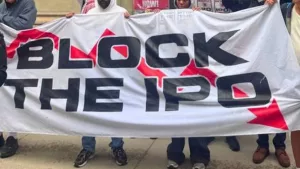
Jim Cramer, the CNBC host, called the offering a crucial test of confidence in A.I. stocks, saying he did not see how the sector could recover in the market without it. The opponents of the I.P.O., by contrast, demanded in New York only days ago that it be called off entirely, because the stock could quickly land in savers’ retirement accounts through index funds.