#BlockTheIPO: Why Opponents Want to Stop Anthropic’s Stock Market Debut


Set Trending Topics as a preferred source on Google.
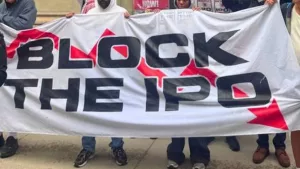
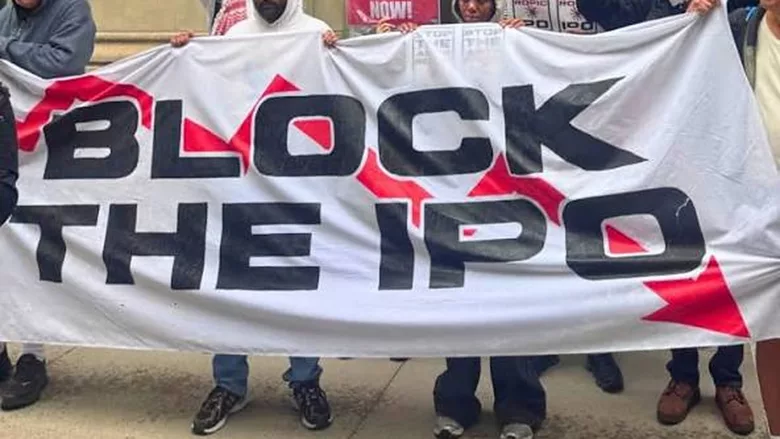
About 40 protesters against a trillion-dollar listing: Outside Anthropic’s New York office, activists have demanded that the maker of Claude call off its initial public offering. At least five people were arrested, according to the organizers. The group is small, but its central argument concerns millions of people: Through index funds, Anthropic’s stock could land in savers’ retirement accounts within weeks, whether they want it or not.
What the Opponents Want
The protest was organized by Stop Funding Billionaires, a campaign of labor, student and community groups that was joined by climate activists. The timing is no accident: Anthropic is meeting investors this week and aims to list on the Nasdaq next week, The Wall Street Journal reported, under the ticker “ANT.”
“Anthropic’s stock is expected to be fast-tracked into index funds because of rule changes at Nasdaq and other index providers,” Elizabeth Parisian, a leader of the campaign and the director of strategic campaigns at the American Association of University Professors, told Trending Topics. “This means Anthropic stock could end up in most retirement funds and stock portfolios.” She expects the shares to start trading at an extremely high valuation “based on hype and projection rather than earnings,” allowing insiders to cash out. Working people whose retirement savings are in major indexes, she said, “will end up owning Anthropic shares within weeks of the IPO, and when the price inevitably comes down, they will bear the losses.”
The offering also puts the broader economy at risk, Ms. Parisian said, by further inflating “what most experts now agree is an AI bubble.” Even before it bursts, she argued, the bubble is driving up the cost of everyday goods and redirecting investment away from things like housing. “The bursting of the AI bubble could cause a financial and economic crisis, putting savings, jobs and communities at risk, and could lead to bailouts for billionaires and AI companies.”
The campaign also warns of social costs: The fresh capital would finance the expansion of a technology with high environmental costs into classrooms, hospitals and the military, it says, and threaten jobs on a historic scale.
The protest is part of a broader front. New York City’s comptroller, Mark Levine, asked Anthropic in October to pause the offering, and a petition is addressed to the underwriting banks as well as BlackRock and Vanguard. Other critics object to the power of the founders, who will always hold 50.1 percent of the votes through a special share.
How Likely the Fast Track Is
How realistic is Ms. Parisian’s scenario? A look at the most important indexes:
| Index | Inclusion | Chances for Anthropic |
|---|---|---|
| Nasdaq-100 | After 15 trading days if the stock ranks among the 40 largest members | Very high, probably in December |
| U.S. total market (CRSP, Russell) | About a week in SpaceX’s case | Very high |
| MSCI World | Accelerated inclusion possible for very large I.P.O.s | Open |
| S&P 500 | After 12 months at the earliest, profits required | None for now |
Nasdaq changed its rules in the spring: If a newcomer ranks among the 40 largest index members by market value, it can join after just 15 trading days. At a valuation of $1 trillion or more, Anthropic clears that bar easily. The providers of total-market indexes, like the one tracked by Vanguard’s largest fund, now also add mega-listings within days.
The most important index, however, remains closed. S&P Dow Jones Indices decided in June to make no exceptions for the S&P 500: Newcomers must be listed for at least 12 months and be profitable. Anthropic most recently posted a quarterly loss of $23 billion (about €20.7 billion), so it would qualify in late 2027 at the earliest.
Then there is the question of weight. Nasdaq weights newcomers at no more than three times their free float. According to Reuters, Anthropic initially told banks it would sell 867 million shares at $70 to $80 each, or up to $69.3 billion (about €62.3 billion), but then retracted the figures. At the valuation of roughly $1.4 trillion derived from them, that would amount to a free float of about 5 percent. The Motley Fool estimates the starting weight in the Nasdaq-100 at about 1 percent.
How It Went With SpaceX
The script already exists. SpaceX listed on the Nasdaq in June at $135 a share and raised $86.2 billion (about €77.4 billion), the largest I.P.O. in history so far. As Trending Topics reported at the time, SpaceX was the first beneficiary of the new rules:
- The hype: The stock closed its first day of trading up 19 percent, and a few days later it peaked at just under $226.
- The index inclusion: Total-market indexes added SpaceX within a week, and the Nasdaq-100 followed after 15 trading days in early July. The stock closed at about $160 the day before and fell nearly 7 percent on the day of inclusion.
- The hangover: In early August, the price briefly dropped to $105, 22 percent below the offering price and less than half its peak.
- Where it stands today: SpaceX most recently closed at $142 (about €128). That is 5 percent above the offering price but 11 percent below the price before it joined the Nasdaq-100.
The forced buying turned out smaller than feared. Before the I.P.O., estimates of $22 billion to $27 billion were circulating; JPMorgan then put passive inflows at about $4.3 billion (about €3.9 billion). Only about 5 percent of SpaceX’s shares were freely tradable. The real test is still to come: The lockup for early investors runs for up to 180 days and therefore ends in December at the latest.
The A.I. Bubble and the Midterm Slump
Fears of a bubble have recently been fed anew. After the Democrats’ victory in the U.S. midterm elections, the Nasdaq-100 plunged more than 6 percent in a single day, and chip stocks and data center operators fell by double digits. Behind the selloff is the fear that the new Congress will slow the construction of data centers and regulate A.I. companies more strictly. The index has since recovered somewhat but is still about 9 percent below its October record. That hits Anthropic directly: Instead of the $2 trillion once floated, the talk is now of a valuation of $1 trillion to $1.4 trillion, and its rival OpenAI has already called off its own offering. On top of that come commitments of about $895 billion for computing power, the very infrastructure that is coming under political pressure.
The Case Against the Alarm
Anthropic is not known to have responded publicly to the demands, and preparations for the offering are continuing. The company’s growth speaks in its favor: In the third quarter, it took in about $17 billion in revenue (about €15.3 billion), 12 times as much as a year earlier.
The risk for index investors also looks smaller in light of SpaceX. The S&P 500, the backbone of American retirement saving, will not add Anthropic for now. In the CRSP total-market index, SpaceX started at a weight of about 0.1 percent: Someone with $50,000 in such a fund held $57 worth of SpaceX shares, according to The New York Times. And despite its summer low, SpaceX’s stock trades above its offering price today. How things go for Anthropic will become clear next week at the earliest.