Chip Expert Tzi-Dar Chiueh: “China Wanted Taiwan Long Before Our Chip Industry Succeeded”


Set Trending Topics as a preferred source on Google.
It is a strange situation: with a market share of around 70 percent, TSMC manufactures virtually every advanced AI chip in the world, for Nvidia as well as for Apple, Broadcom, Google or Amazon. Yet when it comes to the AI models trained on those chips, the small island off the coast of China plays no role at all.
All of this happens under constant pressure from Beijing. By early August 2026, according to the Taiwan Security Monitor, around 1,200 Chinese military aircraft had entered Taiwan’s air defense identification zone, along with some 1,500 sightings of navy vessels and more than 20 coast guard incidents around Kinmen and Dongsha. Taiwan’s answer is a defense tech industry of its own, built explicitly as a “non-red supply chain” without Chinese components: defense spending is set to exceed three percent of GDP for the first time in 2027 (about 30 billion euros), with some 1.1 billion euros for drones alone.
Software is a different story. Start-ups in Taiwan rely on AI models from the United States or China just as European ones do, even though those models would not exist without chips made in Taiwan. We talked about why that is at the Taiwan Innotech Expo 2026 in Taipei with Tzi-Dar Chiueh, Prof. of Electrical Engineering at National Taiwan University in Taipei, who earned his PhD in the United States.
The Top Students Chose Electrical Engineering
Trending Topics: How did Taiwan build such a dominant position in the semiconductor industry?
Tzi-Dar Chiueh: It starts at the universities. When students in Taiwan enter university, there are three or four top choices: medical school, electrical engineering, law school. Traditionally, if you were more STEM-oriented, you chose electrical engineering. Students who wanted to become doctors went to medical school, and those more interested in literature or law chose law school. Starting maybe 40 years ago, most of the top students entered the electrical engineering departments of Taiwan’s best universities. Many of us, myself included, then went to the United States for a PhD. Others stayed in Taiwan and joined Taiwanese companies.
In 1980s, the Taiwanese government spun off TSMC, together with several other chip manufacturers. So we had top talent: some stayed in Taiwan, some went abroad and then came home. It was a combination of things coming together: talent, technology, government support and an industry that gradually earned recognition from international customers.
Trending Topics: TSMC wasn’t always number one, though.
Tzi-Dar Chiueh: No. For the past four or five years, TSMC has been one of the very top semiconductor manufacturing companies. But 20 years ago, it was lagging far behind companies like Intel, Samsung or American firms like AMD. It climbed all the way to the top.
Back to the Fab in the Middle of the Night
Trending Topics: What made the difference?
Tzi-Dar Chiueh: We like to say it’s the work ethic of Taiwanese employees. You must have heard the story: when an earthquake hit Taiwan, the engineers went back to their companies, even in the middle of the night. They returned to their stations and checked their machines and equipment to see whether the processes were still running smoothly. That’s how strong their sense of responsibility is, and it’s not because the system requires it. After the earthquake, there was actually a traffic jam, so many cars were rushing back to the fabs.
Trending Topics: Why do employees feel so connected to their company? Are they incentivized, for example with shares?
Tzi-Dar Chiueh: Yes, something like that. But mostly it’s the culture. People know that if they don’t come back now, there will be more trouble in the weeks to come. So it’s better to fix it right away than to stay in bed, come in the next morning and realize there are two more weeks of work ahead. It’s also their responsibility to get the process running again. The sooner you go back and see what the damage is, the sooner you can start working on it.
Why TSMC Can’t Simply Be Copied in America
Trending Topics: The United States wants to produce chips domestically, and TSMC is building fabs there. Can that work?
Tzi-Dar Chiueh: Morris Chang, TSMC’s founder, addressed this in one of his talks. In essence, he said that if you call TSMC’s US plant in the middle of the night, no one will come. Taiwan is a whole different place. So he is not very keen, he is actually quite pessimistic about the success of the TSMC plants in the US. It is not easy to export that practice to the United States. I understand that the US wants chip production in its own country, of course, but it’s not so easy.
Editor’s note: Europe faces the same question. TSMC is co-building a chip factory here as well: the European Semiconductor Manufacturing Company (ESMC) in Dresden is a joint venture of TSMC, Bosch, Infineon and NXP Semiconductors, set up to build and operate a semiconductor fab in Saxony. Part of the answer to the culture problem is training. Every year, between 70 and 100 specialists are sent to Taiwan to learn the processes on site, so that they can later run the lines in Dresden.
Trending Topics: Isn’t it just a question of the technical recipe?
Tzi-Dar Chiueh: The recipe itself is not that special. It’s about squeezing out the last drop of efficiency. If you run your line more efficiently and fix the equipment as soon as it breaks down, both yield and throughput will be higher.
Trending Topics: How big is the cost gap?
Tzi-Dar Chiueh: People say that making a chip at TSMC’s US plant costs two to three times as much as in Taiwan, because of salaries, lower efficiency and so on. Two to three times is probably an exaggeration. I would say the cost is at least 30 to 40 percent higher. TSMC, of course, charges its customers higher prices for chips made in the US. And customers accept that because they want to diversify their sources.
Trending Topics: Was this division of labor between chip design and manufacturing actually planned?
Tzi-Dar Chiueh: We often say it wasn’t really planned; it just gradually happened, quite naturally. From the perspective of the international economy, the model makes sense. Companies like TSMC keep improving their manufacturing technology, taking it to the next, and more advanced level while keeping costs down at the same time. Companies in other regions can focus on designing more innovative chips and products.
A 70 Percent Share of Contract Manufacturing
Trending Topics: What is Taiwan’s share of the global chip market?
Tzi-Dar Chiueh: If you mean chips designed and sold by Taiwanese companies, the share is not that high, maybe 18 to 19 percent, in any case below 20 percent. Nvidia is the top chip design company, followed by companies like Qualcomm and AMD. Taiwan’s MediaTek ranks among the top five.
Trending Topics: And if you include production for other companies?
Tzi-Dar Chiueh: That’s hard to estimate. When you search for semiconductor revenue, usually only the value of the chips sold is counted. You can’t see how much TSMC makes, because TSMC doesn’t sell directly to end customers. It manufactures for its customers, who put their brand on the chip and sell it. So the revenue is attributed to the customers, not to TSMC. But in foundry services, meaning making chips for other companies, TSMC has about 70 percent of the market. A very high share.
Trending Topics: Who is the biggest customer, Nvidia or Apple?
Tzi-Dar Chiueh: Apple used to be TSMC’s top customer; now it’s number two after Nvidia. Apple is also a strange case, because its chips aren’t sold separately. They go into its phones and computers. So Apple’s chips don’t show up in semiconductor revenue at all. That’s why these numbers are so hard to evaluate.
“We Cannot Afford to Slow Down”
Trending Topics: What role does the chip industry play in the conflict with China? Many people in Europe believe China wants Taiwan because of its semiconductors.
Tzi-Dar Chiueh: China wanted Taiwan long before our chip industry succeeded. After the government retreated to Taiwan, there were still some small battles, for example over Kinmen, a small island very close to mainland China. Today the situation is very complicated, with politics, technology and tariffs all put together. We always say that all we can do is advance our technology. We have already passed the point of no return. We cannot afford to slow down and allow others to catch up. That is the state of mind of most leaders in Taiwan’s industry and government.
Trending Topics: Are there many semiconductor start-ups in Taiwan?
Tzi-Dar Chiueh: Software-based start-ups are, of course, easier to build. Hardware companies require a lot of capital investment, for EDA tools, silicon IP and manufacturing. So there are not so many. More start-ups are working on AI applications and similar things.
AI Sovereignty, the Taiwanese Way
Trending Topics: In Europe there is a lot of debate about digital sovereignty and AI sovereignty. The leading AI models come from the United States and China. How does Taiwan see this?
Tzi-Dar Chiueh: We understand that you need to put in a lot of money and get a lot of data. Meta, for instance, pays one person a salary that could pay maybe hundreds of engineers in Taiwan. So it’s not feasible for Taiwan to follow in their footsteps. Instead, we work with our own data, more specific to Taiwan. We are building our own high-performance computing facilities, and we take open models and customize them with our data. We understand that AI is a big-country’s game, and right now companies from the two big countries monopolize these very large models.
Editor’s note: Every project Trending Topics saw in Taiwan follows exactly that pattern. The startups, companies and research teams we met build their products on existing models from the United States or China rather than training their own. The startup SiliconMind runs on Alibaba’s Qwen, ELAN Microelectronics uses the object detection model YOLOv9 for its AI traffic monitoring, and the translation tool developed at the National University of Tainan is based on OpenAI’s Whisper. The value that is created locally sits in the data, the domain knowledge and the hardware around the model.
Trending Topics: So what is Taiwan’s strategy?
Tzi-Dar Chiueh: We want to ride the wave of the AI revolution, so we focus on AI infrastructure. Taiwan’s exports to the US are breaking records this year because we export so many AI servers. The AI servers for Nvidia or Google are almost all built by Taiwanese companies. The computing chips inside them, like Nvidia’s GPUs or Google’s AI chips, are all fabricated by TSMC, and the advanced packaging is most likely done at TSMC as well. So we are leveraging our strengths instead of fighting head-on in a field like large AI models, where we don’t think we can compete.
“Help Comes With a Cost”
Trending Topics: From the American perspective, is the chip industry a major reason to protect Taiwan?
Tzi-Dar Chiueh: The previous US president publicly said four times that the US would defend Taiwan. For the current one, for his own reasons, Taiwan seems to be more of a bargaining chip with China. So the mindset of Taiwanese people is mixed. Of course we need all the help we can get; after all, we are facing a very big adversary. But at the same time we understand that help comes with a cost. If someone helps you, they may want something from you. What will that cost be? Maybe you don’t pay it yourself, but the next generation does.
Trending Topics: What are you hoping for?
Tzi-Dar Chiueh: I hope that some US politicians share our values, like democracy and freedom. Whether that is also true for the broader American public, we don’t know. If it meant spending a lot of money and US soldiers dying in the defense of Taiwan, they might decide differently. As the saying goes in English, heaven helps those who help themselves. Even the Almighty helps only those who help themselves. If you don’t help yourself, no one will help you. That’s why we need to stay ahead in semiconductor technology and, of course, be strong in national defense as well.
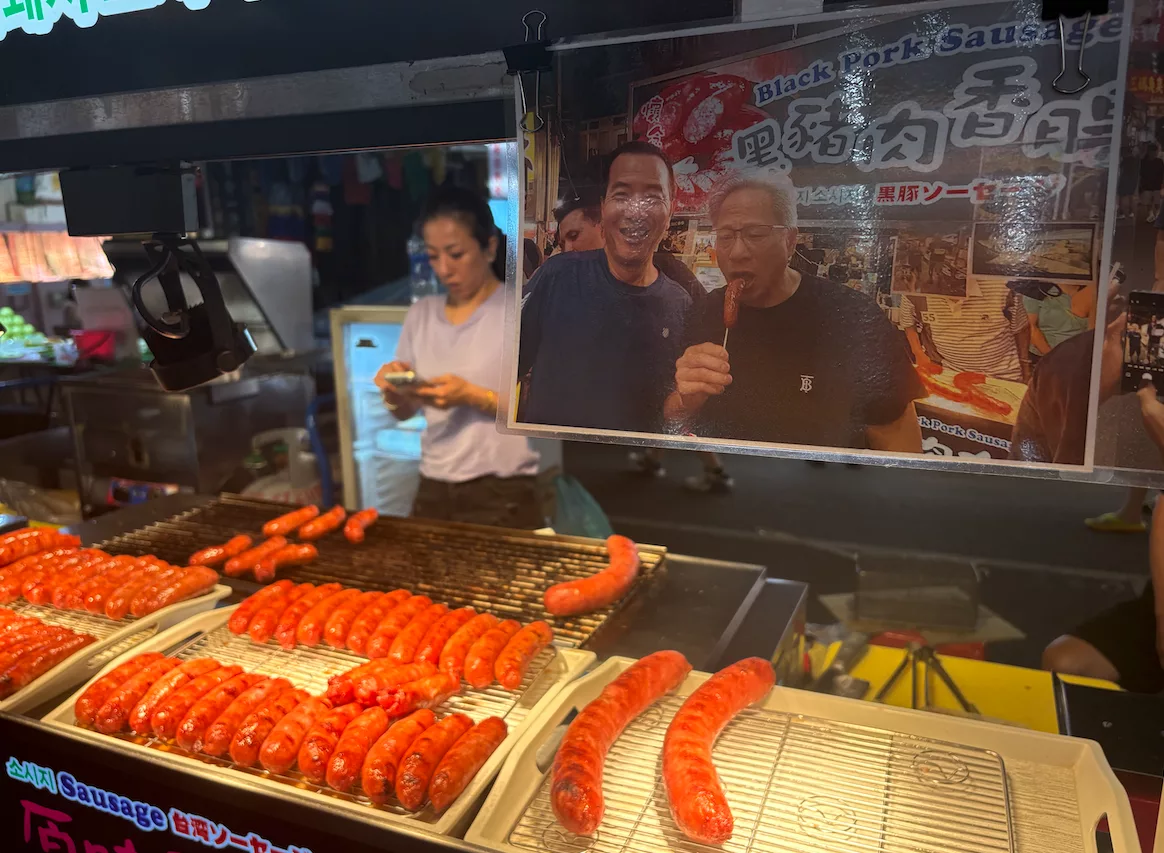
Author’s note: Nvidia CEO Jensen Huang, born in the coastal city of Tainan, is a superstar in Taiwan. At the food markets, vendors advertise, among other things, that Huang once stopped by their stall for sausages and the like.