Higgsfield Hits $1 Billion in Revenue as OpenAI Steps Aside


Set Trending Topics as a preferred source on Google.
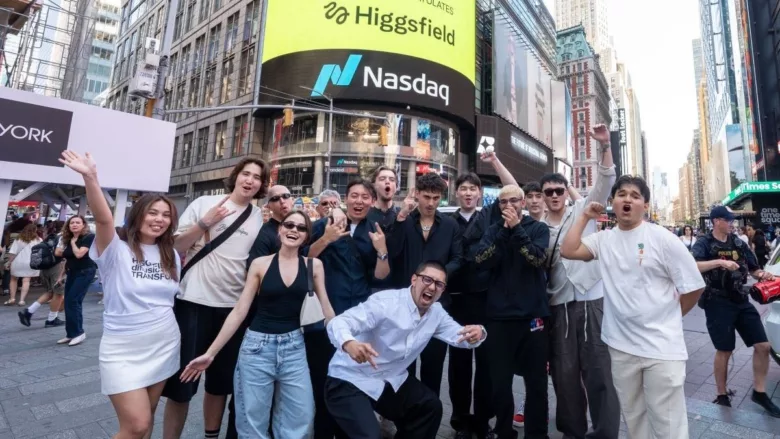
OpenAI buried its video experiment Sora, and an 18-month-old startup is now making a billion dollars a year with AI video. Higgsfield has just crossed $1 billion (around €850 million) in annualized revenue, according to the company. CEO and co-founder Alex Mashrabov announced the milestone on LinkedIn, and Bloomberg also reported on it.
The Numbers Behind the Billion
Mashrabov says Higgsfield grew 20x within a single year. The curve is steep: At the end of 2025, the run rate stood at roughly $200 million. By June 2026 it had reached $500 million, and by August $700 million. That was when the company raised a $400 million Series B (about €340 million) led by DST Global, quadrupling its valuation in eight months to $5.4 billion (around €4.6 billion).
Other key figures from the announcement:
- Enterprise: Enterprise adoption is growing 115 percent month over month, driven by an enterprise team of fewer than 20 people.
- Net revenue retention: 300 percent, meaning existing customers spend three times as much as they did a year earlier.
- Margins: Higgsfield has had positive gross margins since the beginning of the year.
- Reach: 78 percent of Fortune 500 companies and more than 32 million creators use the platform.
One detail deserves attention. Positive gross margins only since early 2026 mean that last year, Higgsfield paid more for compute and model providers per generated video than it took in. For a company that relies heavily on other firms’ models, that margin is the decisive lever. Mashrabov also claims the platform cuts production costs for businesses by up to 97 percent.
What Higgsfield Actually Sells
Higgsfield was founded in 2023 by Alex Mashrabov and Erzat Dulat and is headquartered in San Francisco. Mashrabov previously led generative AI at Snap after the company acquired his startup AI Factory in 2020. The platform itself launched in March 2025.
At its core, Higgsfield sells a production environment for images and videos built on top of AI models. Customers pay via subscription or buy credits that they spend on generations. According to Mashrabov, annual subscriptions account for about 40 percent of revenue. The key products include:
- Cinema Studio: a tool for filmmakers who stage camera moves, shots and scenes with AI
- Marketing Studio: workflows for advertising and marketing teams producing campaign videos at scale
- Apps and templates: ready-made effects and presets, many of which go viral on social media
- API and agents: access for developers, plus integrations with ChatGPT and Claude
The target audience has shifted along the way. Higgsfield originally expected individual creators to drive the business. Today, according to Mashrabov, about 70 percent of revenue comes from creative agencies. The average customer is worth roughly $1,000 (about €850) per year.
Many Models Under One Roof
Technically, Higgsfield is above all an aggregator. Shortly after launch, the team rebuilt almost the entire product because “a new video model ships basically every week,” as Mashrabov explained in the SaaStr interview. The platform bundles the best models on the market and lets them run in parallel instead of betting on a single in-house model.
Higgsfield’s video page currently lists, among others, Seedance 2.5 and 2.0 from ByteDance, Kling 3.0 and Kling o1 from Kuaishou, Veo 3.1 from Google, Wan 2.7 from Alibaba and Grok Imagine from xAI. For images, it offers Google’s Nano Banana, Flux 2 from Black Forest Labs, Seedream 5 and OpenAI’s GPT Image 2. On top of that come in-house developments such as the image model Soul, which specializes in consistent characters, and an internal “reasoning engine” designed to keep scenes consistent across multiple shots.
The added value therefore lies mostly in the workflow on top of the models: camera control, templates, character consistency and the ability to run the same brief through several models at once. That also makes Higgsfield dependent on Google, ByteDance and others, which sell their models directly as well.
More Room Since Sora Shut Down
One event came at just the right moment for Higgsfield. In the spring, OpenAI unexpectedly killed Sora and scrapped its billion-dollar Disney deal. The social video app and the web version went dark in April, and according to OpenAI, the API followed this past Thursday, the very day Higgsfield announced its billion. According to a Wall Street Journal investigation cited by TechCrunch, Sora cost OpenAI around $1 million per day while its user base dropped from about one million to fewer than 500,000. Sam Altman preferred to spend the compute on the core business and the race against Anthropic. The Disney agreement would have given Sora access to more than 200 characters from the Disney universe.
Since then, the market has been missing the best-known name in AI video, along with OpenAI’s marketing muscle and ChatGPT as a distribution channel. Higgsfield’s numbers suggest that part of that demand has moved to specialized platforms: Between the end of 2025 and June 2026, its run rate more than doubled, and another $500 million followed in just three months. Losing Sora 2 as one of many models in its lineup is easy for Higgsfield to absorb, with Veo, Kling and Seedance offering plenty of alternatives. Anyone who depended on a single app like Sora has also just learned why a multi-model provider can be the safer bet.
The Competition
Higgsfield still faces a tough field. Runway, Pika and Luma AI also build creative tools around AI video, but according to Startup Fortune, they continue to burn venture capital. Synthesia dominates the enterprise segment for training and communication videos with AI avatars. The biggest threat, however, comes from the model providers themselves: Google markets Veo through Gemini and its film tool Flow, Kuaishou sells Kling directly to creators, and ByteDance could integrate Seedance more deeply into CapCut and TikTok at any time. Higgsfield has to prove that the workflow on top of the models is worth more in the long run than the models underneath.